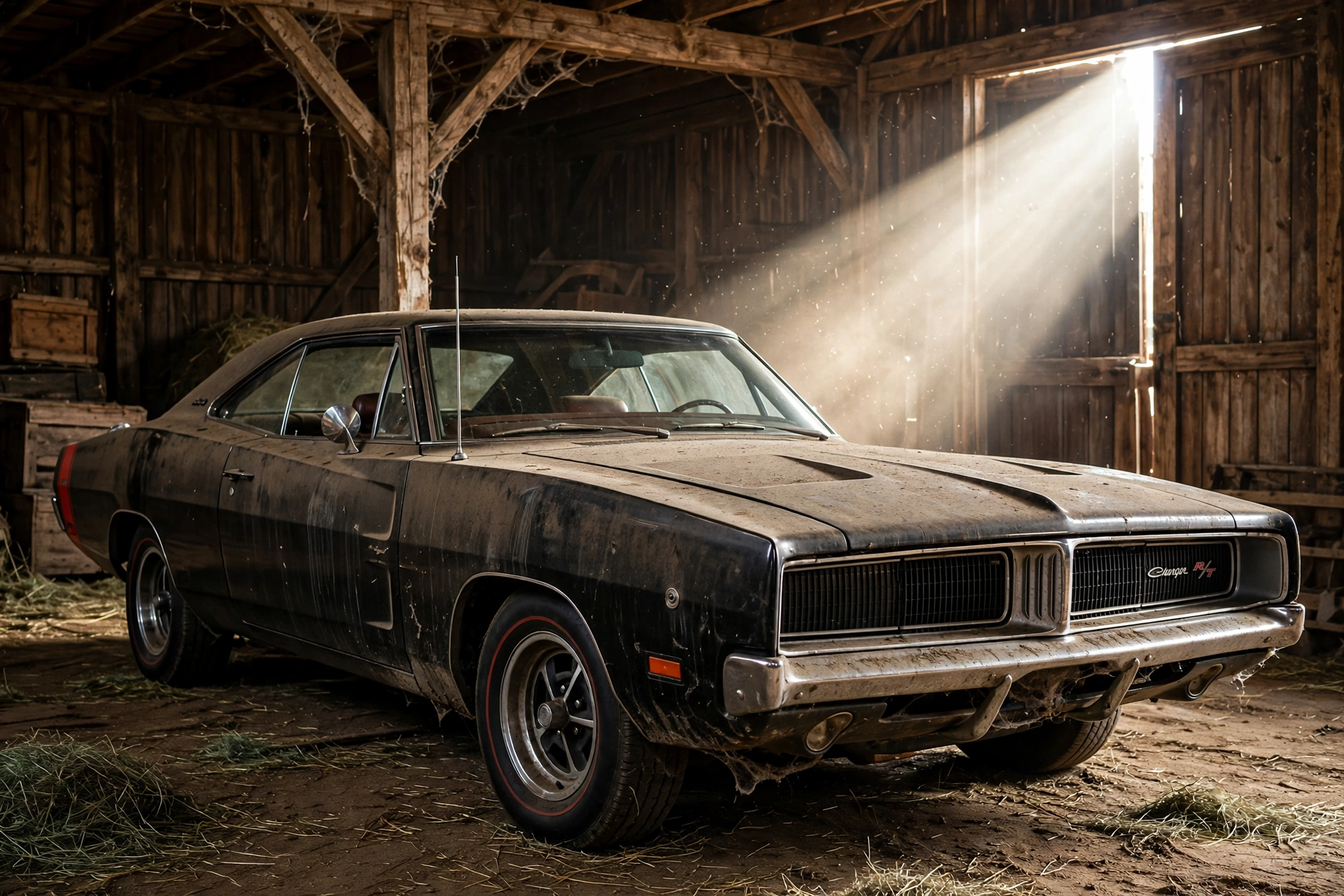
Every barn find starts the same way: a door that has not opened in years, a shape under a tarp or a layer of dust, and the same question — is this a treasure, or just an old car that somebody gave up on? Tonight’s reel shows both ends of that story in ten seconds: a 1969 Dodge Charger R/T, filthy and forgotten, and then the same car gleaming, restored, alive again. The transformation is the hook. The car underneath is the reason it matters.
It is not the first barn find we have covered — a Mustang Mach 1 waited forty years in the dark before anyone opened its barn door. But the Charger is a different kind of discovery, because what makes it valuable was decided on the factory floor in 1969, not in the barn.
What the R/T actually is
The 1969 Charger R/T is the performance version of the second-generation Charger — the restyled car that turned a slow seller into a hit, with production jumping to 96,100 cars in 1968 after just 15,788 the year before. R/T stands for Road/Track, and unlike plenty of performance badges of the era it came with real hardware: a heavy-duty suspension with stiffer torsion bars and a rear stabiliser, bigger brakes, heavy-duty shocks, dual exhausts with chrome tips, and the bumblebee stripe around the tail.
440 standard, Hemi rare
Under the hood, every R/T left the factory with the 440 Magnum as standard: 440 cubic inches, a single four-barrel carburettor, 375 horsepower and 480 lb-ft of torque. The only optional engine was the 426 Street Hemi — 425 horsepower and 490 lb-ft from two four-barrel carburettors — and almost nobody ordered it. Dodge built just over 20,000 Charger R/Ts for 1969, but only 432 of them got the Hemi: 208 with the TorqueFlite automatic, 224 with the four-speed manual. That is why a dusty Hemi car is a six-figure discovery and a dusty 440 car is still a serious one. In period testing, Motor Trend recorded a 440 automatic R/T doing 0–60 mph in 6.1 seconds and the quarter-mile in 13.9 seconds at 101.4 mph. The Hemi’s rarity is the same story we told in our Battle of the Big Three cold-start comparison, where the 426 Hemi was the Mopar entry.
Four questions before a single bolt turns
But the dust hides the questions that decide whether a barn find is worth restoring at all. First: is it numbers-matching — does the engine in the car match the car it left the factory in? Second: is the fender tag still there, and does it say R/T, or is this a base Charger wearing an R/T stripe? Third: where is the rust — floors, frame rails and the lower quarters, the places dust and damp work together for decades. And fourth, the least glamorous and most decisive: is there a clean title? A genuine R/T with its original 440, a readable tag and solid rails is a restoration. The same car with a swapped engine, a missing tag and rotten floors is a parts donor wearing a good story.
That is the real before and after. The dust makes every barn find look the same — mysterious, romantic, full of promise. The gleam at the end of tonight’s reel is not just polish. It is the answer to all four questions coming back yes, one expensive bolt at a time.
Tonight’s reel shows the dust and the gleam — watch it, then tell us in the comments: you open the barn doors and find THIS. What is the first thing you do?
Sources
Specifications, production figures and test results in this article were checked against:
- Silodrome — Dodge Charger R/T 426 Hemi — 96,100 built in 1968 vs 15,788 in 1967; 440 Magnum 375 hp / 480 lb-ft; 432 Hemi cars; ~20,057 R/Ts
- Autoevolution — Charger R/T SE Hoarded for 35 Years — 20,100 R/Ts for 1969; 432 Hemi cars — 208 automatics, 224 manuals
- Autoevolution — One-Owner Survivor 1969 Charger R/T — Motor Trend test: 0–60 in 6.1 seconds, quarter-mile 13.9 seconds @ 101.4 mph