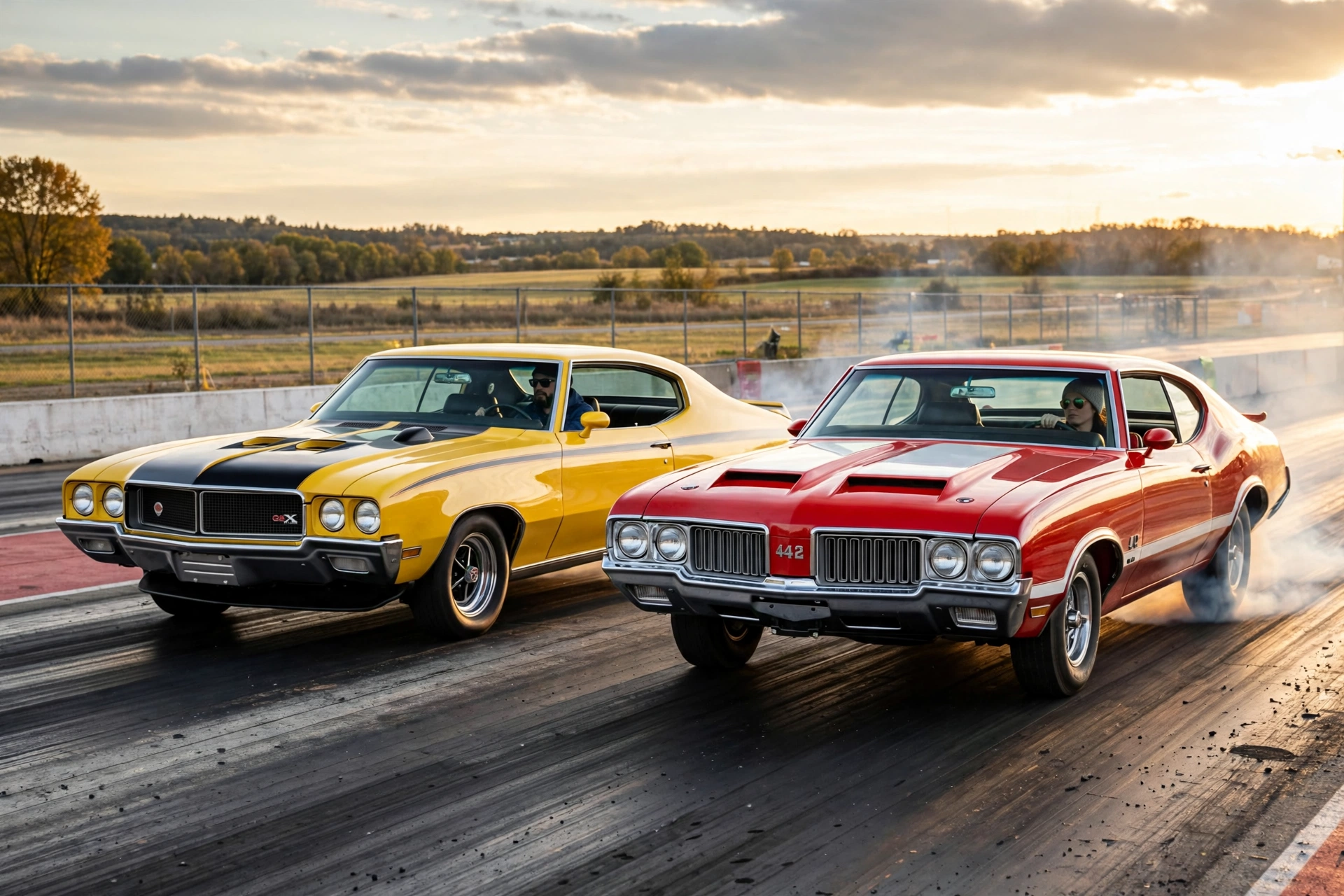
This morning’s reel asked the question with tyre smoke instead of words: a 1970 Buick GSX Stage 1 and a 1970 Oldsmobile 442 W-30, staged side by side at the lights, both with a 455-cubic-inch V8 under the hood. Same displacement, same GM A-body platform, same model year — and two completely different attitudes about what a muscle car should be. The Buick was the torque monster nobody saw coming. The Oldsmobile was the gentleman’s brawler. Both were underrated on paper, and both were faster than their badges admitted.
The Buick: the torque champion
The GSX debuted in 1970 as an appearance package on the Buick GS 455, and it did not whisper. Saturn Yellow or Apollo White only, black hood stripes, a rear spoiler, and a blacked-out grille — it looked like a gentleman’s express and ran like a brawler. Buick built just 678 GSX coupes in 1970. The Stage 1 option on top of that added larger valves, 10.5:1 compression, a hotter cam and a specially tuned Quadrajet carburettor, for $199.05 on a $3,283 GS 455 coupe. Officially it made 360 horsepower — just 10 more than the standard 455. But the number that mattered was the torque: 510 lb-ft at only 2,800 rpm, the highest torque figure of any American production car at the time, a record that stood until the Dodge Viper’s V10 arrived. On the dyno, Stage 1 engines went around 400 horsepower. On the street, the GSX Stage 1 ran 0–60 mph in about 5.5 seconds — quicker than cars with far louder reputations.
The Oldsmobile: the gentleman’s brawler
The 442 W-30 took the opposite route to the same destination. The W-30 package added a fibreglass ram-air hood, an aluminium intake, a hotter cam, revised heads and red plastic inner fenders to save weight. The 455 made 370 horsepower and 500 lb-ft of torque on paper, and like the Buick, it made more than that on a dyno, comfortably into 400-horsepower territory. Oldsmobile built just over 2,500 W-30 hardtops for 1970. It was the refined member of the GM muscle family — upscale interior, premium comforts, a car that handled better than most of its rivals — and it still ran 0–60 in about 6 seconds and the quarter-mile in the high 13s. The W-30 is the connoisseur’s pick: people who have owned several of these cars tend to keep the Olds.
Same displacement, different attitude
So which one wins the duel? On the spec sheet, the Buick has the torque and the rarity — 678 GSX coupes against a few thousand W-30s — and the quicker launch. The Oldsmobile has the horsepower, the handling and the polish. On the strip, it came down to the driver and the tyres, which is exactly why the duel format works: there is no wrong answer, only a favourite. That is the same reason our Chevelle vs Road Runner duel from Day 6 ended in a dead heat — when two cars are this evenly matched, the vote is about character, not numbers.
Both cars also belong on any honest list of the decade’s best — our Top 10 Muscle Cars of the 1970s has the GSX Stage 1 at number three and the 442 W-30 at number six, and neither ranking would surprise anyone who has driven one. The Buick embarrassed cars with louder reputations. The Oldsmobile outclassed them. GM built both in the same year, on the same platform, with the same 455 cubic inches — and let its own divisions fight it out in the showroom.
This morning’s reel asked it first — Comment 1 for the GSX, 2 for the 442. Watch the burnout, listen to both big-blocks, then tell us: same displacement, different attitude. Which one are you taking home?
Sources
Specifications, production figures and test results in this article were checked against:
- Hemmings — 1970 Olds 4-4-2 vs 1970 Buick GS 455 — Stage 1: larger valves, 10.5:1 compression, hotter cam, tuned Quadrajet; 360 hp / 510 lb-ft; $199.05 option on a $3,283 GS 455
- HotCars — Short-Lived Buick That Out-Muscled the GTO — 678 GSX units built; 360 hp / 510 lb-ft @ 2,800 rpm; torque record until the 2003 Dodge Viper V10
- HotCars — Oldsmobile Muscle Car Smart Collectors Snap Up Quietly — W-30: 3,100 built, 370 hp / 500 lb-ft, 0–60 ~5.5s, quarter 13.7s
- Autoevolution — 1970 Oldsmobile 442 W-30 — W-30: 3,100 total (2,574 hardtops, 262 post coupes, 264 convertibles); 0–60 just under 6 seconds