Tag: Pontiac

  • First Wash in 20 Years: The 1970 Pontiac Trans Am That Time Forgot

    First Wash in 20 Years: The 1970 Pontiac Trans Am That Time Forgot

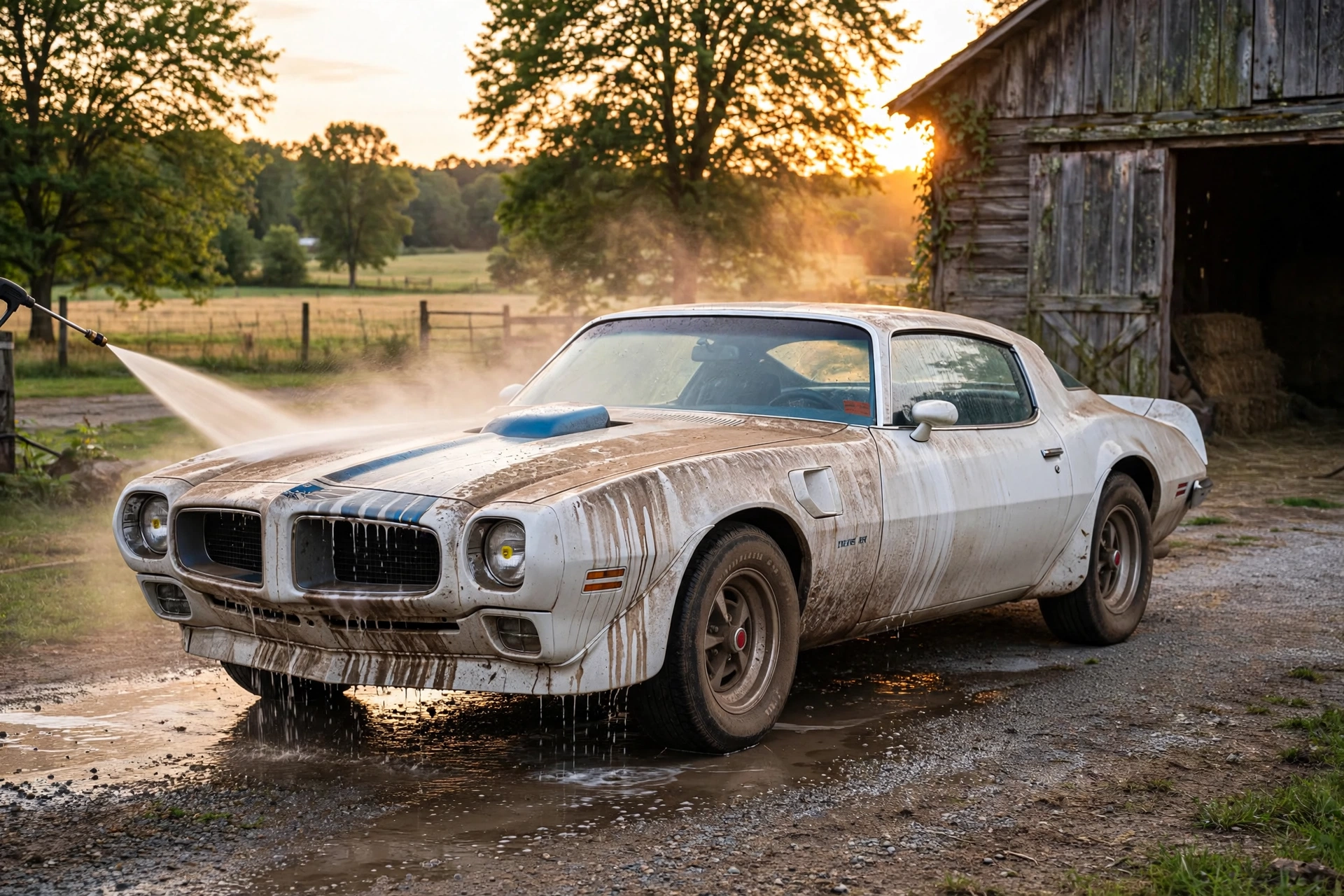
    There is nothing more satisfying than watching decades of dust wash off a true classic — and tonight’s reel is ten seconds of exactly that. A pressure washer peels twenty years of grime off a 1970 Pontiac Trans Am, and with every pass, the car underneath gets sharper: Polar White paint, blue stripes, the shaker hood scoop shaking with the engine. But the wash is only the beginning of the story, because what makes this car special was decided on the factory floor in 1970, not in the barn.

    One of 3,196 — and a first-year car

    The 1970 Trans Am is the first year of the second-generation Firebird, introduced mid-year — a 1970½, in collector shorthand. Pontiac built just 48,739 Firebirds for 1970, and only 3,196 of them were Trans Ams. That makes it one of the rarest Trans Ams of any year, and the short production run was no accident: the new Camaro and Firebird arrived so late that the model year was cut short. Of those 3,196 cars, 2,150 were sprayed Polar White with blue stripes and 1,046 were Lucerne Blue with white stripes. There were only two colours. Pick one, and you had already joined a very small club.

    Ram Air III standard, Ram Air IV almost mythical

    Every 1970 Trans Am left the factory with a 400-cubic-inch V8, and the standard engine was the Ram Air III: 345 horsepower and 430 lb-ft of torque, breathing through the rear-facing shaker scoop that moved with the engine. The optional engine was the Ram Air IV — 370 horsepower, bigger ports, better heads, swirl-polished valves and an aluminium intake — and almost nobody ordered it. Pontiac built 3,108 Trans Ams with the Ram Air III and just 88 with the Ram Air IV. Less than three percent of production got the engine the car was named for. In period testing, a Ram Air III four-speed ran 0–60 mph in 5.7 seconds and the quarter-mile in 14.1 seconds. One small detail collectors love: 1970 was the only year the shaker scoop carried no engine designation at all.

    It is the same lesson as our 1969 Charger R/T barn find — the dust makes every forgotten car look equally romantic, but the factory paperwork decides what it is really worth. A numbers-matching Ram Air IV car is a six-figure discovery. A Ram Air III car with its original engine, a readable build sheet and solid floors is still a serious one.

    Wash it — or keep the patina?

    That is the question tonight’s reel is really asking, and it is the same argument every barn find starts. Wash it and you get the gleam: the white paint, the blue stripes, the car Pontiac actually built. Keep the dust and you keep the story — twenty years of sitting still, untouched, exactly as found. Our advice is the same as it was for the Mustang Mach 1 that waited forty years in the dark: wash it, but do not restore anything until you know what you have. Check the numbers first — is the engine the one the car left the factory with? Check the rust — floors, frame rails and lower quarters, where dust and damp work together for decades. And check the paperwork, because a genuine 1970 Trans Am with a clean title and its original 400 is a restoration. The same car with a swapped engine and rotten floors is a parts donor wearing a good story.

    The pressure washer does not answer any of those questions. It just strips away the twenty years so you can finally see the car you are asking them about. And for a first-year Trans Am — one of 3,196, with a shaker scoop and a rear spoiler and a shape Pontiac would ride for another decade — what it reveals is worth the wait.

    Tonight’s reel shows the first wash in twenty years — watch it, then tell us in the comments: would you restore it to showroom shine, or keep the patina and drive it exactly as found?

    Sources

    Specifications, production figures and test results in this article were checked against:

  • Here Comes the Judge: The 1969 Pontiac GTO Judge

    Here Comes the Judge: The 1969 Pontiac GTO Judge

    Pontiac did not set out to build The Judge. The original plan was a cheap, stripped-down GTO — a budget drag-strip special with a 350 V8, aimed at the Plymouth Road Runner. Somewhere on the way to the showroom, the joke took over. Pontiac named it after the catchphrase from Rowan & Martin’s Laugh-In — “Here comes the Judge” — and built the loudest, proudest GTO it had ever made.

    The $337 Package

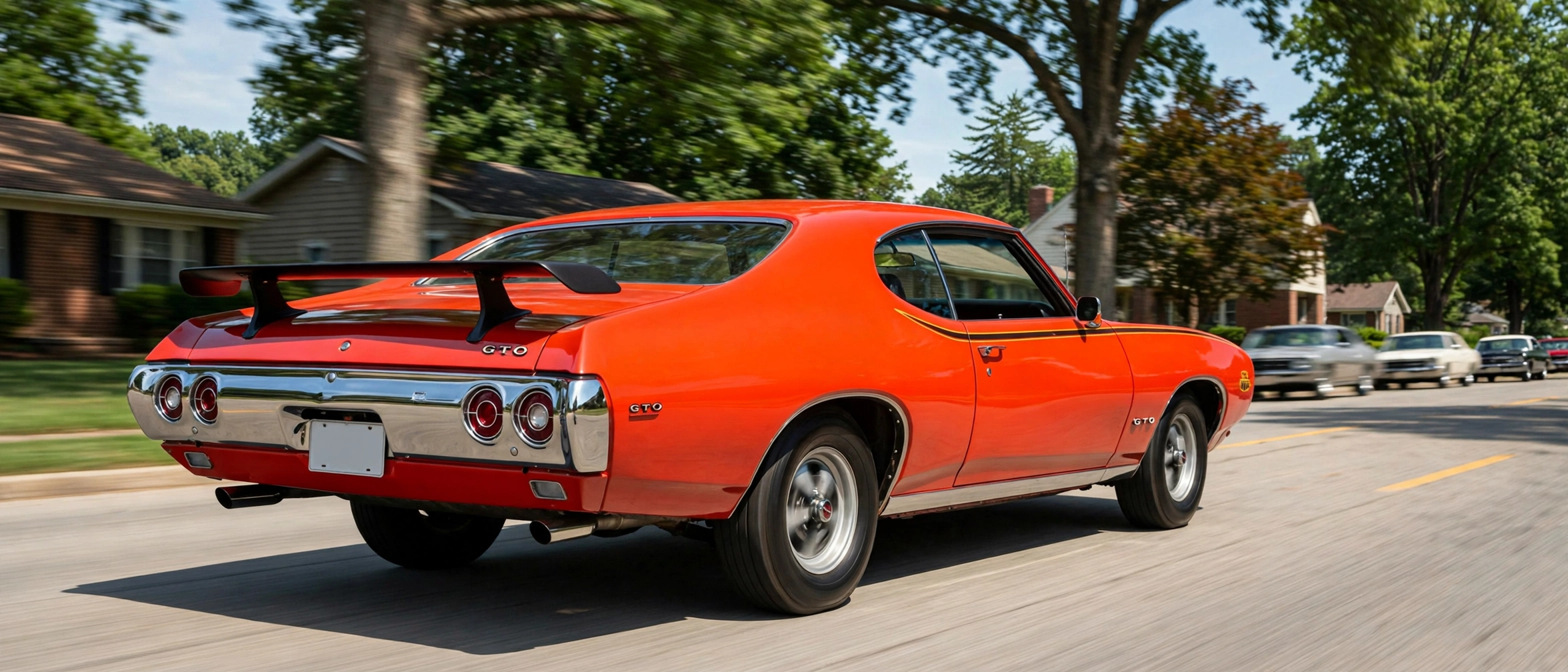
    The Judge package cost $337 on top of a 1969 GTO, and it spent the money where everyone could see it. The first cars were all painted Carousel Red — a bright orange-red borrowed from the Firebird — with tri-color side stripes, a body-color Endura front bumper, Rally II wheels without trim rings, and a 60-inch rear wing bolted to the decklid. It was impossible to miss, and that was the point.

    Ram Air III and Ram Air IV

    Underneath the show, the hardware was serious. The standard engine was the Ram Air III: a 400-cubic-inch V8 with a hot hydraulic cam, 10.75:1 compression and a Rochester Quadrajet, rated at 366 horsepower and 445 lb-ft of torque. The only engine option was the Ram Air IV at 370 horsepower. Functional hood scoops rammed cool air into the carburetor, and with the right gears the Judge was a consistent 14-second drag-strip performer — quick enough to back up every bit of the attitude.

    6,833 Built — 108 Convertibles

    Pontiac built 6,833 Judges for 1969: 6,725 hardtops and just 108 convertibles. The first roughly 2,000 cars were all Carousel Red before other GTO colors were allowed, which is why the orange-red Judge is the one everyone pictures. The Judge ran for only three model years — 1969 to 1971, 11,004 cars in total — and then it was gone, a victim of the same insurance rates and emissions rules that killed the whole muscle era.

    What survives is the idea: a car that refused to be subtle. The Judge did not whisper about performance. It wore stripes, a wing and a punchline, and then went out and ran the number. More than fifty years later, a Carousel Red Judge cruising down a sunny street still does what it did in 1969 — it makes everyone look.

    So here is the question the page will ask again on Day 7, when the Judge returns for the photo post: underrated or overrated? Be honest.

    Watch this morning’s Judge reel on the page, then tell us in the comments: underrated or overrated?

    Keep Reading

    Sources

    Specifications, production figures and test results in this article were checked against:

  • Top 10 Muscle Cars of the 1970s

    Top 10 Muscle Cars of the 1970s

    The seventies opened with the wildest horsepower war in automotive history — and closed with smog pumps, 5-mph bumpers and horsepower ratings that read like typos. But the decade’s best cars weren’t just the last of the breed; several were the best of the breed, full stop. Here is our ranking, argued the way we argue it in the comments: power, presence, and what it feels like when one rolls past.

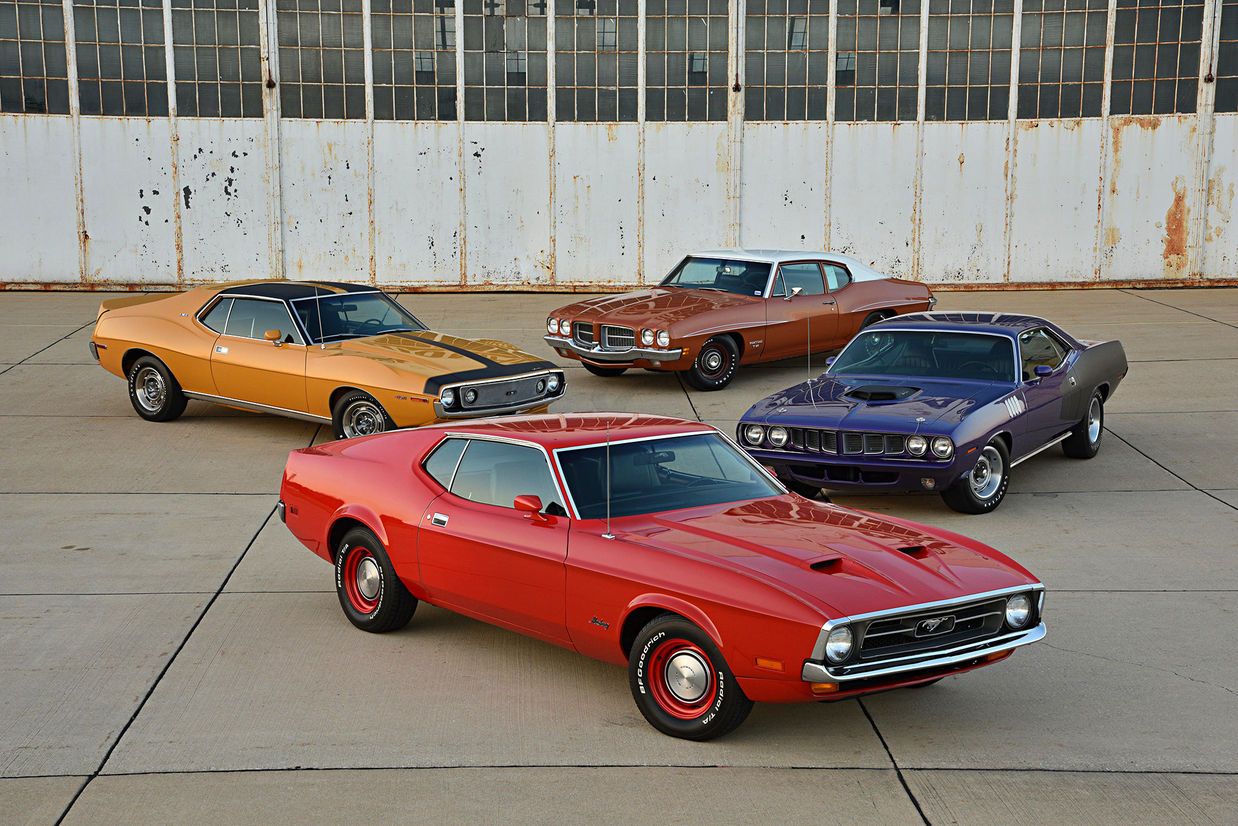
    1. 10 — 1973 Pontiac Trans Am SD-455

      The last true believer. When everyone else detuned, Pontiac hand-built the Super Duty 455 — advertised at 310 hp — officially rated 290 hp net after certification — in an era of 200 hp flagships. Proof the fire wasn’t out, just banked.

    2. 9 — 1971 Ford Mustang Mach 1 (429 Cobra Jet)

      The biggest Mustang ever made, with the biggest engine ever offered in one. Controversial then, collectible now — and the star of our barn-find story above.

    3. 8 — 1970 AMC AMX

      Two seats, a short wheelbase and a 390 V8 with 325 hp. The underdog from Kenosha embarrassed bigger names at the drag strip and still gets underrated at auction.

    4. 7 — 1970 Pontiac GTO Judge

      Ram Air power, wild stripes, and the most confident name in the business. The Judge was the muscle car as pure theater — 366 hp of it with the Ram Air III.

    5. 6 — 1970 Dodge Challenger R/T

      Late to the pony-car party and dressed to kill. With the 440 Six-Pack or the Hemi, the Challenger had the longest hood and the shortest temper of the class of ’70.

    6. 5 — 1970 Buick GSX Stage 1

      The gentleman’s express. Its 455 was rated 360 hp, but the number that mattered was 510 lb-ft of torque — the highest of any American production car of the era.

    7. 4 — 1970 Plymouth Road Runner Superbird

      A nose cone, a wing you could land aircraft on, and one job: win at NASCAR. Dealers once struggled to sell them. Try that sentence at an auction today.

    8. 3 — 1970 Dodge Charger R/T

      The silhouette alone earns the podium. Add a 440 Magnum — or the 426 Hemi at 425 hp — and you have the decade’s definitive big coupe.

    9. 2 — 1970 Plymouth Hemi ‘Cuda

      The 426 Hemi in the lightest, meanest wrapper Plymouth ever built. Convertible Hemi ‘Cudas are now among the most valuable American cars on Earth. The hardtop is the same thunder, slightly less lottery ticket.

    10. 1 — 1970 Chevrolet Chevelle SS 454 LS6

      450 factory-rated horsepower — the highest rating ever given to a production muscle car of the classic era. The LS6 wasn’t the peak of the horsepower war by accident. It was the peak, period.

    Your turn: this ranking gets defended daily on the page. If your number one isn’t the LS6, the comments on Facebook are open — bring numbers, not feelings.

    Sources

    Specifications, production figures and test results in this article were checked against:

  • 5 Real Muscle Cars You Can Still Buy Under $25,000

    5 Real Muscle Cars You Can Still Buy Under $25,000

    Watch enough auction coverage and you’d think classic muscle now starts at six figures. It doesn’t. The famous names got expensive; the honest cars didn’t — at least, not yet. Driver-quality examples of all five cars below still change hands under $25,000 in the US market. Here’s where the smart money starts.

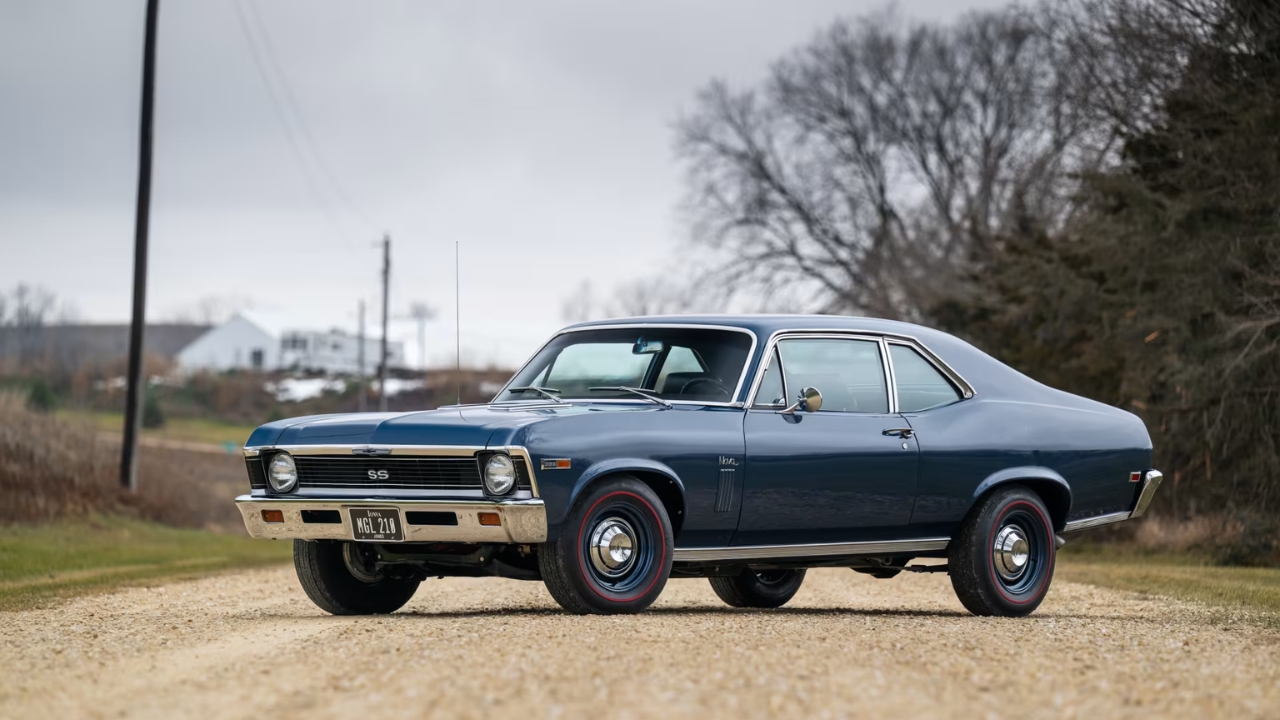
    1. Chevrolet Nova (1968–1974)

    The thinking person’s muscle car. Light, simple, and built around an engine bay that accepts any small block or big block Chevrolet ever made. V8 cars in driver condition are the easiest under-$25K ticket in this list, and every part is a phone call away.

    2. Plymouth Duster & Dodge Dart (1970–1976)

    Mopar’s A-bodies were the budget bruisers when new and remain so. A 340 car is the dream; a 318 car with a 360 swap in its future is the realistic buy. Watch the torsion-bar front end and rear frame rails for rust.

    3. Ford Maverick Grabber & Comet GT (1970–1977)

    The forgotten Ford. A Maverick with the 302 V8 is a Mustang in a cheaper suit — same drivetrain logic, half the entry price, and a fastback silhouette that gets better looking every year.

    4. Pontiac LeMans (1968–1972)

    Everything a GTO is, without the three letters that double the price. Same A-body, same engine bay, and a 350 or 400 Pontiac V8 under the hood of the right example. Buy the best body you can find; drivetrains are the easy part.

    5. Chevrolet Monte Carlo (1970–1972)

    The personal-luxury coupe that shared its bones with the Chevelle. Big-block cars exist at the top of the budget; small-block cars in clean driver shape sit comfortably under it — with the longest hood in the business thrown in free.

    The under-$25K rules: buy the best body, not the biggest engine — rust repair costs more than horsepower. Verify the VIN matches the story. And budget the wake-up costs (tires, brakes, fuel system) on top of the purchase price, every time.

    None of these cars will headline an auction catalog. All of them will do the thing that actually matters: a V8 idle at a gas station, a Saturday-morning cars-and-coffee, and a garage project that’s yours. That’s the hobby. The rest is just pricing.

    How to check prices before you buy

    Compare recent U.S. sales for the same year, engine, body style and condition. A base six-cylinder Nova and a documented Nova SS are different markets. Use Hagerty’s guide to valuing a classic car to find comparable sales, then get an independent pre-purchase inspection and leave room in your budget for transport and immediate repairs.

    Sources

    Specifications, production figures and test results in this article were checked against:

    Prices for the Pontiac LeMans and Chevrolet Monte Carlo reflect general A-body market observation — no model-specific valuation was available at publication.