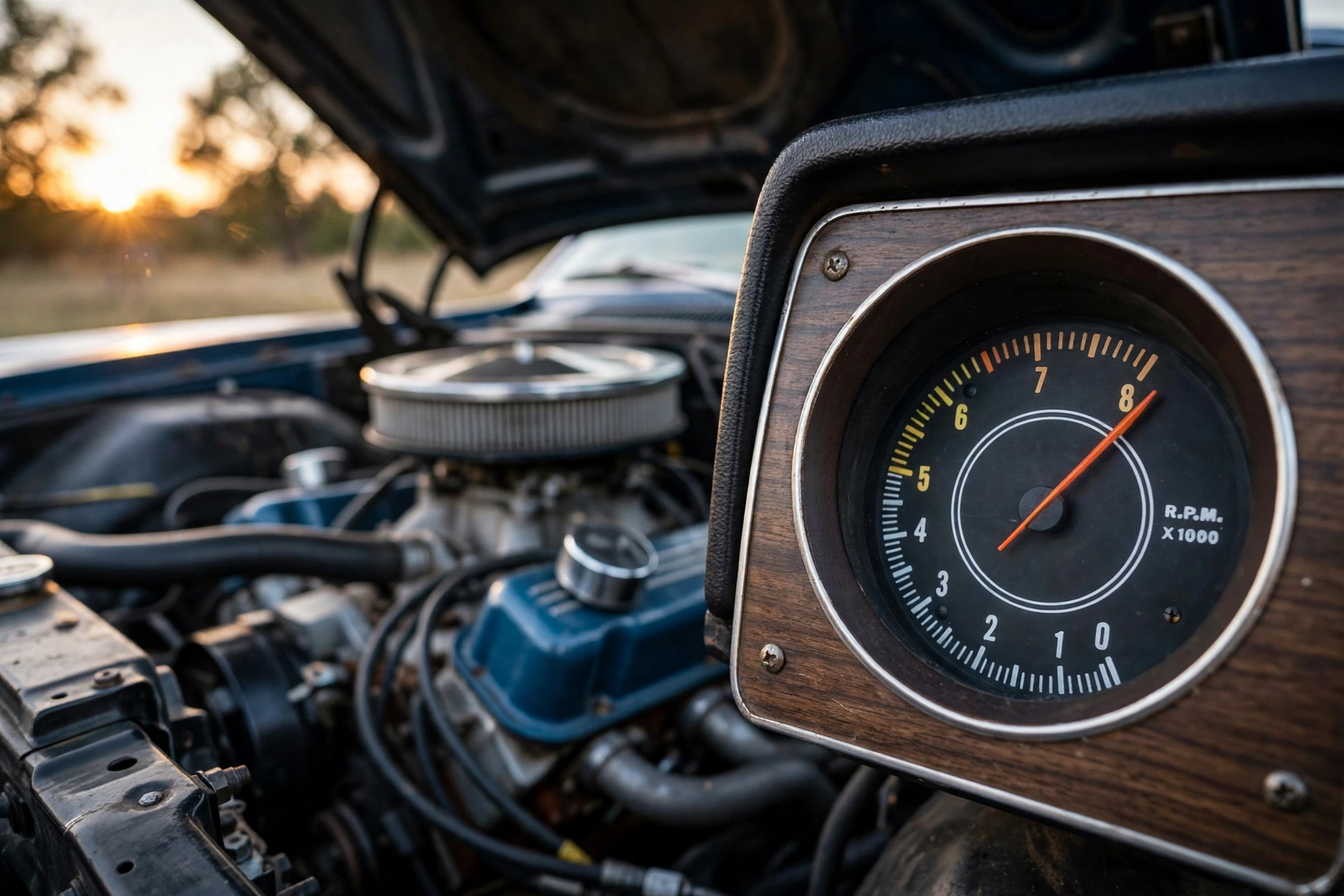
There is a sound no software update will ever reproduce. It is a big-block V8 climbing past 5,000 rpm through a pair of exhaust pipes, and the 1970 Plymouth ‘Cuda is one of the best places ever built to hear it.
The ‘Cuda arrived in 1970 as a clean-sheet car. Plymouth threw out the old Valiant-based Barracuda and built the E-body from scratch — wider, lower, on a 108-inch wheelbase, designed from the start to swallow big engines. The range split in two: Barracuda was the standard car, and ‘Cuda was the performance model, with its own engines, suspension and attitude.
The engine ladder tells the whole story. The base ‘Cuda carried a 383 big-block rated at 335 horsepower. Above it sat the 340 small-block at 275, the 440 four-barrel at 375, and the 440 Six Barrel — three two-barrel carburetors feeding 390 horsepower — the streetable monster. And at the top, the 426 Hemi: 425 horsepower on paper, fed by two four-barrel carburetors, a figure historians have long treated as a polite fiction for the insurance companies. A healthy street Hemi made at least that, and usually more.
Fewer than 700 Hemi ‘Cudas were built for 1970, out of 55,499 Barracudas total. The Hemi was an $871 option in 1970 — roughly a third of what a basic new car cost outright — which is why most buyers took the 440 Six Barrel instead: nearly as quick in a straight line, and far easier to live with. Today that rarity is exactly why documented Hemi ‘Cudas trade for over a million dollars.
But the numbers are only half the car. The other half is the noise. A ‘Cuda at full throttle is mechanical music: the lope of a solid-lifter cam at idle, the roar as the secondaries open, the crackle on the overrun. It is the sound of explosions happening 5,000 times a minute, three feet in front of you, with nothing between you and them but sheet metal. An electric car can be fast — faster, even — but it cannot be loud in the same way, because there is nothing in it exploding. The sound is the byproduct of the machine doing its work, not a soundtrack added afterwards.
That is what tonight’s reel is: ten seconds of tachometer and throttle, no commentary needed. Watch it, turn the volume up, and then answer honestly — can anything electric replace this feeling?
Watch tonight’s 1970 ‘Cuda reel on the page, then tell us in the comments: which V8 sound beats it — Hemi, 440 Six Pack, or something else entirely?
Related reading
Sources
Specifications, production figures and test results in this article were checked against:
- Hagerty — 1970 Plymouth Cuda Valuation — 108-inch wheelbase; 55,499 Barracudas sold in 1970; Hemi option $871
- Autoevolution — 1970 ‘Cuda 383 — full engine ladder including the 426 Hemi at 425 hp; 652 hardtops + 14 convertibles = 666 Hemi ‘Cudas
- TopSpeed — Most Expensive HEMI-Powered Car Ever Sold at Auction — 1970 Hemi ‘Cuda convertible sold for $1,980,000 at Mecum Indy 2019
Hagerty’s valuation page is cited here for production totals and the $871 Hemi option price; the Hemi’s 425 hp rating is sourced from Autoevolution.
Leave a Reply