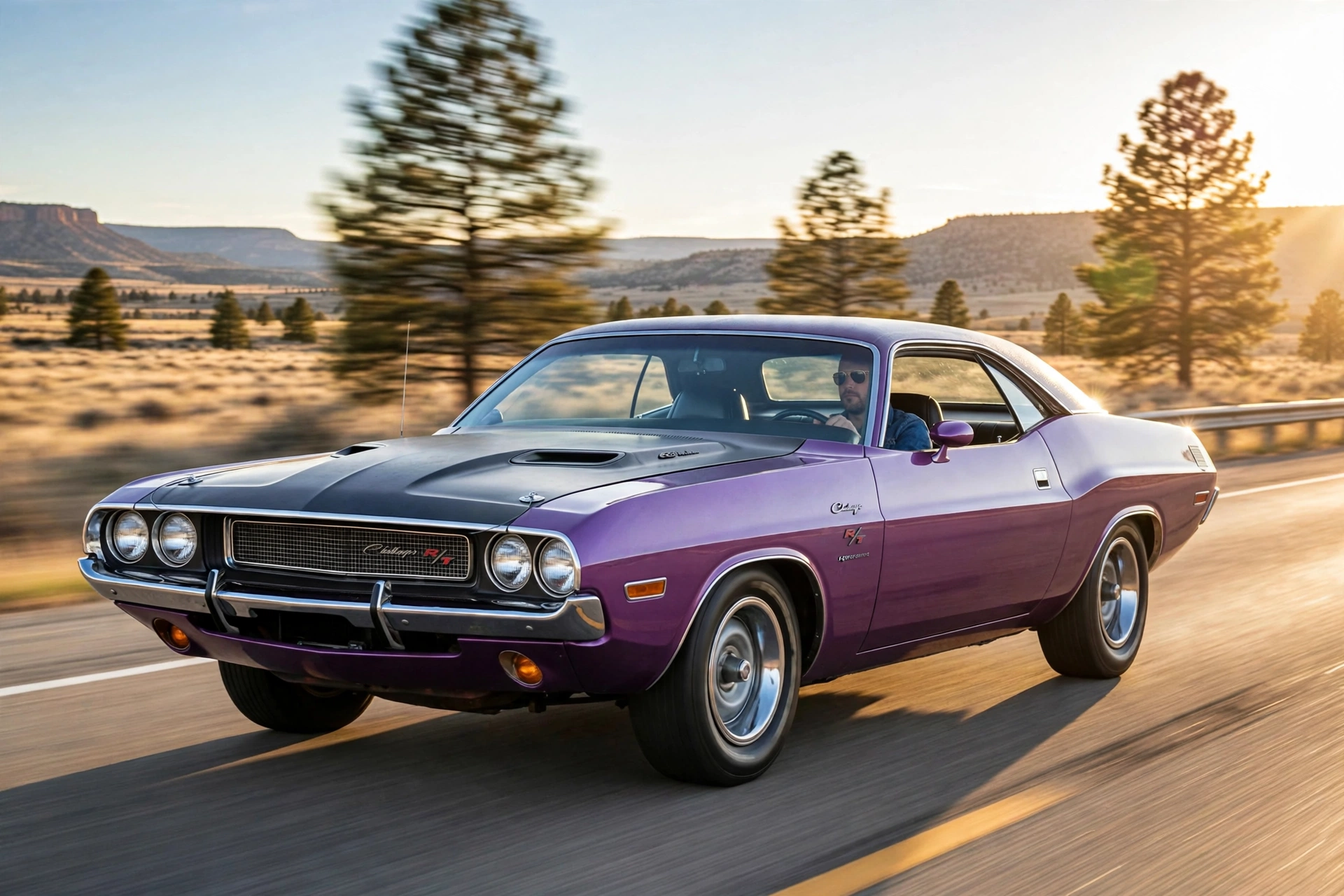
Tonight’s reel is thirty seconds of pure sunlight: a Plum Crazy 1970 Dodge Challenger R/T rolling down the highway, black hood drinking in the light, and the hook says it plainly — 1970 was peak automotive design. For the Challenger R/T, that is not nostalgia talking. It was the car’s first year, its best-selling year, and the year Dodge threw everything it had at the muscle car wars in a single package. No later Challenger ever matched it.
The first-year car that got everything right
The Challenger arrived late to the pony car fight — fall 1969, as a 1970 model, five years after the Mustang and three after the Camaro. Dodge used the wait well. The new E-body platform, shared with the Plymouth Barracuda, was wider and longer than the Mustang’s, with a 110-inch wheelbase that gave the Challenger its signature long-hood, short-deck stance. Dodge had benchmarked the Mercury Cougar while developing it, and the result was a car that looked expensive standing still. Buyers agreed: Dodge built 76,935 Challengers for 1970, more than any other year of the first generation, and 18,512 of them — nearly one in four — were R/T models. The breakdown tells the story of what people actually ordered: 13,796 R/T hardtops, 3,753 with the Special Edition luxury trim, and just 963 convertibles.
The R/T badge was not just lettering. Every R/T came standard with a big-block V8, a twin-scooped hood, heavy-duty suspension, and the Rallye instrument cluster — a full gauge package with a 150-mph speedometer, an 8,000-rpm tachometer, an oil pressure gauge, a clock and a trip odometer. It was the equipment that told you, before you ever turned the key, that this car was built to be driven hard.
Four engines, one badge
The R/T’s real party trick was the order sheet. No other muscle car in 1970 let you choose between four completely different V8s, and each one gave the car a different personality. The standard engine was the 383 Magnum: 335 horsepower and 425 lb-ft of torque, and 12,281 buyers were happy with exactly that. Step up and Dodge would sell you the 440 Magnum four-barrel, with 375 horsepower and 480 lb-ft — the most popular upgrade, chosen by 3,840 buyers. Above that sat the 440 Six Pack, three two-barrel carburetors good for 390 horsepower and 490 lb-ft, ordered by 2,035 buyers. And at the top, the 426 Hemi: 425 horsepower and 490 lb-ft, officially, though everyone in the hobby knows the real number was higher. Just 356 buyers ticked the Hemi box — 287 hardtops, 60 Special Editions and nine convertibles — and it cost $1,228 plus required heavy-duty equipment. The Six Pack and the Hemi could not be ordered with air conditioning. Dodge was not pretending these were luxury cars.
That spread is what makes the R/T so collectible today. A 383 car is a genuine, affordable piece of the legend. A Six Pack car is a rare factory hot rod. A Hemi car — especially one of the nine convertibles — is one of the most valuable American muscle cars ever built. Same badge, same body, four different cars depending on the engine code.
Plum Crazy and the High-Impact colours
Then there is the paint. The car in tonight’s reel wears Plum Crazy, factory code FC7, one of Chrysler’s High-Impact colours for 1970 — the loudest, proudest palette Detroit ever offered, and the colour that turned an already dramatic car into something you could spot from a quarter-mile away. We wrote about what Plum Crazy did for the Challenger earlier in the series, and the point still stands: in 1970, Dodge was not selling subtlety. Plum Crazy, Sublime, Go Mango, Top Banana — these were colours for a car that was meant to be stared at, and the Challenger’s long, clean flanks wore them better than anything else on the road. In the sunlight, exactly as the reel shows it, Plum Crazy shifts from deep violet to bright purple as the light moves across the panels. No other colour does that to this car.
Why 1970 was the peak — and why it ended so fast
The cruel part of the Challenger story is how quickly the peak passed. For 1971, total Challenger production collapsed to 27,377 cars, and just 4,892 of them were R/Ts. Compression ratios dropped across the board, insurance rates climbed, and the emissions rules that would strangle the whole segment were already on the horizon. The R/T badge itself would be gone within a few years, and the big-block engines with it. The 1970 car is the one collectors chase because it is the one where everything aligned: the new platform, the full engine menu, the High-Impact colours, and the freedom to build a car with no apologies in it.
That is why the reel’s hook lands. “1970 was peak automotive design” is not a claim about one paint colour or one engine — it is a claim about a moment when a car company built its best car in its best year and did not know it would never get to do it again. The 1970 Challenger R/T is the proof: 76,935 built, 18,512 of them R/Ts, four engines from 335 to 425 horsepower, and a shape that still stops traffic fifty-six years later. Watch the reel, then tell us in the comments — yes or no on Plum Crazy in the sunlight?
Keep Reading
Plum Crazy: The Colour That Made the 1970 Challenger R/T Impossible to Ignore
340 Six Pack: The Small-Block That Scared the Big-Blocks
Sources
Hemmings — 1970–71 Dodge Challenger R/T: A Muscle Car Icon
Wikipedia — Dodge Challenger (1970)
AutoEvolution — 1970 Challenger R/T production and engine figures
HowStuffWorks — 1970 Dodge Challenger R/T 440 Six Pack
Leave a Reply