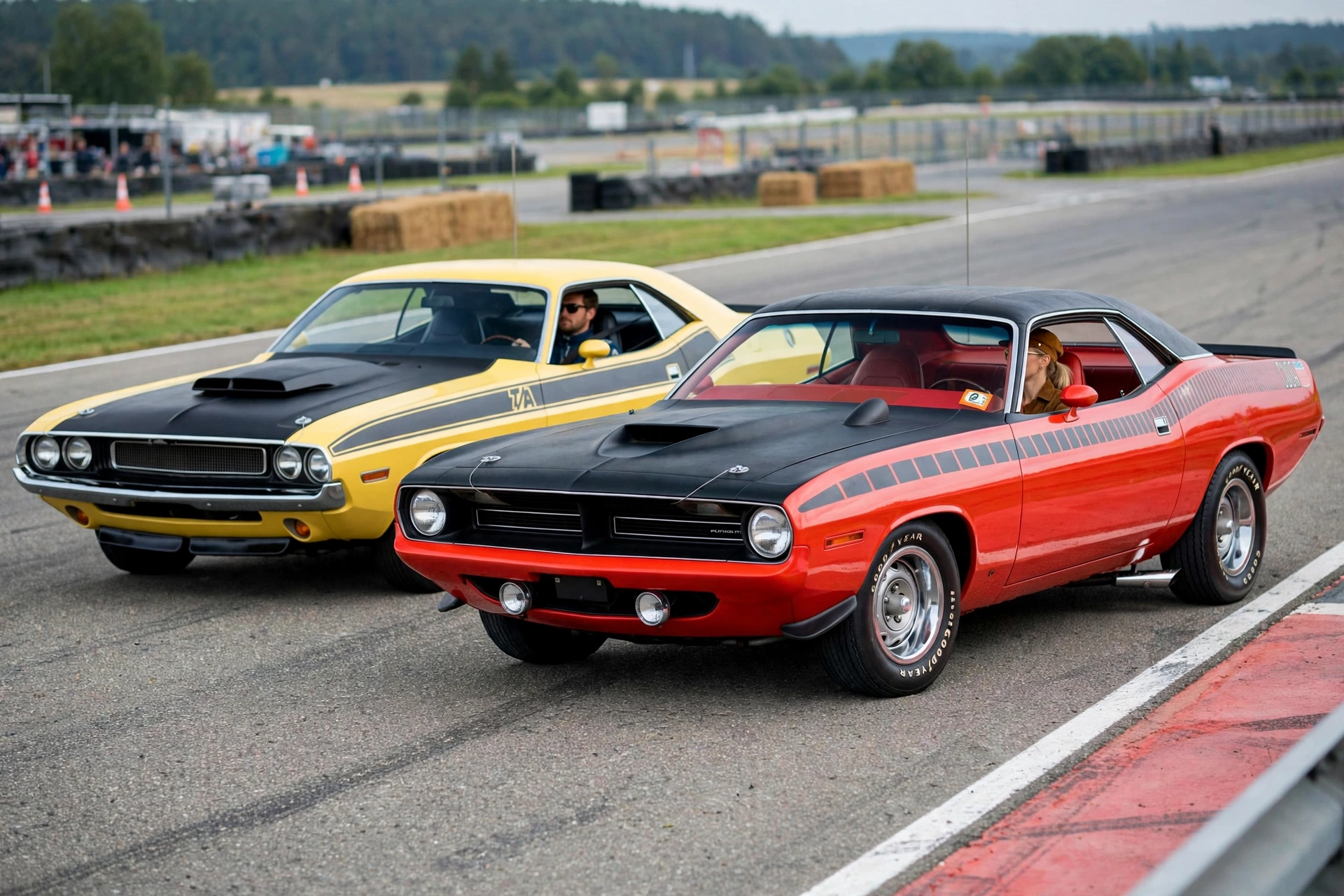
On paper, the 340 Six Pack should not have been a threat. It was a small-block — 340 cubic inches against the 426 Hemi’s 426 and the 454’s 454 — rated at just 290 horsepower, a number the big-blocks laughed at. But the paper lied, and everybody in 1970 knew it. The Six Pack was three Holley two-barrel carburettors on an Edelbrock intake, feeding a high-revving 340 that made far more than its rating — estimates put real output over 320 horsepower — and it came in two cars built for one purpose: to get Mopar into the SCCA Trans Am series.
Trans Am rules capped engines at 305 cubic inches, so Chrysler’s race engineers destroked the 340 to 303.8 cubic inches. With new cast-iron heads with massive ports and race internals, the racing version made over 460 horsepower — more than the 426 Street Hemi’s official 425. To qualify, the rules demanded showroom cars, so Dodge and Plymouth each built a street version in spring 1970: the Dodge Challenger T/A, named for Trans Am, and the Plymouth AAR ‘Cuda, named for Dan Gurney’s All American Racers team. Both were one-year-only cars. Plymouth built 2,724 AAR ‘Cudas in about five weeks, March to April 1970; Dodge built 2,399 Challenger T/As.
The Street Cars: Challenger T/A and AAR ‘Cuda
The AAR ‘Cuda is the racing cousin of the 1970 Plymouth ‘Cuda we covered on Day 4 — same Barracuda body, but built to turn rather than just to go straight. The street cars got the full treatment, not just a badge. Both had the 340 Six Pack (Plymouth called it the Six Barrel, same hardware), a functional fibreglass hood with a big flat-black scoop, a rear spoiler, side-exit exhausts that dumped ahead of the rear wheels — the sound this morning’s reel is duelling over — stiffer suspension with heavy-duty torsion bars and bigger sway bars, and staggered tyres, bigger at the back than the front. They were built to turn, not just to go straight, which made them strange and wonderful in a muscle-car world obsessed with the quarter-mile.
Why the Six Pack Still Matters
It did not work, at least not on the track. Neither car fared well in the 1970 Trans Am season, and Mopar pulled out after a single year. The T/A and the AAR became history in the same season they were born. But that failure is exactly why they matter now: 2,399 and 2,724 cars, one year, one racing rule, and an engine that was always better than its badge claimed. The big-blocks won the horsepower war on paper. The Six Pack won the argument that a small-block, breathing through three carburettors and shouting through side pipes, could scare them anyway.
This morning’s reel asked it first — Comment 1 for Challenger T/A, 2 for AAR ‘Cuda. Listen to both exhaust notes, then tell us: which side pipe sounds meaner? If you enjoy a good head-to-head, our Chevelle vs Road Runner duel from Day 6 ended in a dead heat — see if this one does too.
Keep Reading
- No EV Will Ever Sound Like This: The 1970 Plymouth ‘Cuda
- From Dust to Gleam: The 1969 Charger R/T Barn Find
Sources
Specifications, production figures and test results in this article were checked against:
- Hemmings — Buyer’s Guide: 1970 Dodge Challenger T/A — 2,399 T/As + 2,724 AARs; 290 hp @ 5,000 rpm; three Holley 2-barrels on an Edelbrock intake; 305 ci SCCA cap
- Street Muscle Magazine — 1970 Plymouth AAR ‘Cuda — destroked to 303.8 ci; race engine over 460 hp; street output over 320 hp; Mopar left Trans Am after one season
- Muscle Car Fan — Plymouth ‘Cuda 1970 AAR — “Six Barrel” Plymouth naming; 2,724 built in a five-week window; fibreglass hood and side-exit exhausts
Leave a Reply