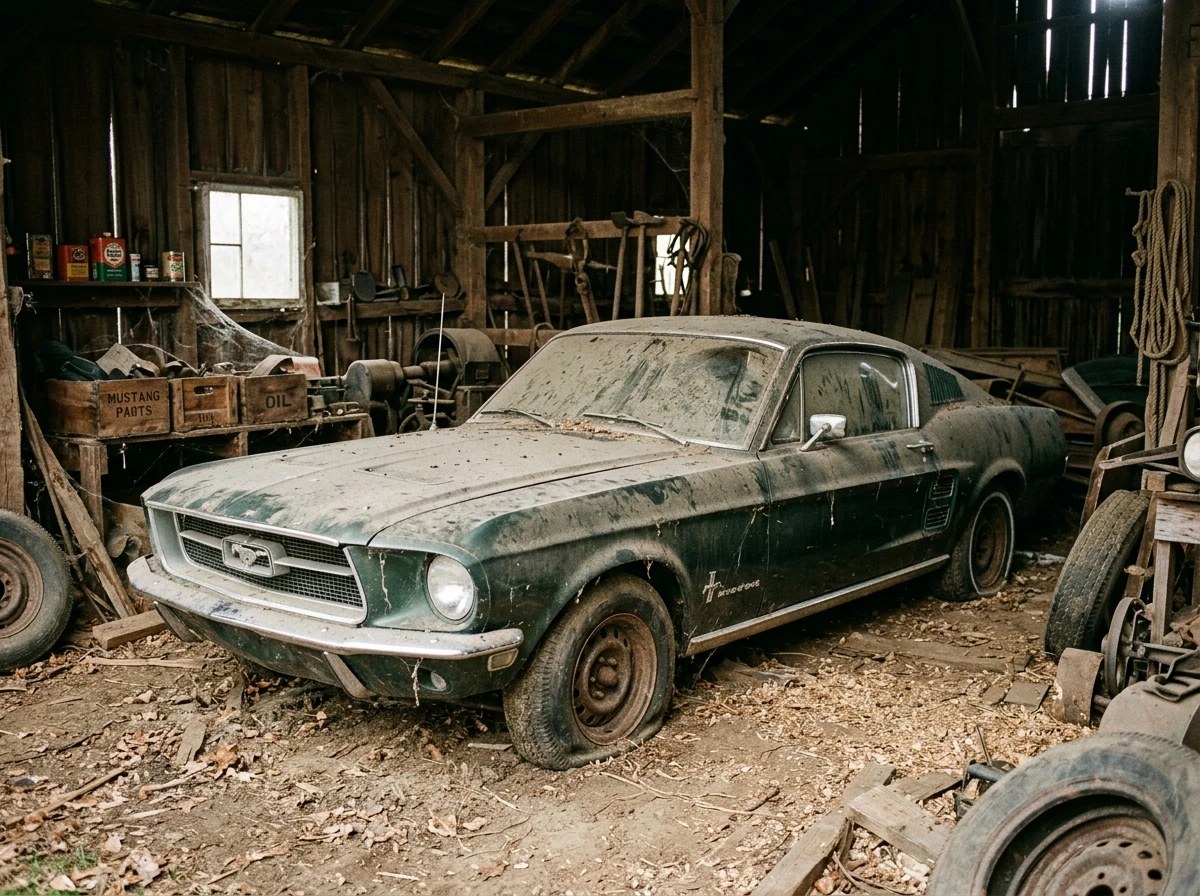
Every barn-find story starts the same way: a door that hasn’t opened in decades, a shaft of light, and a shape under the dust that makes your heart beat faster. In this case the shape is a Mustang Mach 1 fastback — parked in the mid-1980s when life got busy, and simply never driven again.
The Mach 1 deserves the drama. Ford launched it for 1969 as the Mustang’s serious performance flagship: fastback-only, with engines running from the 351 Windsor up to the 428 Cobra Jet. It was the car that killed off the GT and took over as the Mustang’s performance flagship once the Shelby program ended. Finding one asleep for forty years is finding a piece of the horsepower war in suspended animation.
What forty years actually does to a car
Dust is the least of it. Time attacks a sleeping car in a predictable order, and knowing the order is what separates a rescue from a very expensive sculpture:
- Fuel system first. Old gasoline turns to varnish, tanks rust from the inside, and rubber lines crack. Nothing from the original fuel system should be trusted.
- Rubber everything. Tires, belts, hoses, seals and bushings harden and split — even when they look fine in the dark.
- Brakes. Master cylinders corrode, wheel cylinders seize, and fluid absorbs moisture for four decades straight.
- The engine itself. Rings can stick, valves can hang open, and cylinders collect moisture. This is the part everyone wants to rush — and the part that punishes rushing.
- Uninvited tenants. Mice treat wiring harnesses and seat foam as a housing development. Check before you power anything.
The wake-up order (don’t skip steps)
- Photograph everything before touching a bolt. Originality is value, and memory lies.
- Pull the plugs, oil the cylinders, and let it sit overnight. Then turn the engine by hand — by hand — before the starter ever gets a vote.
- Fresh fluids everywhere: oil, filter, coolant. Prime the oil pump until the gauge or light says pressure.
- Feed it from a clean can, not the tank, with a new filter inline. The tank gets cleaned or replaced later.
- Brakes before roads. A car that starts but can’t stop is a story nobody wants to tell.
- First drive: short, slow, close to home. Listen. A forty-year nap ends in stages, not in a burnout.
The rule of the barn: the first start is a diagnostic, not a celebration. If it turns by hand, holds oil pressure and takes clean fuel, the celebration comes soon enough — and it will sound like 1969.
Is a car like this worth saving? A Mach 1 with its original drivetrain is worth saving almost regardless of condition — the fastback shape and the performance pedigree aren’t coming back. But the honest answer is that the cheapest barn find is the one somebody else already woke up. Budget for the fuel system, brakes, rubber and tires before you budget for paint, and the car will reward you in the right order.
Related reading
Sources
Specifications, production figures and test results in this article were checked against:
- Wikipedia — Ford Mustang Mach 1 — 1969 debut, fastback-only body, 351 Windsor to 428 Cobra Jet engine range
- Hemmings — Buying a 1969 Ford Mustang Mach 1 — 72,458 sold in the debut year; engine ratings from 250 to 335 hp
- Silodrome — 1969 Ford Mustang Mach 1 (428 Cobra Jet) — 428 Cobra Jet rated 335 bhp / 440 lb-ft
Leave a Reply