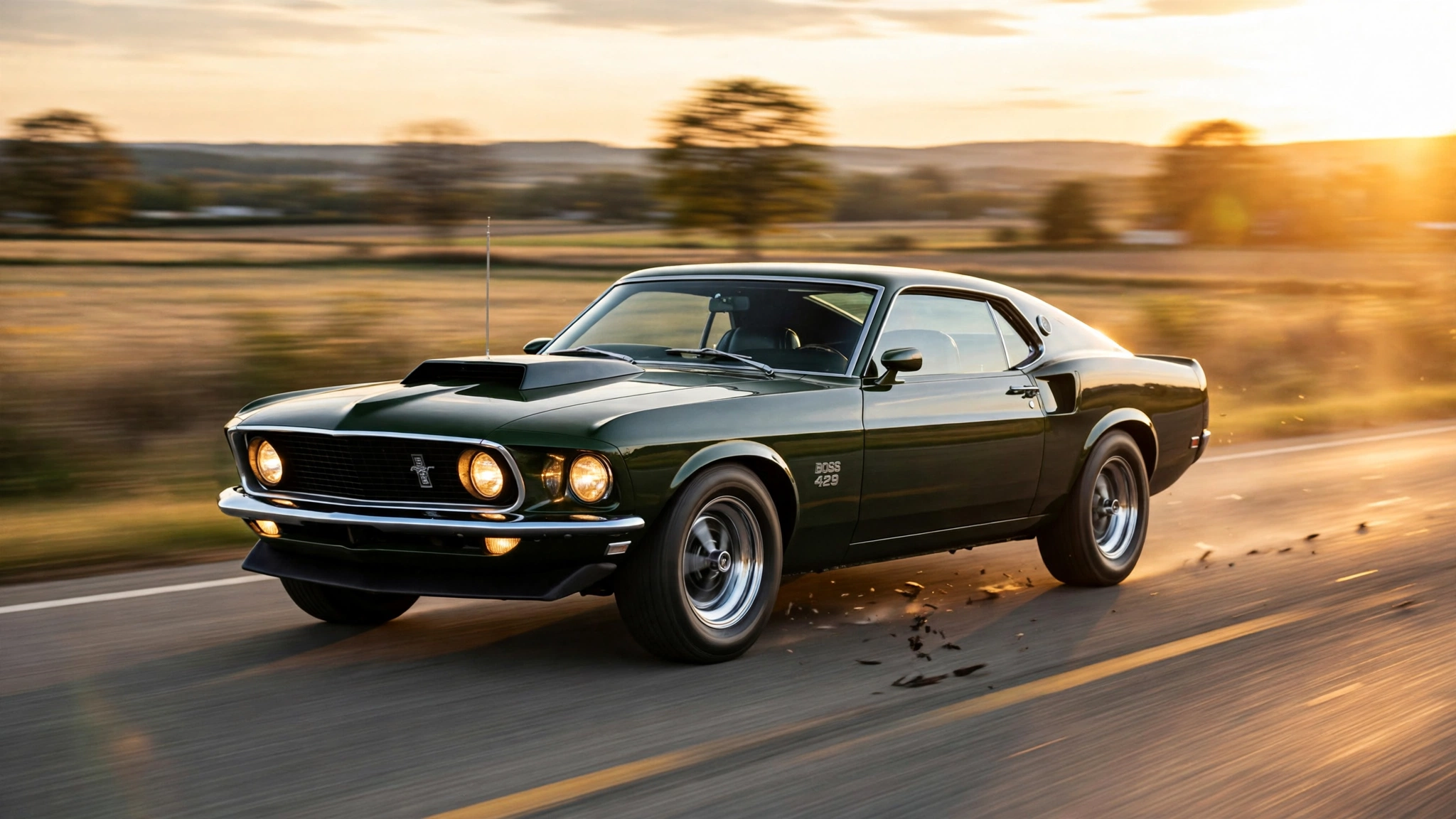
Some muscle cars were built to sell. The 1969 Boss 429 Mustang was built to qualify. NASCAR’s homologation rules said Ford had to put at least 500 street cars with its new 429 engine on the road before it could race the engine — so Ford did exactly that, and not one car more than it had to. Only 859 Boss 429 Mustangs were built for 1969, with another 499 for 1970.
The engine was the whole point. The 429 cubic-inch (7.0-litre) Boss V8 was a race design from the start: aluminium cylinder heads with semi-hemispherical combustion chambers — the “semi-hemi” — four-bolt main caps, a forged steel crank and forged steel connecting rods, and a 735 CFM Holley four-barrel on an aluminium intake. Ford rated it at 375 horsepower at 5,200 rpm and 450 lb-ft of torque at 3,400 rpm, figures everyone at the time understood were conservative. Period tests and insider estimates put the real output near 500 horsepower, with quarter-mile times around 14 seconds.
It was so big it did not fit. A standard Mustang engine bay could not take the Boss 429, so Ford sent partially built bodies from its Rouge plant to Kar Kraft, its specialist contractor in Brighton, Michigan — the same outfit that had helped build the Le Mans-winning GT40. Kar Kraft widened the space between the shock towers, revised the suspension geometry, relocated the battery to the trunk, and installed the engine by hand. Every finished car carried a Ford serial number plus a Kar Kraft “KK” number stamped on its door data plate. The 1969 cars ran hydraulic lifters; 1970 switched to solid lifters to stop valve float at high rpm.
Ford’s target was never the Mustang itself. The homologated 429 went racing in Torino Talladegas and Mercury Cyclones on the superspeedways, making its NASCAR debut on 30 March 1969 at Atlanta with Cale Yarborough at the wheel — built to take on Chrysler’s 426 Hemi, the engine that had ruled the big ovals. The Mustang was simply the street car Ford chose to carry the engine into the showrooms, because no Torino could make the statement a Mustang could.
That is what makes tonight’s reel worth ten seconds of your evening. The car in it is one of 859 — a hand-finished homologation special, a race engine wearing licence plates, sold through ordinary dealerships because a rulebook demanded it. Turn the volume up for the flyby, then answer the reel’s question honestly: would you drive it, or lock it in a museum?
Watch tonight’s 1969 Boss 429 flyby reel on the page, then tell us in the comments: drive it, or lock it in a museum?
Ford reference material
Ford’s Mustang timeline lists the Boss 429 as a 375-horsepower addition to the 1969 lineup. Ford Performance’s engine history provides background on the 429 Boss and the related Ford big-block engines.
Related reading
Sources
Specifications, production figures and test results in this article were checked against:
- Wikipedia — Boss 429 — 859 built in 1969; 375 bhp @ 5,200 rpm / 450 lb-ft @ 3,400 rpm; 735 CFM Holley; Kar Kraft assembly
- Silodrome — 1969 Ford Mustang Boss 429 — NASCAR homologation; true output near 500 hp; quarter-mile around 14 seconds
- Hemmings — 10 Greatest NASCAR Homologation Specials — 500-unit homologation rule; homologated March 13, 1969; first win at Atlanta, March 30, 1969
- HotCars — The Ford NASCAR Engine Muscle Car Fans Need to Know About — NASCAR debut March 30, 1969 at Atlanta; Cale Yarborough’s first win for the engine
Leave a Reply