Tag: Chevrolet

  • Three Cold Starts, One Question: Which V8 Sounds Best — Ford, Chevy or Mopar?

    Three Cold Starts, One Question: Which V8 Sounds Best — Ford, Chevy or Mopar?

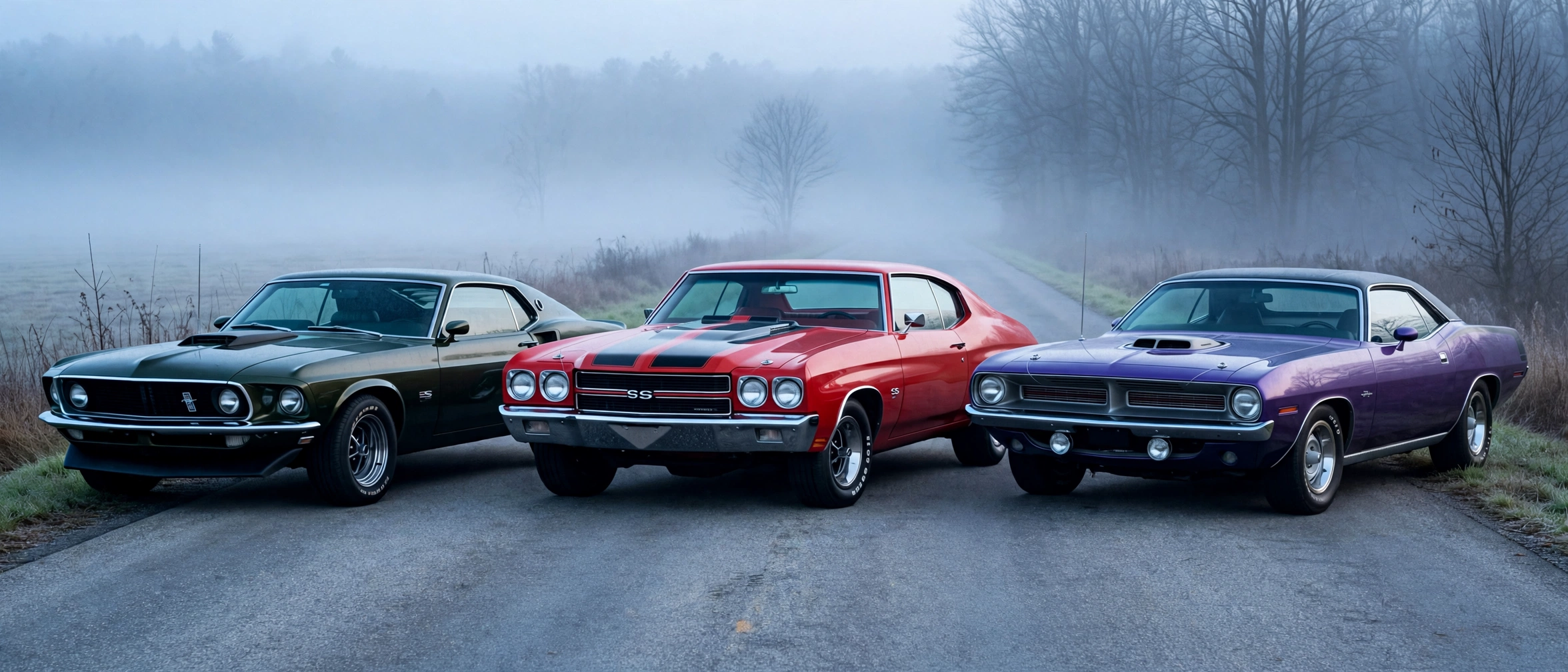
    A cold start is the most honest sound a muscle car ever makes. No warm-up, no choke fully off, no exhaust yet hot enough to hide anything — just a big V8 clearing its throat on a cold morning, fast idle, thick vapour, and the whole neighbourhood knowing exactly what you drive. Tonight’s reel lines up three of them, one from each of the Big Three, and asks you to vote 1, 2 or 3. Here is the case for each side.

    1 — Ford: the Boss 429. Ford’s entry is the most exotic engine of the three. The 429 cubic-inch Boss V8 was a race design built to satisfy NASCAR’s homologation rules: aluminium heads with semi-hemispherical combustion chambers — the “semi-hemi” — four-bolt main caps, a forged steel crank and forged rods, and a 735 CFM Holley four-barrel. Ford rated it at 375 horsepower, but everyone at the time understood the real figure was near 500. Only 859 were built for 1969, each one hand-finished by Kar Kraft because the engine was too big for a standard Mustang engine bay. On a cold start it is the highest-strung of the three — a sharp, metallic bark that settles into an impatient, cammy idle. It sounds like a race engine because that is what it is: the street car existed only so the engine could race.

    2 — Chevy: the LS6 454. Chevrolet’s answer is displacement and torque. The 1970 Chevelle SS 454 in LS6 form made 450 horsepower and 500 lb-ft of torque — the most powerful stock big-block Chevrolet ever built, and a one-year-only option. Where the Boss 429 screams, the LS6 thunders: it is widely remembered for one of the deepest exhaust notes ever fitted to a production muscle car, a slow, thunder-like rumble at idle that explodes into a booming roar under throttle. On a cold morning it is the one you feel in your chest before you hear it properly. It does not need to rev to make its point — it just needs to idle.

    3 — Mopar: the 426 Hemi. Chrysler’s 426 Hemi is the legend the other two were built to beat. 425 horsepower and 490 lb-ft from hemispherical combustion chambers — the design that gave the engine its name — and an exhaust pulse so deep and slow that at idle the whole car shakes visibly. The Hemi’s sound is primal rather than refined: a thunderous, loping idle that turns into a raw bellow the moment the throttle opens. It is the engine Ford built the Boss 429 to take on at the superspeedways, and the one every bench race in 1970 eventually came back to.

    So which one wins tonight? There is no wrong answer — that is the point of the vote. The Ford is the rarest and the most race-bred, the Chevy is the deepest and the most powerful on paper, and the Mopar is the one that made the other two necessary. Listen to all three cold starts in tonight’s reel, turn the volume up, and vote with your ears, not your badge loyalty. Or vote with your badge loyalty — nobody will blame you.

    Watch tonight’s three cold starts on the page, then vote in the comments: 1 for Ford, 2 for Chevy, 3 for Mopar. Which V8 wakes the street best?

    Sources

    Specifications, production figures and test results in this article were checked against:

  • Chevelle vs Road Runner: The 1970 Duel That Ended in a Dead Heat

    Chevelle vs Road Runner: The 1970 Duel That Ended in a Dead Heat

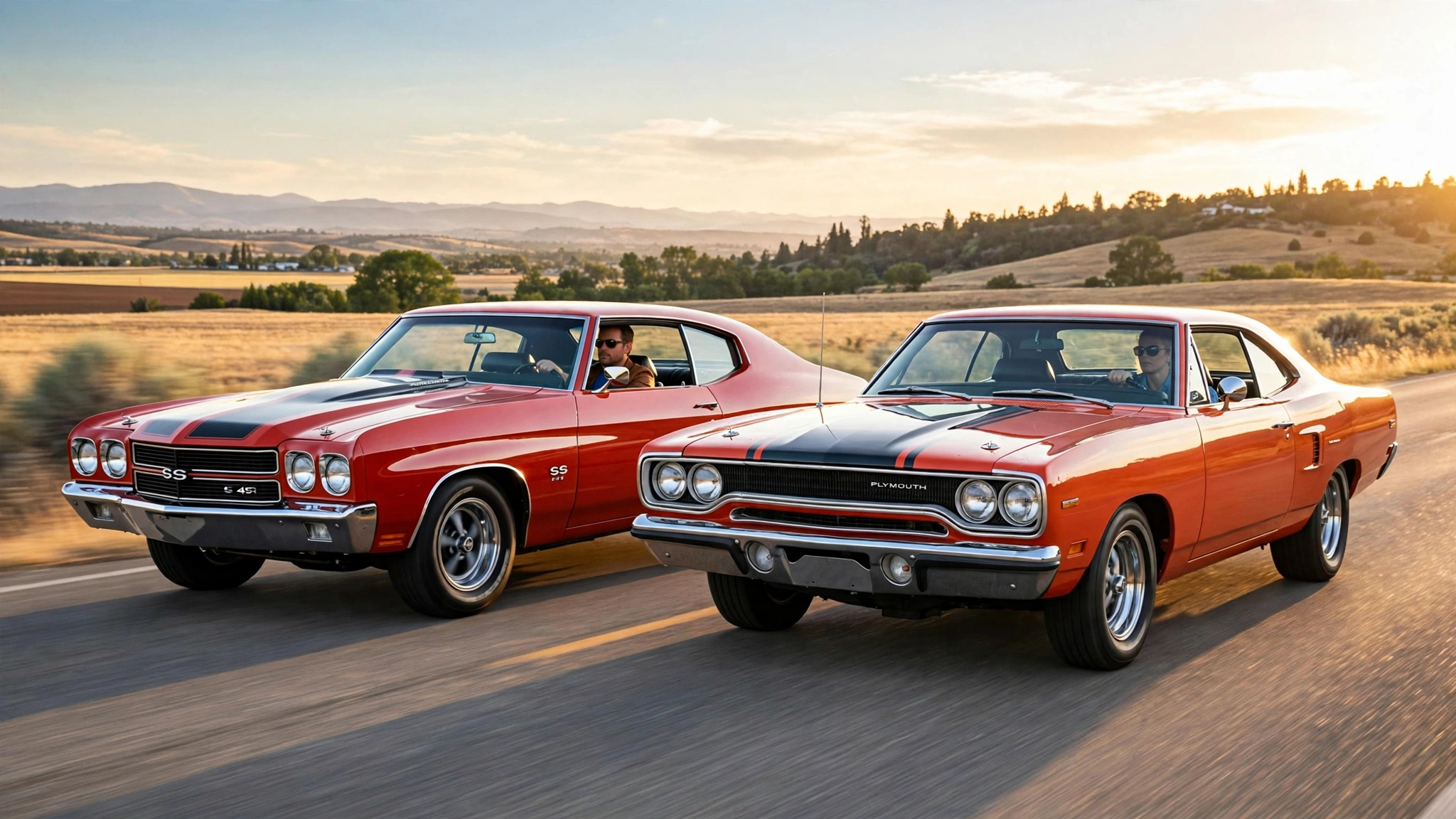
    1970 was the year the horsepower war peaked, and this duel is the proof. For years General Motors had banned engines over 400 cubic inches in its intermediate cars. When that ban lifted for 1970, Chevrolet finally gave the Chevelle the engine it had been waiting for: the 454. In LS5 form it made 360 horsepower; in LS6 form — a one-year-only option, produced only in 1970 — it made 450 horsepower and 500 lb-ft of torque, the most powerful stock big-block Chevrolet ever built.

    The Road Runner answered with choice instead of a single headline number. It was born in 1968 as a cheap, bare-bones speed machine — a $2,870 sticker price that left buyers money to spend on the engine — and by 1970 the menu ran from the standard 383 at 335 horsepower, through the 440 at 375, to the 440 Six Barrel at 390 horsepower and 490 lb-ft, and finally the 426 Street Hemi at 425 horsepower and 490 lb-ft. The Six Barrel is the clever pick in this fight: three two-barrel carburetors, Hemi-matching torque, and a $250 option price against $841 for the Hemi — near-Hemi speed for a third of the money.

    So who actually won? The period timing slips refuse to pick a side. Hot Rod magazine ran a stock LS6 Chevelle through the quarter-mile in 13.44 seconds, and period tests put the Hemi Road Runner right beside it. Car Craft went quicker still in the Chevelle, 13.12 seconds at 107 mph, while the 440 Six Barrel Road Runner was clocked around 13.5 seconds, again essentially the same car. Different days, different tracks, different drivers — but every serious test lands both cars in the low 13s, and that is the real result: on horsepower the Chevelle wins by 25, on the clock nobody wins.

    That is the argument this morning’s reel is having, ten seconds at a time. Two 1970 big-blocks, side by side, full car and movement from the first second — the exact format that works, after the static tachometer reel on Day 4 stalled at 575 views. Watch it, pick your side, and be honest about why: the numbers, or the noise?

    This morning’s reel asked it first — Comment 1 for CHEVELLE, 2 for ROAD RUNNER. Cast your vote on the page, then tell us: which one are you taking home?

    Sources

    Specifications, production figures and test results in this article were checked against:

  • How Much Tire Life Is Left? The 1968 Camaro SS and the Art of the Burnout

    How Much Tire Life Is Left? The 1968 Camaro SS and the Art of the Burnout

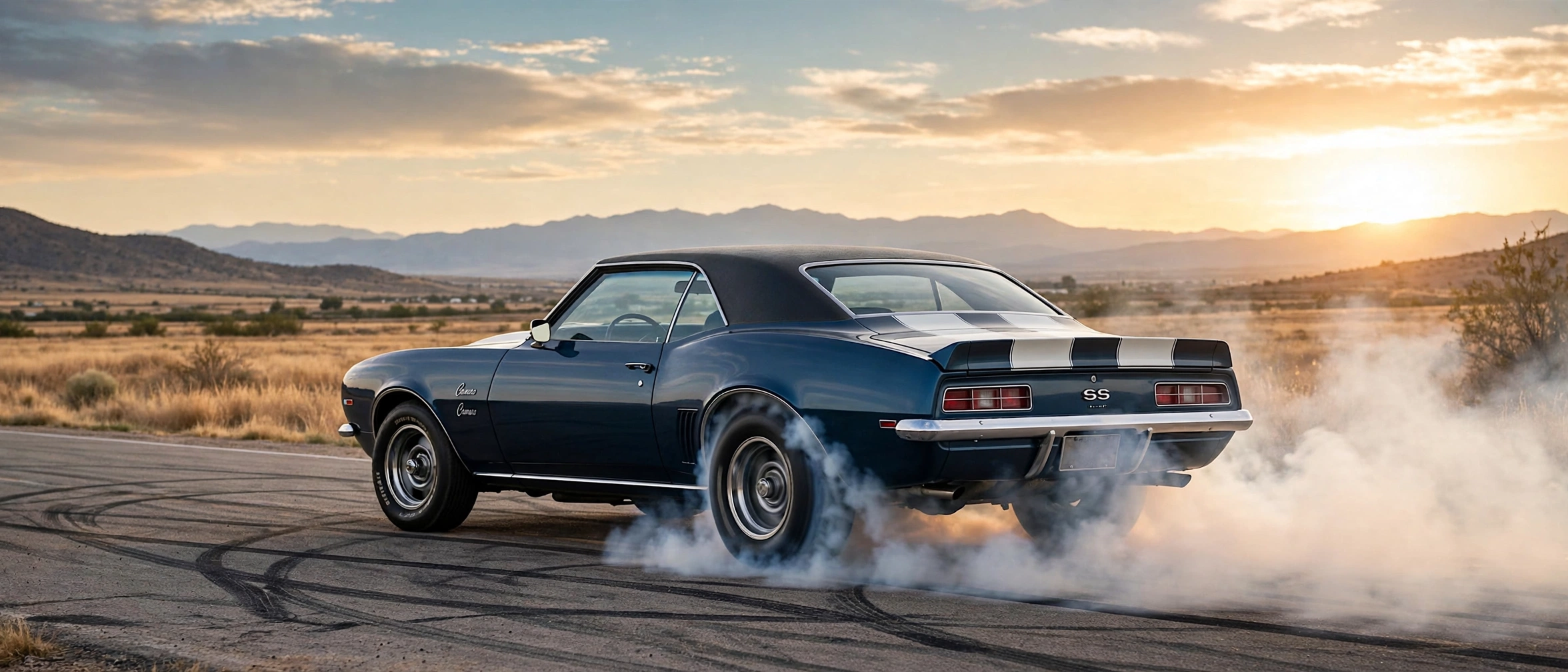
    A burnout looks like showing off, and it is — but it started as work. On a drag strip, spinning the rear tyres cleans them and heats the rubber until it grips, and on the street it became the loudest possible way to say what is under the hood. The 1968 Camaro SS had plenty to say.

    The SS was an option package, not a separate model, and in 1968 it came with a real choice. The base SS350 carried the new-for-1967 350 small-block, rated at 295 horsepower and 380 lb-ft of torque. Step up to the SS396 and there were three big-blocks to pick from: the 325-horsepower L35, the 350-horsepower L34 — new for 1968 — and the 375-horsepower L78 with its solid-lifter cam, 11:1 compression and Holley four-barrel. The rarest of all was the L89, the L78 fitted with aluminium cylinder heads: only 272 were built in 1968. Every SS came with a four-barrel carburetor and dual exhaust as standard, plus the bumblebee nose stripe, blacked-out grille and simulated hood intakes that told everyone at the lights what they were looking at.

    The 1968 car matters for a burnout for a reason you cannot see in the smoke. The 1967 Camaro suffered from axle tramp — the rear axle hopping under hard acceleration — so for 1968 Chevrolet fitted multi-leaf rear springs in place of the single-leaf set-up and staggered the rear shock absorbers. It was a small, unglamorous fix, and it is exactly what lets a ’68 SS plant its tyres and spin them cleanly instead of juddering across the asphalt. Side marker lamps were the visible change for the year; the suspension was the one that mattered when the light went green.

    How many SS Camaros were built in 1968? Chevrolet’s engine records tell the story: 12,496 with the 350, 10,773 with the 325-horsepower 396, 2,579 with the 350-horsepower 396, 4,575 with the 375-horsepower 396, and 272 with the aluminium-head L89 version of it — 30,695 SS Camaros in all, out of about 235,000 Camaros that year. The SS was never rare, and that is part of the point: this was affordable, attainable muscle, built in numbers ordinary buyers could actually find and afford.

    Performance backed up the noise. A 396/325 SS had more than enough muscle to turn a set of rear tyres into smoke on demand. The top L78 cars were quicker still, into the high 13s in the quarter-mile.

    That is what tonight’s reel is: ten seconds, one Camaro, and a question with no wrong answer. Watch it, turn the volume up, and then be honest — how much tyre life is left?

    Watch tonight’s 1968 Camaro SS burnout reel on the page, then tell us in the comments: best burnout car ever — Camaro SS, or something else entirely?

    Sources

    Specifications, production figures and test results in this article were checked against:

  • Top 10 Muscle Cars of the 1970s

    Top 10 Muscle Cars of the 1970s

    The seventies opened with the wildest horsepower war in automotive history — and closed with smog pumps, 5-mph bumpers and horsepower ratings that read like typos. But the decade’s best cars weren’t just the last of the breed; several were the best of the breed, full stop. Here is our ranking, argued the way we argue it in the comments: power, presence, and what it feels like when one rolls past.

    1. 10 — 1973 Pontiac Trans Am SD-455

      The last true believer. When everyone else detuned, Pontiac hand-built the Super Duty 455 — advertised at 310 hp — officially rated 290 hp net after certification — in an era of 200 hp flagships. Proof the fire wasn’t out, just banked.

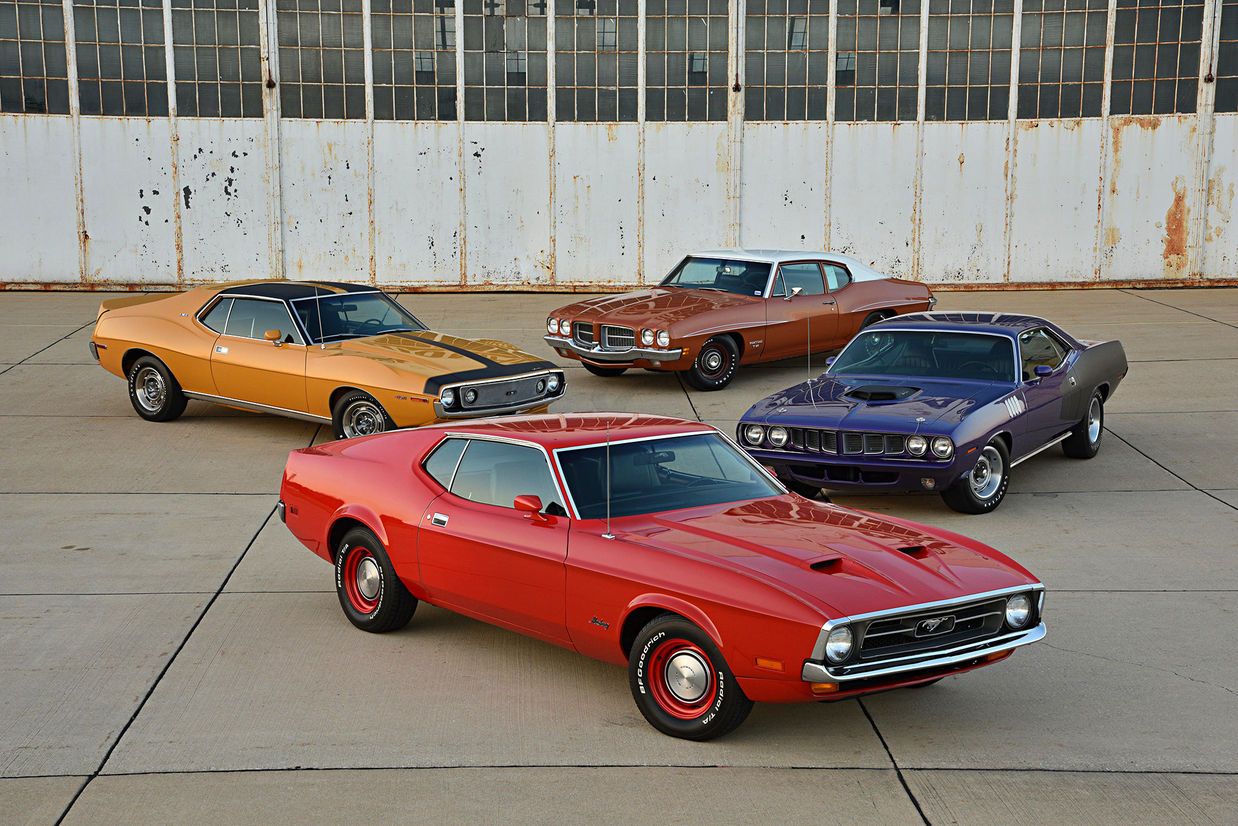
    2. 9 — 1971 Ford Mustang Mach 1 (429 Cobra Jet)

      The biggest Mustang ever made, with the biggest engine ever offered in one. Controversial then, collectible now — and the star of our barn-find story above.

    3. 8 — 1970 AMC AMX

      Two seats, a short wheelbase and a 390 V8 with 325 hp. The underdog from Kenosha embarrassed bigger names at the drag strip and still gets underrated at auction.

    4. 7 — 1970 Pontiac GTO Judge

      Ram Air power, wild stripes, and the most confident name in the business. The Judge was the muscle car as pure theater — 366 hp of it with the Ram Air III.

    5. 6 — 1970 Dodge Challenger R/T

      Late to the pony-car party and dressed to kill. With the 440 Six-Pack or the Hemi, the Challenger had the longest hood and the shortest temper of the class of ’70.

    6. 5 — 1970 Buick GSX Stage 1

      The gentleman’s express. Its 455 was rated 360 hp, but the number that mattered was 510 lb-ft of torque — the highest of any American production car of the era.

    7. 4 — 1970 Plymouth Road Runner Superbird

      A nose cone, a wing you could land aircraft on, and one job: win at NASCAR. Dealers once struggled to sell them. Try that sentence at an auction today.

    8. 3 — 1970 Dodge Charger R/T

      The silhouette alone earns the podium. Add a 440 Magnum — or the 426 Hemi at 425 hp — and you have the decade’s definitive big coupe.

    9. 2 — 1970 Plymouth Hemi ‘Cuda

      The 426 Hemi in the lightest, meanest wrapper Plymouth ever built. Convertible Hemi ‘Cudas are now among the most valuable American cars on Earth. The hardtop is the same thunder, slightly less lottery ticket.

    10. 1 — 1970 Chevrolet Chevelle SS 454 LS6

      450 factory-rated horsepower — the highest rating ever given to a production muscle car of the classic era. The LS6 wasn’t the peak of the horsepower war by accident. It was the peak, period.

    Your turn: this ranking gets defended daily on the page. If your number one isn’t the LS6, the comments on Facebook are open — bring numbers, not feelings.

    Sources

    Specifications, production figures and test results in this article were checked against:

  • 5 Real Muscle Cars You Can Still Buy Under $25,000

    5 Real Muscle Cars You Can Still Buy Under $25,000

    Watch enough auction coverage and you’d think classic muscle now starts at six figures. It doesn’t. The famous names got expensive; the honest cars didn’t — at least, not yet. Driver-quality examples of all five cars below still change hands under $25,000 in the US market. Here’s where the smart money starts.

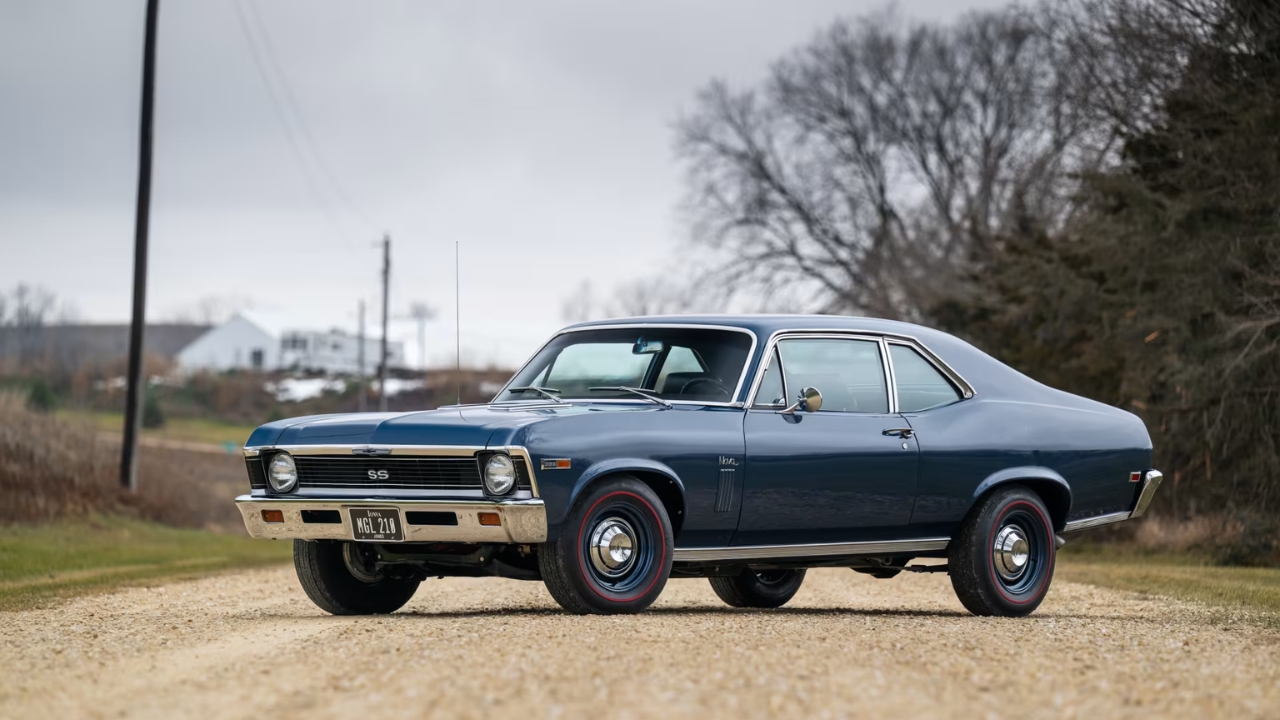
    1. Chevrolet Nova (1968–1974)

    The thinking person’s muscle car. Light, simple, and built around an engine bay that accepts any small block or big block Chevrolet ever made. V8 cars in driver condition are the easiest under-$25K ticket in this list, and every part is a phone call away.

    2. Plymouth Duster & Dodge Dart (1970–1976)

    Mopar’s A-bodies were the budget bruisers when new and remain so. A 340 car is the dream; a 318 car with a 360 swap in its future is the realistic buy. Watch the torsion-bar front end and rear frame rails for rust.

    3. Ford Maverick Grabber & Comet GT (1970–1977)

    The forgotten Ford. A Maverick with the 302 V8 is a Mustang in a cheaper suit — same drivetrain logic, half the entry price, and a fastback silhouette that gets better looking every year.

    4. Pontiac LeMans (1968–1972)

    Everything a GTO is, without the three letters that double the price. Same A-body, same engine bay, and a 350 or 400 Pontiac V8 under the hood of the right example. Buy the best body you can find; drivetrains are the easy part.

    5. Chevrolet Monte Carlo (1970–1972)

    The personal-luxury coupe that shared its bones with the Chevelle. Big-block cars exist at the top of the budget; small-block cars in clean driver shape sit comfortably under it — with the longest hood in the business thrown in free.

    The under-$25K rules: buy the best body, not the biggest engine — rust repair costs more than horsepower. Verify the VIN matches the story. And budget the wake-up costs (tires, brakes, fuel system) on top of the purchase price, every time.

    None of these cars will headline an auction catalog. All of them will do the thing that actually matters: a V8 idle at a gas station, a Saturday-morning cars-and-coffee, and a garage project that’s yours. That’s the hobby. The rest is just pricing.

    How to check prices before you buy

    Compare recent U.S. sales for the same year, engine, body style and condition. A base six-cylinder Nova and a documented Nova SS are different markets. Use Hagerty’s guide to valuing a classic car to find comparable sales, then get an independent pre-purchase inspection and leave room in your budget for transport and immediate repairs.

    Sources

    Specifications, production figures and test results in this article were checked against:

    Prices for the Pontiac LeMans and Chevrolet Monte Carlo reflect general A-body market observation — no model-specific valuation was available at publication.