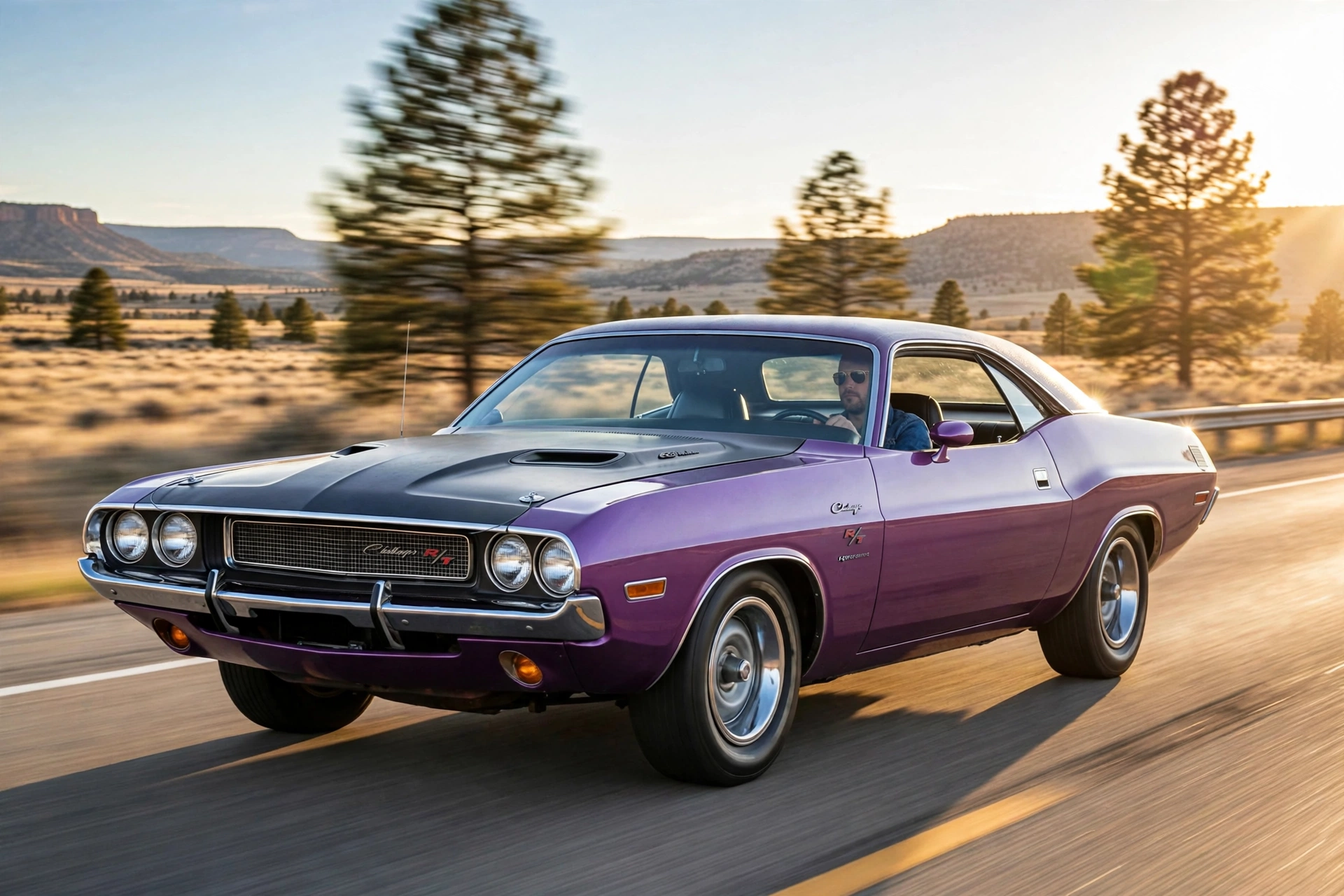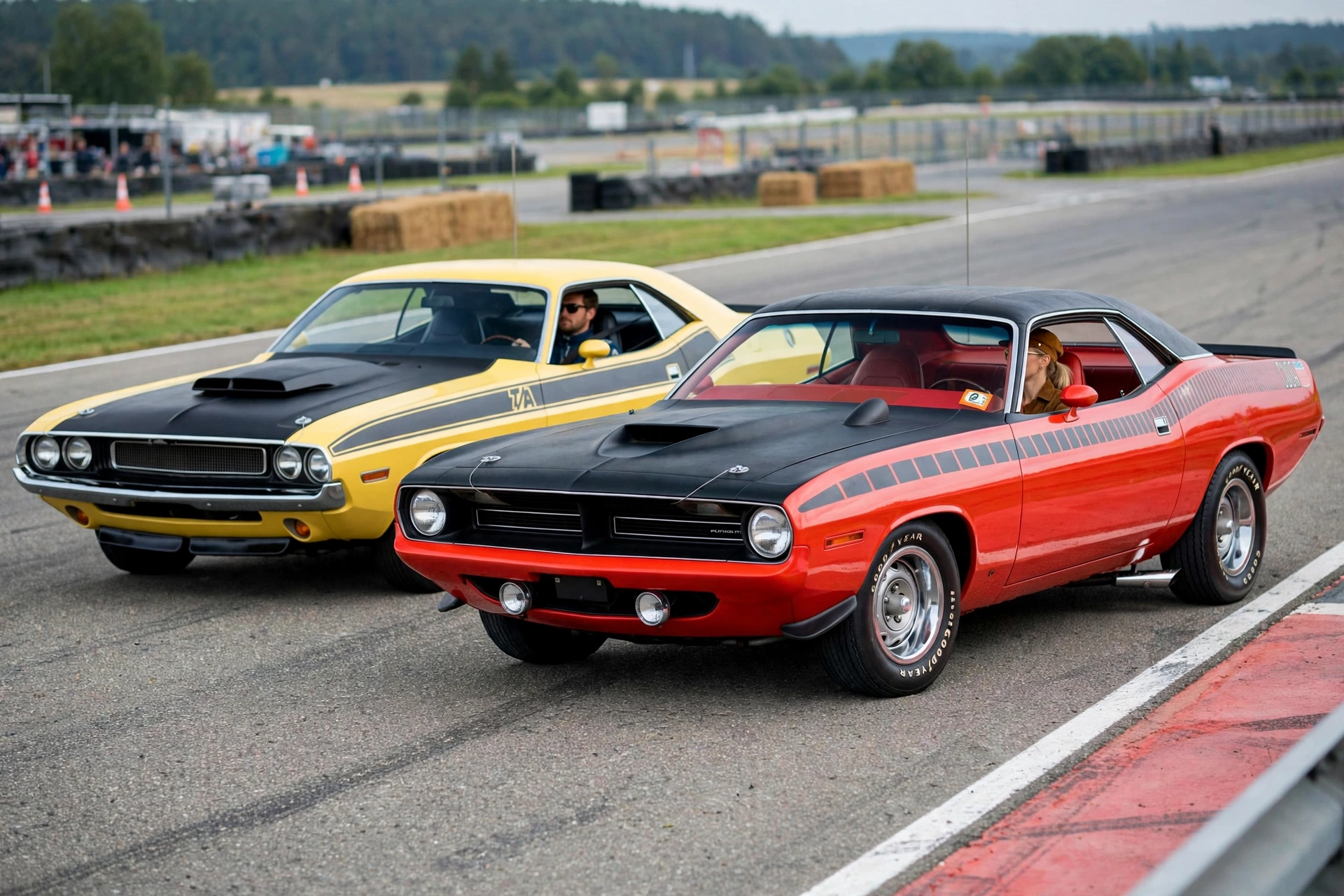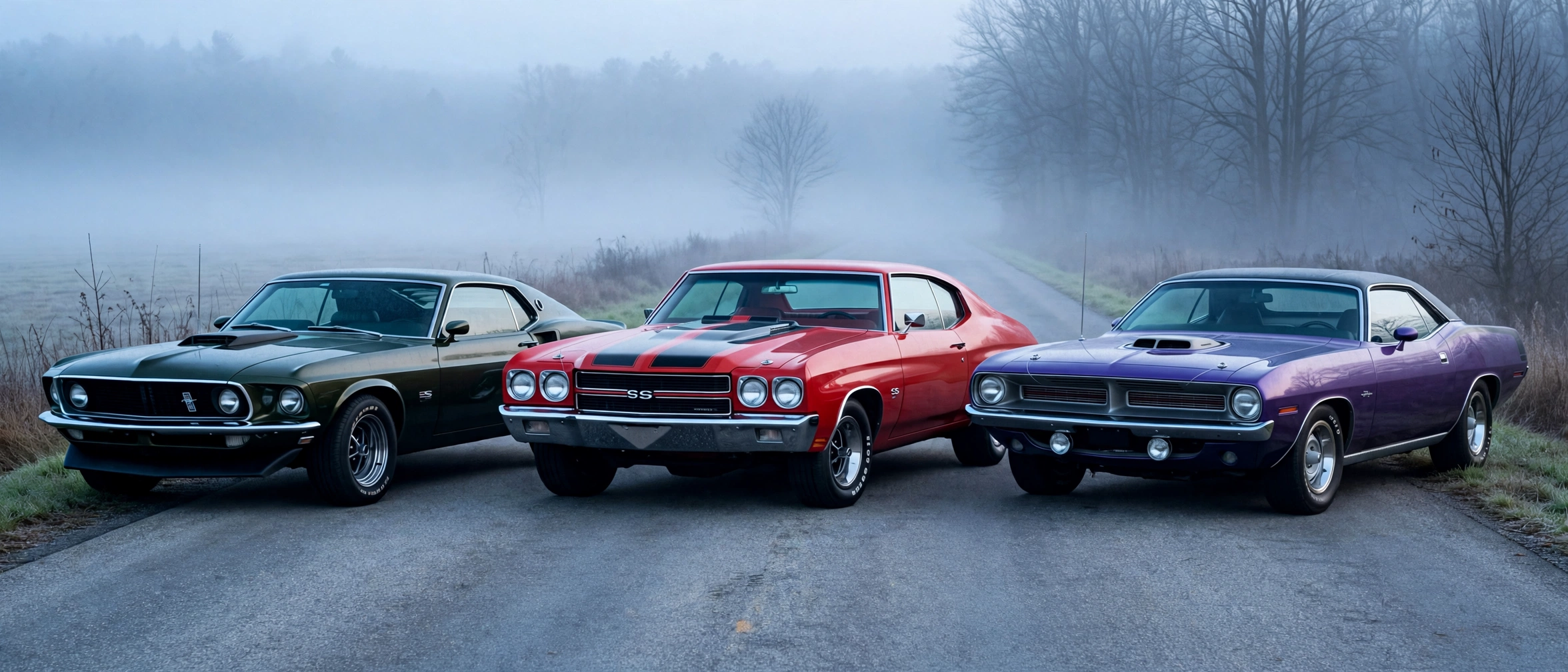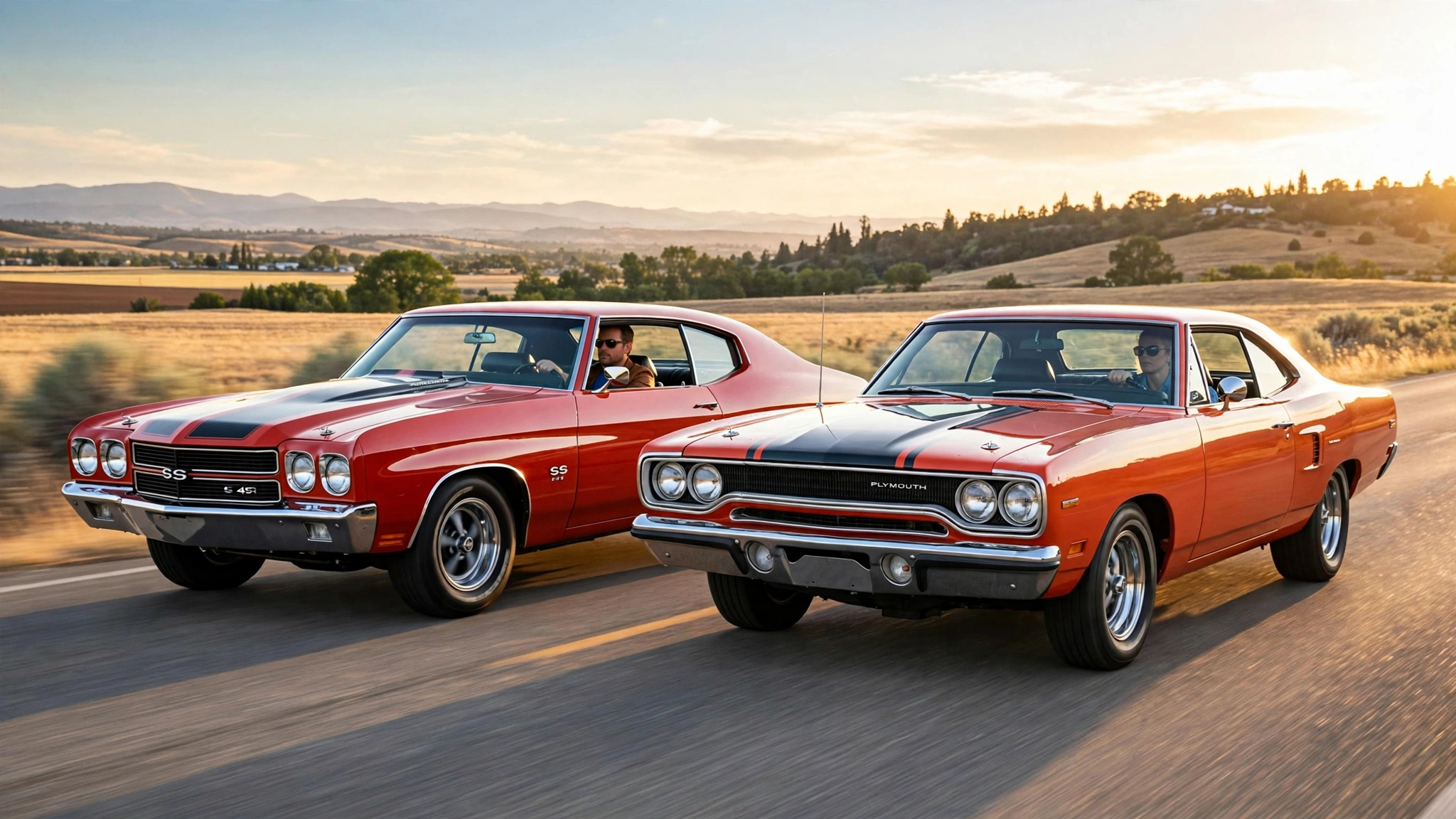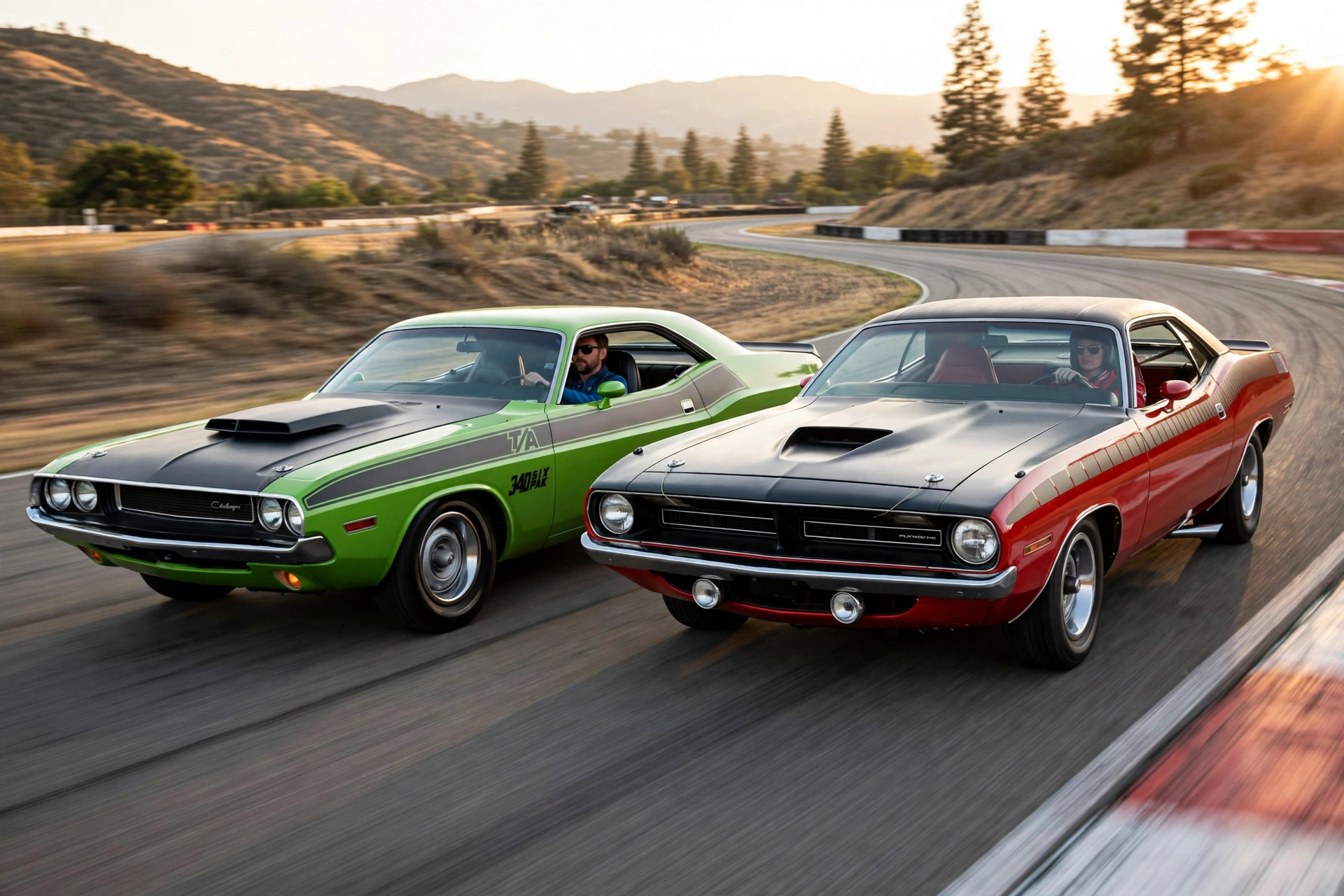
Our Day 8 reel asked the question with exhaust notes instead of words: a 1970 Challenger T/A against a 1970 AAR ‘Cuda, trading the same corner twice so you could hear the difference. Here is the thing — there is almost no difference to hear. Both cars carry the same engine, a 340-cubic-inch small-block with three two-barrel carburetors, built for the same mission. Chrysler built two cars to do one job, gave them to two different race teams, and let them fight it out in showrooms and on road courses. This is the story of Mopar’s twin Trans-Am weapons — and why collectors still argue about which one is the better car.
Why Chrysler built two of the same car
The reason is a rulebook. The SCCA’s Trans-Am series capped race engines at 305 cubic inches, and to race a car, a manufacturer had to build at least 2,500 street versions of it for the public. Chrysler wanted in — badly — but it had two pony cars and two divisions that both wanted the glory. So Dodge built the Challenger T/A and Plymouth built the AAR ‘Cuda, each homologated as its own race entry. Plymouth’s car was named for Dan Gurney’s All American Racers team; Dodge’s was developed with Sam Posey’s Autodynamics team. The race versions used a destroked 340, cut down to 303.8 cubic inches to meet the limit. The street versions kept the full 340 — and that is the engine that makes both cars special.
Neither car was supposed to exist for long. Plymouth built its entire AAR run in five weeks, from March 11 to April 20, 1970 — 2,724 cars and done. Dodge built 2,399 Challenger T/As, barely clearing the homologation threshold. Together, barely 5,100 cars, each one a one-year-only model. Chrysler pulled the plug on its Trans-Am efforts after just one season, and the T/A and the AAR were axed with it.
The 340 Six Pack: a small-block with a big-block trick
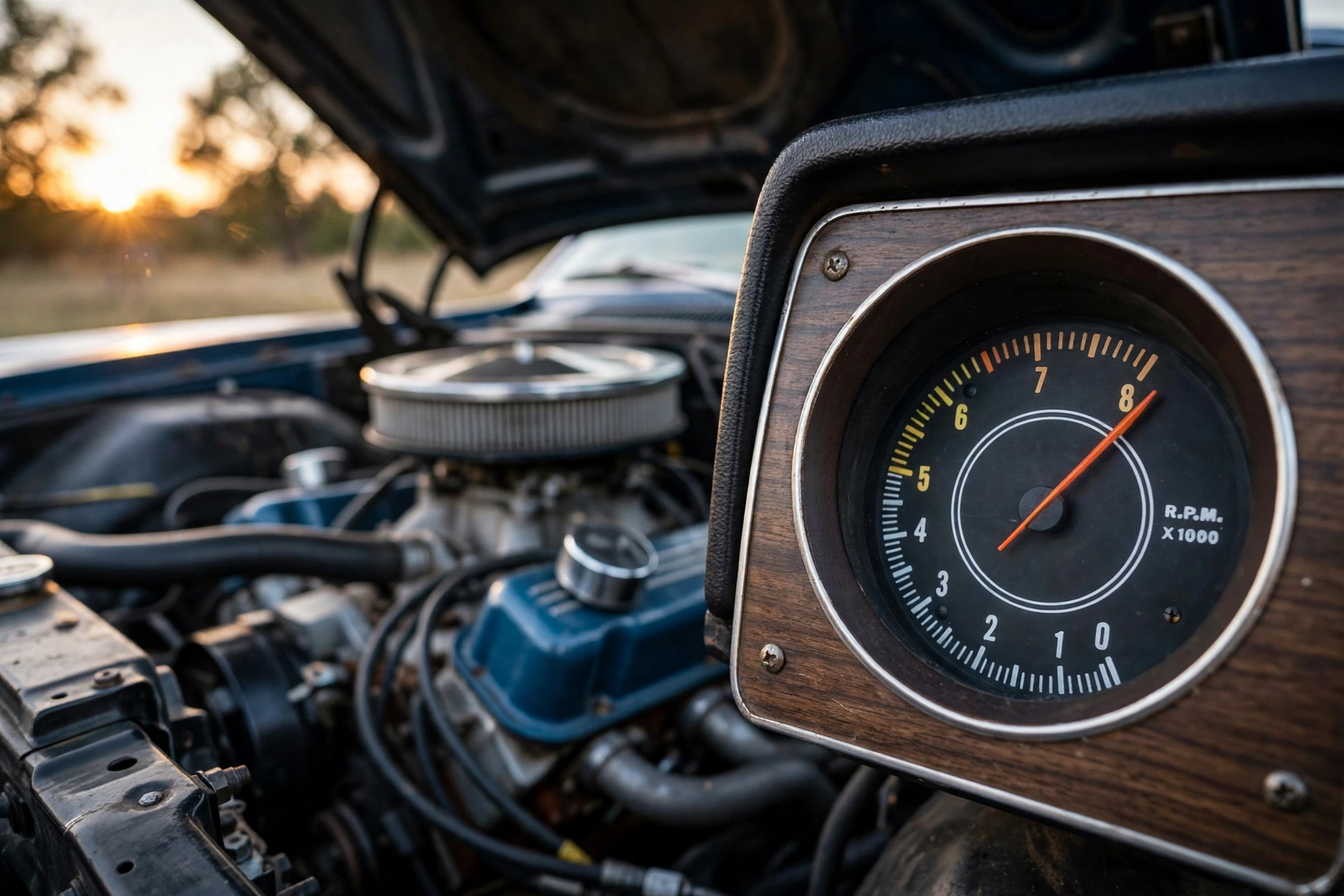
The heart of both cars is the 340 Six Pack — Plymouth called it the Six Barrel, Dodge called it the Six Pack, same engine. Three Holley two-barrel carburetors sit on an Edelbrock aluminium intake, feeding a high-winding 340 small-block with a special block and heads. Officially it made 290 horsepower and 345 lb-ft of torque, fifteen more horsepower than the four-barrel 340’s 275. Like every great Mopar number of the era, 290 was conservative. The Six Pack’s real trick was not the peak figure but the way it delivered it: the centre carburetor handled everyday driving, and the two outer carburetors opened up when you buried the throttle, turning a well-mannered small-block into something that pulled like a big-block. We covered the engine itself in our 340 Six Pack deep dive — in these two cars, it was at its absolute best, because it had a chassis and a purpose built around it.
T/A vs AAR: the differences that matter
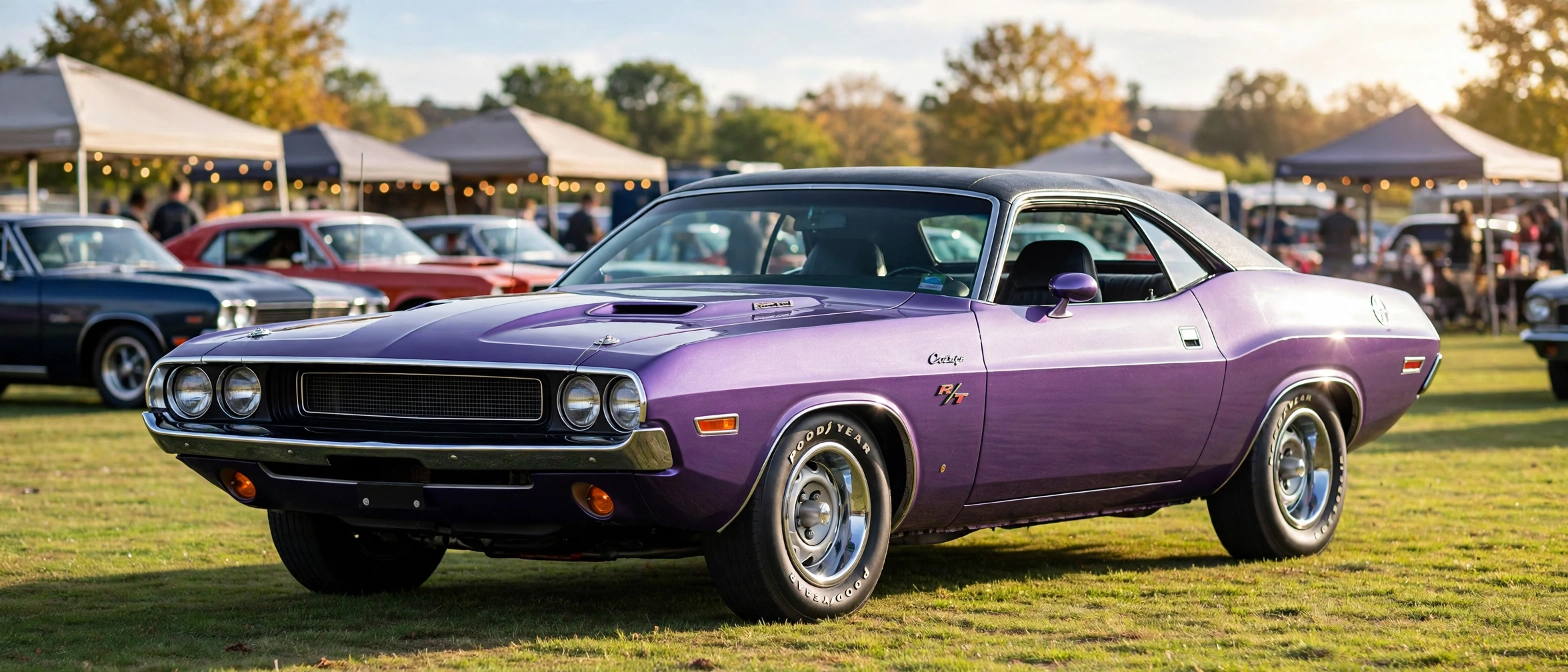
Same engine, same mission — but the cars are not the same, and the differences are worth knowing. The Challenger T/A rides on a 110-inch wheelbase, two inches longer than the ‘Cuda’s 108, and it shows: the Dodge is the longer, more planted-looking car, the Plymouth the shorter, sharper one. The T/A wore a fibreglass hood with a big functional scoop, side-exit exhaust pipes, and bold black fender decals calling out “T/A” and “340 SIX PACK”. It was option code A53, an $865.70 upcharge over the $2,953 base V8 Challenger. The AAR ‘Cuda wore its own uniform: a fibreglass hood with a scoop, side-exit exhaust, and black strobe stripes running down its flanks, with AAR badging honouring Gurney’s team.
The production numbers tell you how rare each one is. Of the 2,399 Challenger T/As, just 989 got the four-speed manual — the rest took the TorqueFlite automatic. Of the 2,724 AAR ‘Cudas, 1,120 were four-speed cars and 1,604 were automatics. Both are rare, but the T/A is the rarer car, and the four-speed T/A is the rarest of all: fewer than a thousand built. That scarcity shows up in the market. A Panther Pink Challenger T/A is now the most expensive T/A ever sold, and a Moulin Rouge AAR ‘Cuda — Plymouth’s name for the same pink — changed hands for $308,000 in 2023.
One season, then gone
On the track, the campaign was short and mostly frustrating. The AAR ‘Cuda’s best result was a second place at Road America, and Chrysler walked away from Trans-Am after a single season. The street cars were the real victory. Unlike the race cars, they did not need to win championships to matter — they needed to be the most focused, most purposeful pony cars Chrysler ever built, and they were. Every T/A and AAR left the factory with the same message: a small-block, three carburetors, a fibreglass hood and an exhaust note that told you exactly what the car was for.
So which one would you take? The ‘Cuda is the blade — shorter, sharper, the Gurney car, with the prettier stripes and the slightly bigger production run. The Challenger is the hammer — longer, louder, rarer, the Posey car, with the suitcase-sized hood scoop. Our 1970 Challenger R/T profile covers the big-block brother these two cars were built alongside, and the comparison is instructive: the R/T was the car for the drag strip, the T/A and the AAR were the cars for the road course. Same family, different religion.
The reel asked it first — listen to both Six Packs, then tell us in the comments: T/A or AAR? There is no wrong answer, but there is a right one for you.
Keep Reading
1970 Dodge Challenger R/T: Peak Muscle Car Design
340 Six Pack: The Small-Block That Scared the Big-Blocks
Sources
AutoEvolution — Rare 1970 Plymouth AAR Cuda production figures
AutoEvolution — Panther Pink 1970 Dodge Challenger T/A
Street Muscle — Musclecars You Should Know: 1970 Plymouth AAR ‘Cuda
Revology Cars — Boss 302 vs AAR Cuda vs Challenger T/A vs Z/28: 1970 Trans-Am Wars