Author: Chris Flournoy

  • Challenger T/A vs AAR ‘Cuda: Mopar’s 1970 Trans-Am Twins

    Challenger T/A vs AAR ‘Cuda: Mopar’s 1970 Trans-Am Twins

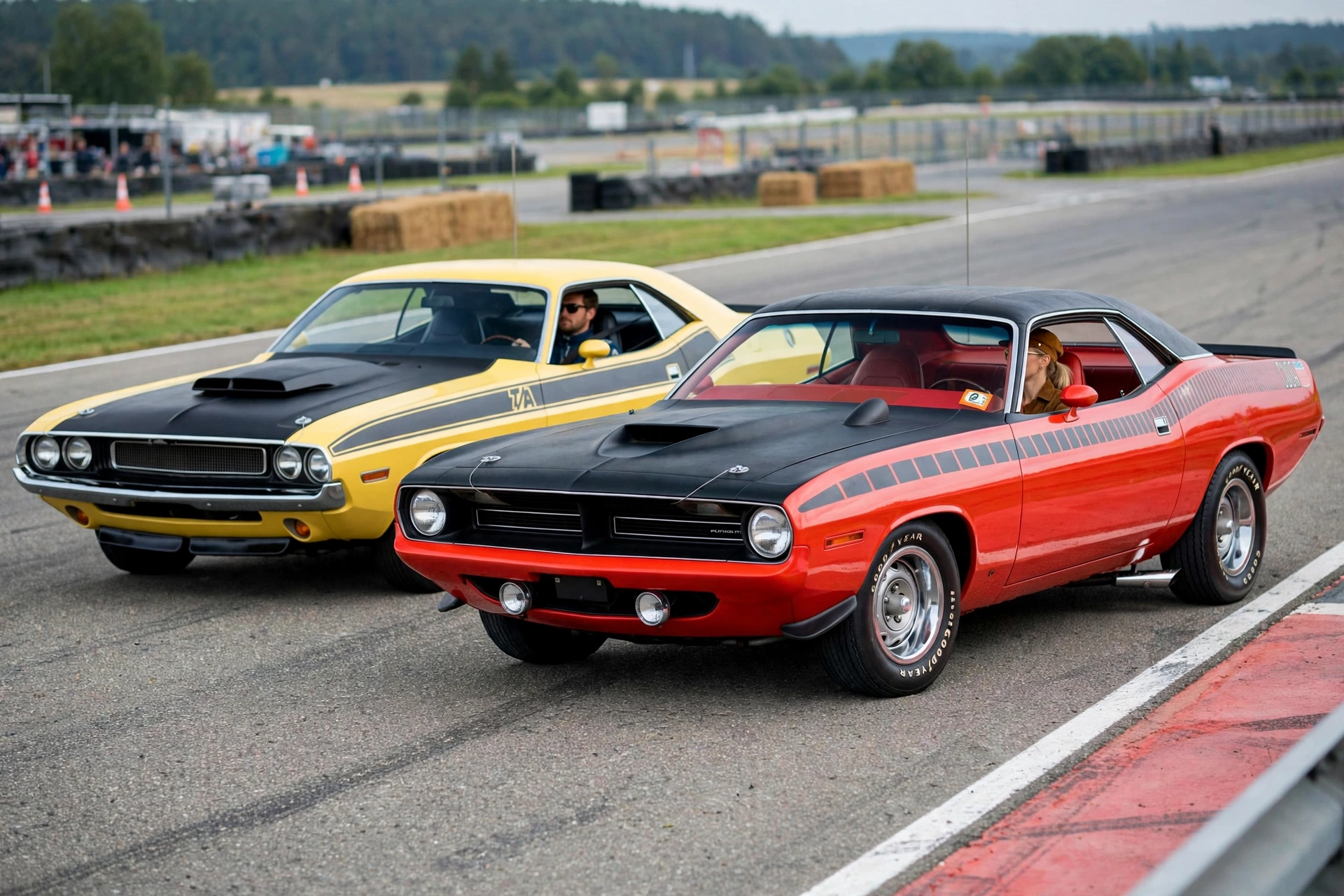
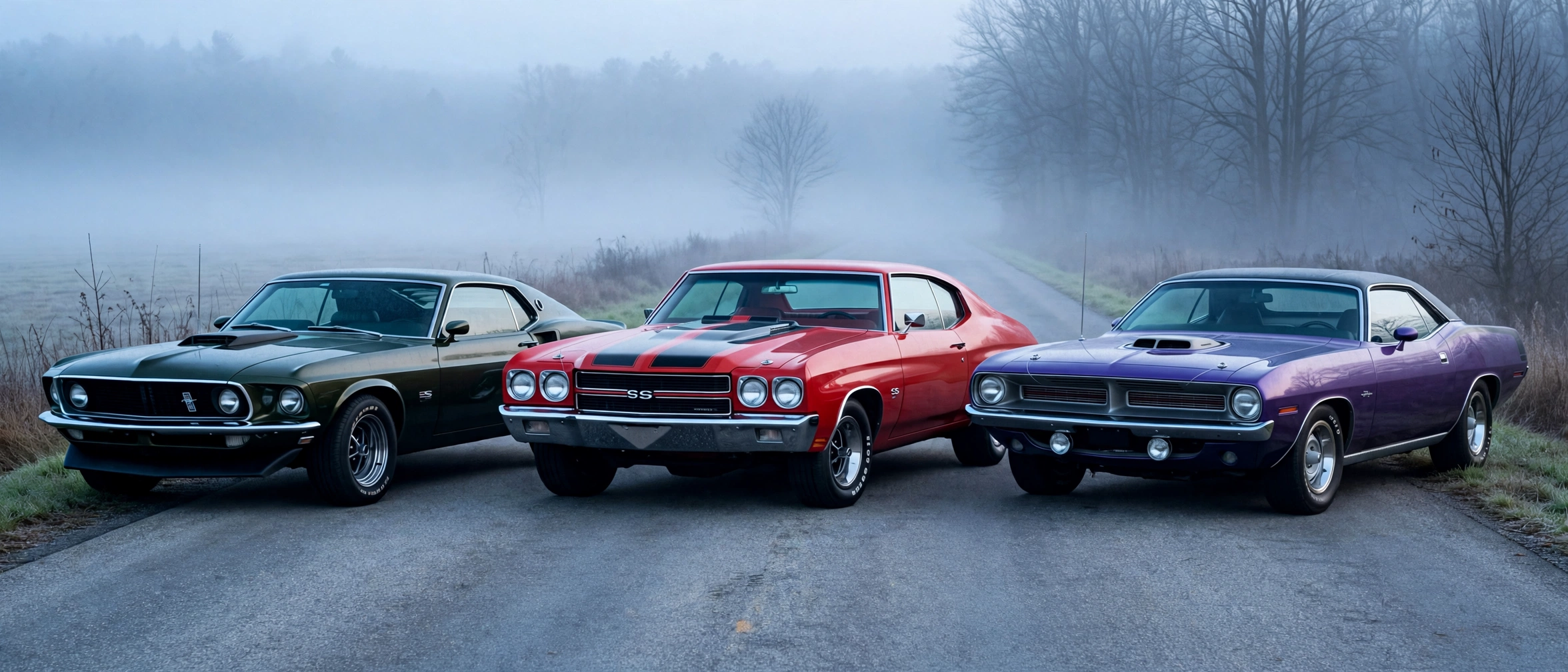
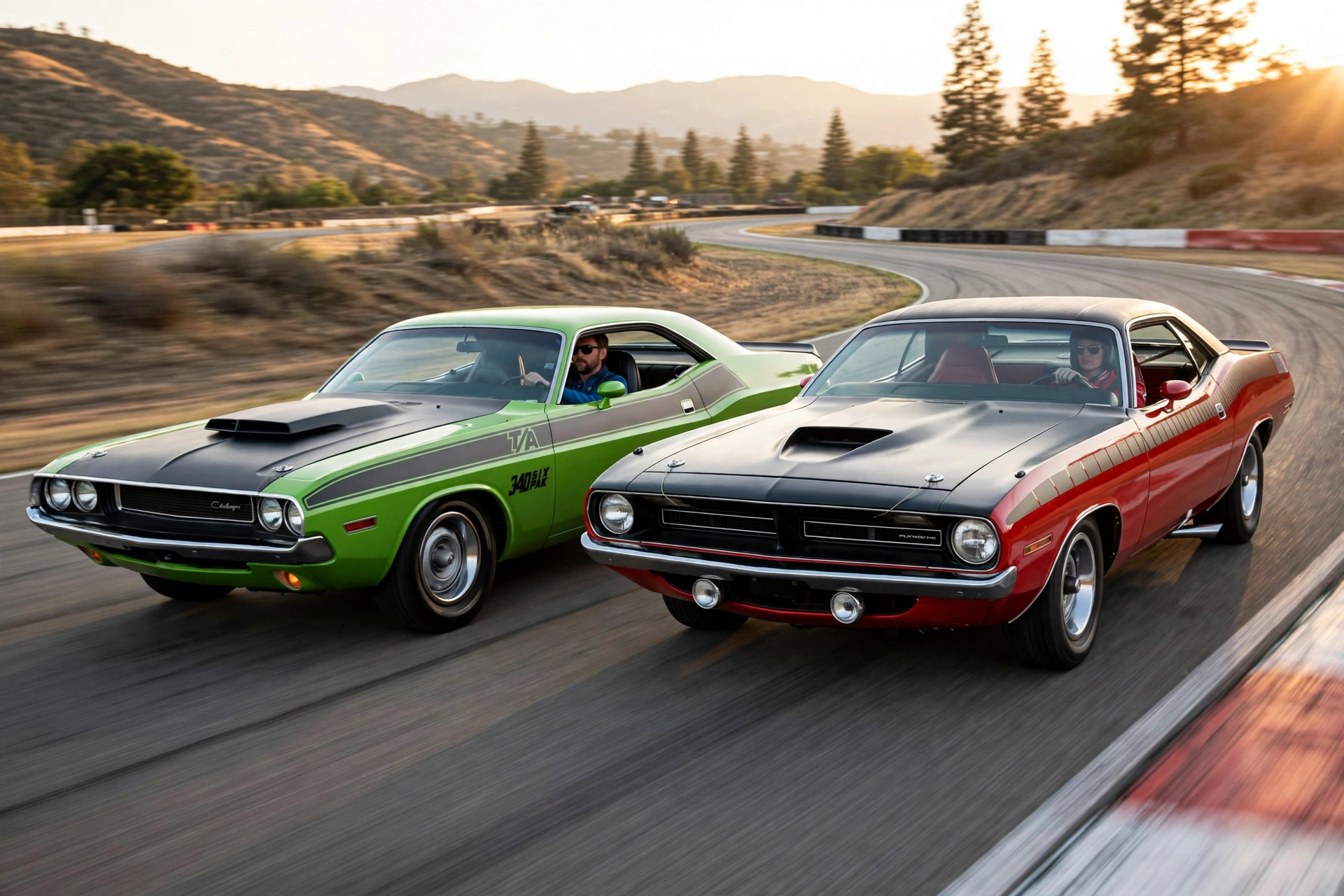
    Our Day 8 reel asked the question with exhaust notes instead of words: a 1970 Challenger T/A against a 1970 AAR ‘Cuda, trading the same corner twice so you could hear the difference. Here is the thing — there is almost no difference to hear. Both cars carry the same engine, a 340-cubic-inch small-block with three two-barrel carburetors, built for the same mission. Chrysler built two cars to do one job, gave them to two different race teams, and let them fight it out in showrooms and on road courses. This is the story of Mopar’s twin Trans-Am weapons — and why collectors still argue about which one is the better car.

    Why Chrysler built two of the same car

    The reason is a rulebook. The SCCA’s Trans-Am series capped race engines at 305 cubic inches, and to race a car, a manufacturer had to build at least 2,500 street versions of it for the public. Chrysler wanted in — badly — but it had two pony cars and two divisions that both wanted the glory. So Dodge built the Challenger T/A and Plymouth built the AAR ‘Cuda, each homologated as its own race entry. Plymouth’s car was named for Dan Gurney’s All American Racers team; Dodge’s was developed with Sam Posey’s Autodynamics team. The race versions used a destroked 340, cut down to 303.8 cubic inches to meet the limit. The street versions kept the full 340 — and that is the engine that makes both cars special.

    Neither car was supposed to exist for long. Plymouth built its entire AAR run in five weeks, from March 11 to April 20, 1970 — 2,724 cars and done. Dodge built 2,399 Challenger T/As, barely clearing the homologation threshold. Together, barely 5,100 cars, each one a one-year-only model. Chrysler pulled the plug on its Trans-Am efforts after just one season, and the T/A and the AAR were axed with it.

    The 340 Six Pack: a small-block with a big-block trick

    The heart of both cars is the 340 Six Pack — Plymouth called it the Six Barrel, Dodge called it the Six Pack, same engine. Three Holley two-barrel carburetors sit on an Edelbrock aluminium intake, feeding a high-winding 340 small-block with a special block and heads. Officially it made 290 horsepower and 345 lb-ft of torque, fifteen more horsepower than the four-barrel 340’s 275. Like every great Mopar number of the era, 290 was conservative. The Six Pack’s real trick was not the peak figure but the way it delivered it: the centre carburetor handled everyday driving, and the two outer carburetors opened up when you buried the throttle, turning a well-mannered small-block into something that pulled like a big-block. We covered the engine itself in our 340 Six Pack deep dive — in these two cars, it was at its absolute best, because it had a chassis and a purpose built around it.

    T/A vs AAR: the differences that matter

    Same engine, same mission — but the cars are not the same, and the differences are worth knowing. The Challenger T/A rides on a 110-inch wheelbase, two inches longer than the ‘Cuda’s 108, and it shows: the Dodge is the longer, more planted-looking car, the Plymouth the shorter, sharper one. The T/A wore a fibreglass hood with a big functional scoop, side-exit exhaust pipes, and bold black fender decals calling out “T/A” and “340 SIX PACK”. It was option code A53, an $865.70 upcharge over the $2,953 base V8 Challenger. The AAR ‘Cuda wore its own uniform: a fibreglass hood with a scoop, side-exit exhaust, and black strobe stripes running down its flanks, with AAR badging honouring Gurney’s team.

    The production numbers tell you how rare each one is. Of the 2,399 Challenger T/As, just 989 got the four-speed manual — the rest took the TorqueFlite automatic. Of the 2,724 AAR ‘Cudas, 1,120 were four-speed cars and 1,604 were automatics. Both are rare, but the T/A is the rarer car, and the four-speed T/A is the rarest of all: fewer than a thousand built. That scarcity shows up in the market. A Panther Pink Challenger T/A is now the most expensive T/A ever sold, and a Moulin Rouge AAR ‘Cuda — Plymouth’s name for the same pink — changed hands for $308,000 in 2023.

    One season, then gone

    On the track, the campaign was short and mostly frustrating. The AAR ‘Cuda’s best result was a second place at Road America, and Chrysler walked away from Trans-Am after a single season. The street cars were the real victory. Unlike the race cars, they did not need to win championships to matter — they needed to be the most focused, most purposeful pony cars Chrysler ever built, and they were. Every T/A and AAR left the factory with the same message: a small-block, three carburetors, a fibreglass hood and an exhaust note that told you exactly what the car was for.

    So which one would you take? The ‘Cuda is the blade — shorter, sharper, the Gurney car, with the prettier stripes and the slightly bigger production run. The Challenger is the hammer — longer, louder, rarer, the Posey car, with the suitcase-sized hood scoop. Our 1970 Challenger R/T profile covers the big-block brother these two cars were built alongside, and the comparison is instructive: the R/T was the car for the drag strip, the T/A and the AAR were the cars for the road course. Same family, different religion.

    The reel asked it first — listen to both Six Packs, then tell us in the comments: T/A or AAR? There is no wrong answer, but there is a right one for you.

    Keep Reading

    1970 Dodge Challenger R/T: Peak Muscle Car Design
    340 Six Pack: The Small-Block That Scared the Big-Blocks

    Sources

    AutoEvolution — Rare 1970 Plymouth AAR Cuda production figures
    AutoEvolution — Panther Pink 1970 Dodge Challenger T/A
    Street Muscle — Musclecars You Should Know: 1970 Plymouth AAR ‘Cuda
    Revology Cars — Boss 302 vs AAR Cuda vs Challenger T/A vs Z/28: 1970 Trans-Am Wars
  • 1970 Dodge Challenger R/T: Peak Muscle Car Design

    1970 Dodge Challenger R/T: Peak Muscle Car Design

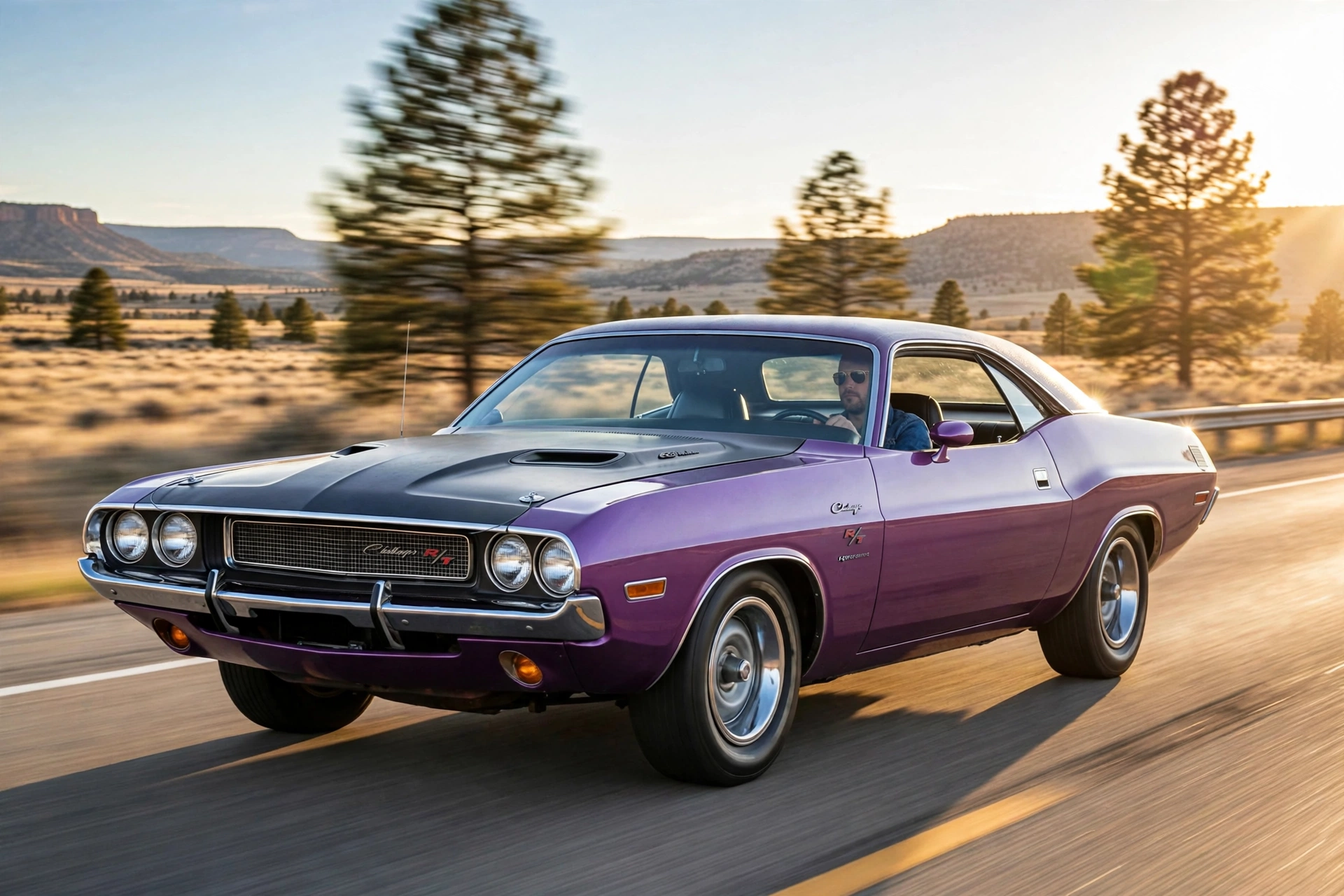
    Tonight’s reel is thirty seconds of pure sunlight: a Plum Crazy 1970 Dodge Challenger R/T rolling down the highway, black hood drinking in the light, and the hook says it plainly — 1970 was peak automotive design. For the Challenger R/T, that is not nostalgia talking. It was the car’s first year, its best-selling year, and the year Dodge threw everything it had at the muscle car wars in a single package. No later Challenger ever matched it.

    The first-year car that got everything right

    The Challenger arrived late to the pony car fight — fall 1969, as a 1970 model, five years after the Mustang and three after the Camaro. Dodge used the wait well. The new E-body platform, shared with the Plymouth Barracuda, was wider and longer than the Mustang’s, with a 110-inch wheelbase that gave the Challenger its signature long-hood, short-deck stance. Dodge had benchmarked the Mercury Cougar while developing it, and the result was a car that looked expensive standing still. Buyers agreed: Dodge built 76,935 Challengers for 1970, more than any other year of the first generation, and 18,512 of them — nearly one in four — were R/T models. The breakdown tells the story of what people actually ordered: 13,796 R/T hardtops, 3,753 with the Special Edition luxury trim, and just 963 convertibles.

    The R/T badge was not just lettering. Every R/T came standard with a big-block V8, a twin-scooped hood, heavy-duty suspension, and the Rallye instrument cluster — a full gauge package with a 150-mph speedometer, an 8,000-rpm tachometer, an oil pressure gauge, a clock and a trip odometer. It was the equipment that told you, before you ever turned the key, that this car was built to be driven hard.

    Four engines, one badge

    The R/T’s real party trick was the order sheet. No other muscle car in 1970 let you choose between four completely different V8s, and each one gave the car a different personality. The standard engine was the 383 Magnum: 335 horsepower and 425 lb-ft of torque, and 12,281 buyers were happy with exactly that. Step up and Dodge would sell you the 440 Magnum four-barrel, with 375 horsepower and 480 lb-ft — the most popular upgrade, chosen by 3,840 buyers. Above that sat the 440 Six Pack, three two-barrel carburetors good for 390 horsepower and 490 lb-ft, ordered by 2,035 buyers. And at the top, the 426 Hemi: 425 horsepower and 490 lb-ft, officially, though everyone in the hobby knows the real number was higher. Just 356 buyers ticked the Hemi box — 287 hardtops, 60 Special Editions and nine convertibles — and it cost $1,228 plus required heavy-duty equipment. The Six Pack and the Hemi could not be ordered with air conditioning. Dodge was not pretending these were luxury cars.

    That spread is what makes the R/T so collectible today. A 383 car is a genuine, affordable piece of the legend. A Six Pack car is a rare factory hot rod. A Hemi car — especially one of the nine convertibles — is one of the most valuable American muscle cars ever built. Same badge, same body, four different cars depending on the engine code.

    Plum Crazy and the High-Impact colours

    Then there is the paint. The car in tonight’s reel wears Plum Crazy, factory code FC7, one of Chrysler’s High-Impact colours for 1970 — the loudest, proudest palette Detroit ever offered, and the colour that turned an already dramatic car into something you could spot from a quarter-mile away. We wrote about what Plum Crazy did for the Challenger earlier in the series, and the point still stands: in 1970, Dodge was not selling subtlety. Plum Crazy, Sublime, Go Mango, Top Banana — these were colours for a car that was meant to be stared at, and the Challenger’s long, clean flanks wore them better than anything else on the road. In the sunlight, exactly as the reel shows it, Plum Crazy shifts from deep violet to bright purple as the light moves across the panels. No other colour does that to this car.

    Why 1970 was the peak — and why it ended so fast

    The cruel part of the Challenger story is how quickly the peak passed. For 1971, total Challenger production collapsed to 27,377 cars, and just 4,892 of them were R/Ts. Compression ratios dropped across the board, insurance rates climbed, and the emissions rules that would strangle the whole segment were already on the horizon. The R/T badge itself would be gone within a few years, and the big-block engines with it. The 1970 car is the one collectors chase because it is the one where everything aligned: the new platform, the full engine menu, the High-Impact colours, and the freedom to build a car with no apologies in it.

    That is why the reel’s hook lands. “1970 was peak automotive design” is not a claim about one paint colour or one engine — it is a claim about a moment when a car company built its best car in its best year and did not know it would never get to do it again. The 1970 Challenger R/T is the proof: 76,935 built, 18,512 of them R/Ts, four engines from 335 to 425 horsepower, and a shape that still stops traffic fifty-six years later. Watch the reel, then tell us in the comments — yes or no on Plum Crazy in the sunlight?

    Keep Reading

    Plum Crazy: The Colour That Made the 1970 Challenger R/T Impossible to Ignore
    340 Six Pack: The Small-Block That Scared the Big-Blocks

    Sources

    Hemmings — 1970–71 Dodge Challenger R/T: A Muscle Car Icon
    Wikipedia — Dodge Challenger (1970)
    AutoEvolution — 1970 Challenger R/T production and engine figures
    HowStuffWorks — 1970 Dodge Challenger R/T 440 Six Pack

  • 455 vs 455: The 1970 Buick GSX Stage 1 and the Oldsmobile 442 W-30 Were GM’s Quiet War

    455 vs 455: The 1970 Buick GSX Stage 1 and the Oldsmobile 442 W-30 Were GM’s Quiet War

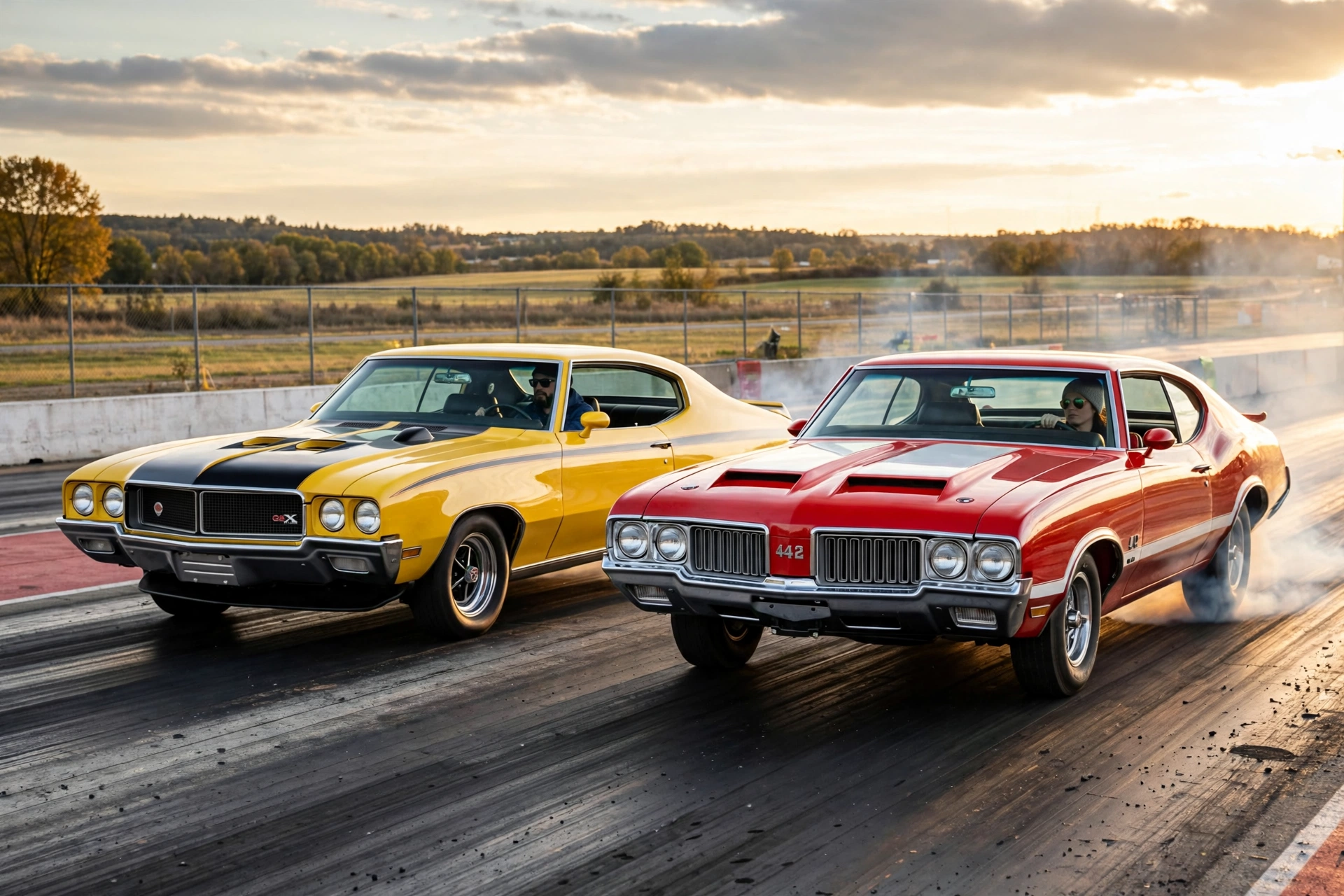
    This morning’s reel asked the question with tyre smoke instead of words: a 1970 Buick GSX Stage 1 and a 1970 Oldsmobile 442 W-30, staged side by side at the lights, both with a 455-cubic-inch V8 under the hood. Same displacement, same GM A-body platform, same model year — and two completely different attitudes about what a muscle car should be. The Buick was the torque monster nobody saw coming. The Oldsmobile was the gentleman’s brawler. Both were underrated on paper, and both were faster than their badges admitted.

    The Buick: the torque champion

    The GSX debuted in 1970 as an appearance package on the Buick GS 455, and it did not whisper. Saturn Yellow or Apollo White only, black hood stripes, a rear spoiler, and a blacked-out grille — it looked like a gentleman’s express and ran like a brawler. Buick built just 678 GSX coupes in 1970. The Stage 1 option on top of that added larger valves, 10.5:1 compression, a hotter cam and a specially tuned Quadrajet carburettor, for $199.05 on a $3,283 GS 455 coupe. Officially it made 360 horsepower — just 10 more than the standard 455. But the number that mattered was the torque: 510 lb-ft at only 2,800 rpm, the highest torque figure of any American production car at the time, a record that stood until the Dodge Viper’s V10 arrived. On the dyno, Stage 1 engines went around 400 horsepower. On the street, the GSX Stage 1 ran 0–60 mph in about 5.5 seconds — quicker than cars with far louder reputations.

    The Oldsmobile: the gentleman’s brawler

    The 442 W-30 took the opposite route to the same destination. The W-30 package added a fibreglass ram-air hood, an aluminium intake, a hotter cam, revised heads and red plastic inner fenders to save weight. The 455 made 370 horsepower and 500 lb-ft of torque on paper, and like the Buick, it made more than that on a dyno, comfortably into 400-horsepower territory. Oldsmobile built just over 2,500 W-30 hardtops for 1970. It was the refined member of the GM muscle family — upscale interior, premium comforts, a car that handled better than most of its rivals — and it still ran 0–60 in about 6 seconds and the quarter-mile in the high 13s. The W-30 is the connoisseur’s pick: people who have owned several of these cars tend to keep the Olds.

    Same displacement, different attitude

    So which one wins the duel? On the spec sheet, the Buick has the torque and the rarity — 678 GSX coupes against a few thousand W-30s — and the quicker launch. The Oldsmobile has the horsepower, the handling and the polish. On the strip, it came down to the driver and the tyres, which is exactly why the duel format works: there is no wrong answer, only a favourite. That is the same reason our Chevelle vs Road Runner duel from Day 6 ended in a dead heat — when two cars are this evenly matched, the vote is about character, not numbers.

    Both cars also belong on any honest list of the decade’s best — our Top 10 Muscle Cars of the 1970s has the GSX Stage 1 at number three and the 442 W-30 at number six, and neither ranking would surprise anyone who has driven one. The Buick embarrassed cars with louder reputations. The Oldsmobile outclassed them. GM built both in the same year, on the same platform, with the same 455 cubic inches — and let its own divisions fight it out in the showroom.

    This morning’s reel asked it first — Comment 1 for the GSX, 2 for the 442. Watch the burnout, listen to both big-blocks, then tell us: same displacement, different attitude. Which one are you taking home?

    Sources

    Specifications, production figures and test results in this article were checked against:

  • First Wash in 20 Years: The 1970 Pontiac Trans Am That Time Forgot

    First Wash in 20 Years: The 1970 Pontiac Trans Am That Time Forgot

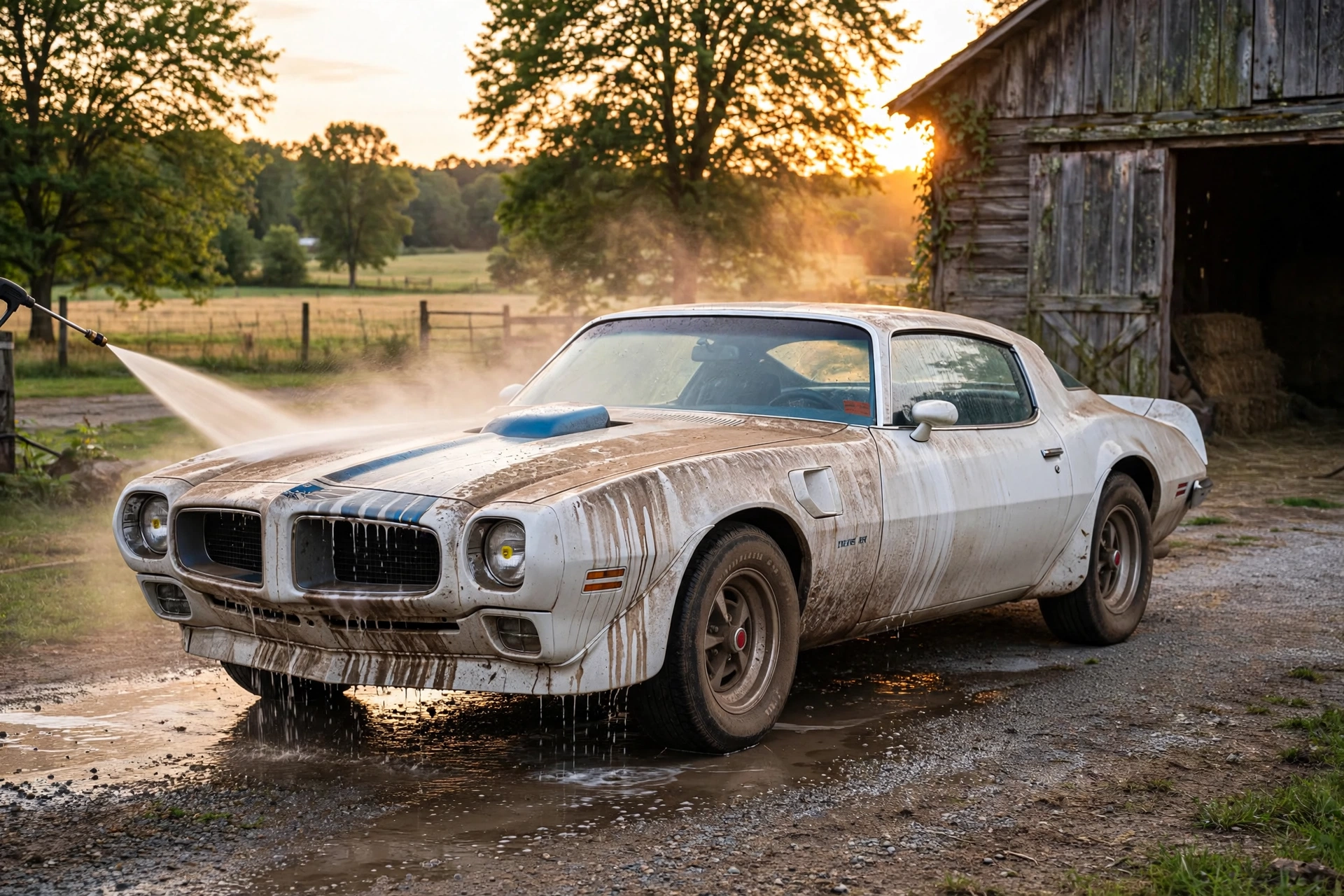
    There is nothing more satisfying than watching decades of dust wash off a true classic — and tonight’s reel is ten seconds of exactly that. A pressure washer peels twenty years of grime off a 1970 Pontiac Trans Am, and with every pass, the car underneath gets sharper: Polar White paint, blue stripes, the shaker hood scoop shaking with the engine. But the wash is only the beginning of the story, because what makes this car special was decided on the factory floor in 1970, not in the barn.

    One of 3,196 — and a first-year car

    The 1970 Trans Am is the first year of the second-generation Firebird, introduced mid-year — a 1970½, in collector shorthand. Pontiac built just 48,739 Firebirds for 1970, and only 3,196 of them were Trans Ams. That makes it one of the rarest Trans Ams of any year, and the short production run was no accident: the new Camaro and Firebird arrived so late that the model year was cut short. Of those 3,196 cars, 2,150 were sprayed Polar White with blue stripes and 1,046 were Lucerne Blue with white stripes. There were only two colours. Pick one, and you had already joined a very small club.

    Ram Air III standard, Ram Air IV almost mythical

    Every 1970 Trans Am left the factory with a 400-cubic-inch V8, and the standard engine was the Ram Air III: 345 horsepower and 430 lb-ft of torque, breathing through the rear-facing shaker scoop that moved with the engine. The optional engine was the Ram Air IV — 370 horsepower, bigger ports, better heads, swirl-polished valves and an aluminium intake — and almost nobody ordered it. Pontiac built 3,108 Trans Ams with the Ram Air III and just 88 with the Ram Air IV. Less than three percent of production got the engine the car was named for. In period testing, a Ram Air III four-speed ran 0–60 mph in 5.7 seconds and the quarter-mile in 14.1 seconds. One small detail collectors love: 1970 was the only year the shaker scoop carried no engine designation at all.

    It is the same lesson as our 1969 Charger R/T barn find — the dust makes every forgotten car look equally romantic, but the factory paperwork decides what it is really worth. A numbers-matching Ram Air IV car is a six-figure discovery. A Ram Air III car with its original engine, a readable build sheet and solid floors is still a serious one.

    Wash it — or keep the patina?

    That is the question tonight’s reel is really asking, and it is the same argument every barn find starts. Wash it and you get the gleam: the white paint, the blue stripes, the car Pontiac actually built. Keep the dust and you keep the story — twenty years of sitting still, untouched, exactly as found. Our advice is the same as it was for the Mustang Mach 1 that waited forty years in the dark: wash it, but do not restore anything until you know what you have. Check the numbers first — is the engine the one the car left the factory with? Check the rust — floors, frame rails and lower quarters, where dust and damp work together for decades. And check the paperwork, because a genuine 1970 Trans Am with a clean title and its original 400 is a restoration. The same car with a swapped engine and rotten floors is a parts donor wearing a good story.

    The pressure washer does not answer any of those questions. It just strips away the twenty years so you can finally see the car you are asking them about. And for a first-year Trans Am — one of 3,196, with a shaker scoop and a rear spoiler and a shape Pontiac would ride for another decade — what it reveals is worth the wait.

    Tonight’s reel shows the first wash in twenty years — watch it, then tell us in the comments: would you restore it to showroom shine, or keep the patina and drive it exactly as found?

    Sources

    Specifications, production figures and test results in this article were checked against:

  • From Dust to Gleam: The 1969 Charger R/T Barn Find — and What the Dust Was Hiding

    From Dust to Gleam: The 1969 Charger R/T Barn Find — and What the Dust Was Hiding

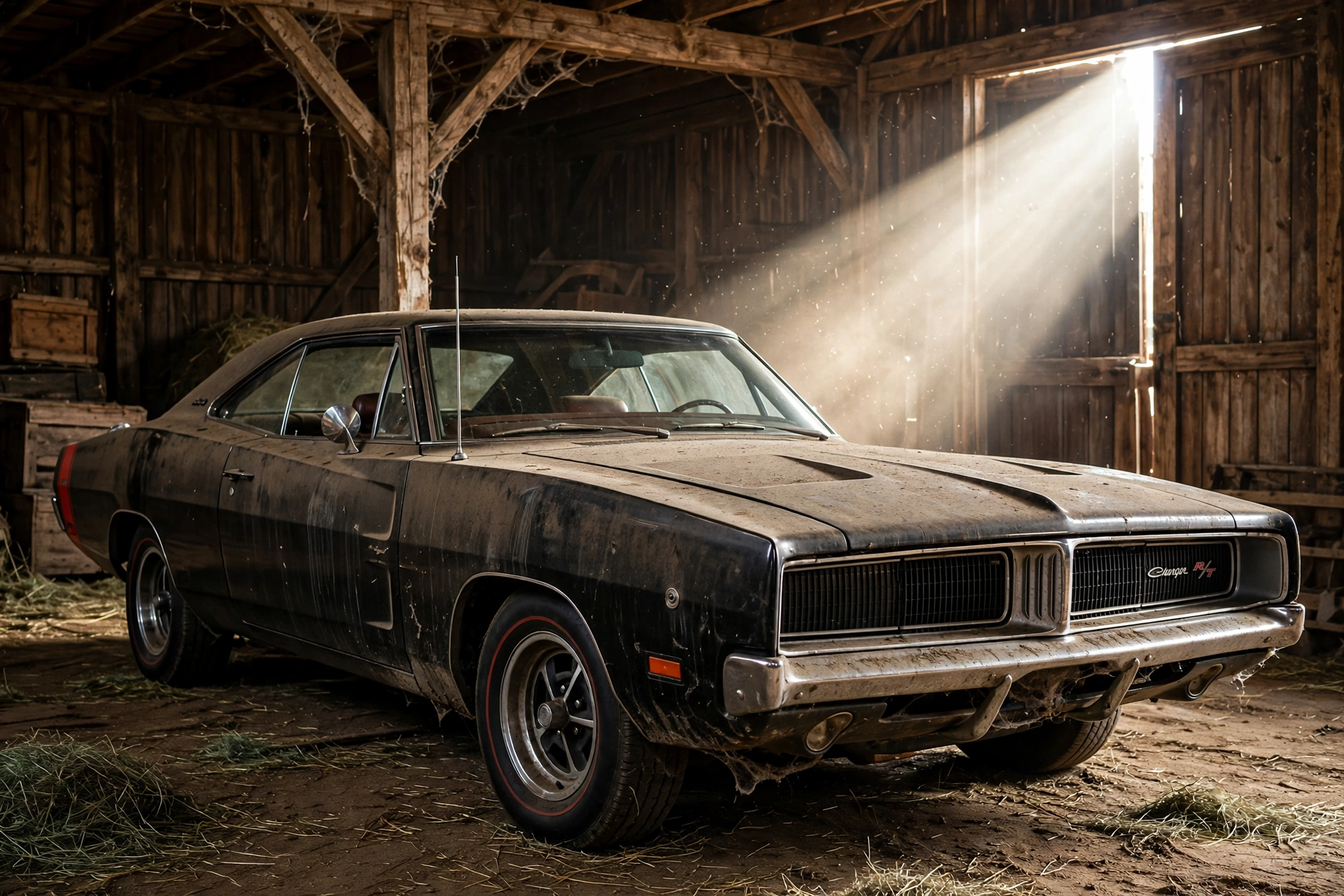
    Every barn find starts the same way: a door that has not opened in years, a shape under a tarp or a layer of dust, and the same question — is this a treasure, or just an old car that somebody gave up on? Tonight’s reel shows both ends of that story in ten seconds: a 1969 Dodge Charger R/T, filthy and forgotten, and then the same car gleaming, restored, alive again. The transformation is the hook. The car underneath is the reason it matters.

    It is not the first barn find we have covered — a Mustang Mach 1 waited forty years in the dark before anyone opened its barn door. But the Charger is a different kind of discovery, because what makes it valuable was decided on the factory floor in 1969, not in the barn.

    What the R/T actually is

    The 1969 Charger R/T is the performance version of the second-generation Charger — the restyled car that turned a slow seller into a hit, with production jumping to 96,100 cars in 1968 after just 15,788 the year before. R/T stands for Road/Track, and unlike plenty of performance badges of the era it came with real hardware: a heavy-duty suspension with stiffer torsion bars and a rear stabiliser, bigger brakes, heavy-duty shocks, dual exhausts with chrome tips, and the bumblebee stripe around the tail.

    440 standard, Hemi rare

    Under the hood, every R/T left the factory with the 440 Magnum as standard: 440 cubic inches, a single four-barrel carburettor, 375 horsepower and 480 lb-ft of torque. The only optional engine was the 426 Street Hemi — 425 horsepower and 490 lb-ft from two four-barrel carburettors — and almost nobody ordered it. Dodge built just over 20,000 Charger R/Ts for 1969, but only 432 of them got the Hemi: 208 with the TorqueFlite automatic, 224 with the four-speed manual. That is why a dusty Hemi car is a six-figure discovery and a dusty 440 car is still a serious one. In period testing, Motor Trend recorded a 440 automatic R/T doing 0–60 mph in 6.1 seconds and the quarter-mile in 13.9 seconds at 101.4 mph. The Hemi’s rarity is the same story we told in our Battle of the Big Three cold-start comparison, where the 426 Hemi was the Mopar entry.

    Four questions before a single bolt turns

    But the dust hides the questions that decide whether a barn find is worth restoring at all. First: is it numbers-matching — does the engine in the car match the car it left the factory in? Second: is the fender tag still there, and does it say R/T, or is this a base Charger wearing an R/T stripe? Third: where is the rust — floors, frame rails and the lower quarters, the places dust and damp work together for decades. And fourth, the least glamorous and most decisive: is there a clean title? A genuine R/T with its original 440, a readable tag and solid rails is a restoration. The same car with a swapped engine, a missing tag and rotten floors is a parts donor wearing a good story.

    That is the real before and after. The dust makes every barn find look the same — mysterious, romantic, full of promise. The gleam at the end of tonight’s reel is not just polish. It is the answer to all four questions coming back yes, one expensive bolt at a time.

    Tonight’s reel shows the dust and the gleam — watch it, then tell us in the comments: you open the barn doors and find THIS. What is the first thing you do?

    Sources

    Specifications, production figures and test results in this article were checked against:

  • 340 Six Pack: The Small-Block That Scared the Big-Blocks

    340 Six Pack: The Small-Block That Scared the Big-Blocks

    On paper, the 340 Six Pack should not have been a threat. It was a small-block — 340 cubic inches against the 426 Hemi’s 426 and the 454’s 454 — rated at just 290 horsepower, a number the big-blocks laughed at. But the paper lied, and everybody in 1970 knew it. The Six Pack was three Holley two-barrel carburettors on an Edelbrock intake, feeding a high-revving 340 that made far more than its rating — estimates put real output over 320 horsepower — and it came in two cars built for one purpose: to get Mopar into the SCCA Trans Am series.

    Trans Am rules capped engines at 305 cubic inches, so Chrysler’s race engineers destroked the 340 to 303.8 cubic inches. With new cast-iron heads with massive ports and race internals, the racing version made over 460 horsepower — more than the 426 Street Hemi’s official 425. To qualify, the rules demanded showroom cars, so Dodge and Plymouth each built a street version in spring 1970: the Dodge Challenger T/A, named for Trans Am, and the Plymouth AAR ‘Cuda, named for Dan Gurney’s All American Racers team. Both were one-year-only cars. Plymouth built 2,724 AAR ‘Cudas in about five weeks, March to April 1970; Dodge built 2,399 Challenger T/As.

    The Street Cars: Challenger T/A and AAR ‘Cuda

    The AAR ‘Cuda is the racing cousin of the 1970 Plymouth ‘Cuda we covered on Day 4 — same Barracuda body, but built to turn rather than just to go straight. The street cars got the full treatment, not just a badge. Both had the 340 Six Pack (Plymouth called it the Six Barrel, same hardware), a functional fibreglass hood with a big flat-black scoop, a rear spoiler, side-exit exhausts that dumped ahead of the rear wheels — the sound this morning’s reel is duelling over — stiffer suspension with heavy-duty torsion bars and bigger sway bars, and staggered tyres, bigger at the back than the front. They were built to turn, not just to go straight, which made them strange and wonderful in a muscle-car world obsessed with the quarter-mile.

    Why the Six Pack Still Matters

    It did not work, at least not on the track. Neither car fared well in the 1970 Trans Am season, and Mopar pulled out after a single year. The T/A and the AAR became history in the same season they were born. But that failure is exactly why they matter now: 2,399 and 2,724 cars, one year, one racing rule, and an engine that was always better than its badge claimed. The big-blocks won the horsepower war on paper. The Six Pack won the argument that a small-block, breathing through three carburettors and shouting through side pipes, could scare them anyway.

    This morning’s reel asked it first — Comment 1 for Challenger T/A, 2 for AAR ‘Cuda. Listen to both exhaust notes, then tell us: which side pipe sounds meaner? If you enjoy a good head-to-head, our Chevelle vs Road Runner duel from Day 6 ended in a dead heat — see if this one does too.

    Keep Reading

    Sources

    Specifications, production figures and test results in this article were checked against:

  • Three Cold Starts, One Question: Which V8 Sounds Best — Ford, Chevy or Mopar?

    Three Cold Starts, One Question: Which V8 Sounds Best — Ford, Chevy or Mopar?

    A cold start is the most honest sound a muscle car ever makes. No warm-up, no choke fully off, no exhaust yet hot enough to hide anything — just a big V8 clearing its throat on a cold morning, fast idle, thick vapour, and the whole neighbourhood knowing exactly what you drive. Tonight’s reel lines up three of them, one from each of the Big Three, and asks you to vote 1, 2 or 3. Here is the case for each side.

    1 — Ford: the Boss 429. Ford’s entry is the most exotic engine of the three. The 429 cubic-inch Boss V8 was a race design built to satisfy NASCAR’s homologation rules: aluminium heads with semi-hemispherical combustion chambers — the “semi-hemi” — four-bolt main caps, a forged steel crank and forged rods, and a 735 CFM Holley four-barrel. Ford rated it at 375 horsepower, but everyone at the time understood the real figure was near 500. Only 859 were built for 1969, each one hand-finished by Kar Kraft because the engine was too big for a standard Mustang engine bay. On a cold start it is the highest-strung of the three — a sharp, metallic bark that settles into an impatient, cammy idle. It sounds like a race engine because that is what it is: the street car existed only so the engine could race.

    2 — Chevy: the LS6 454. Chevrolet’s answer is displacement and torque. The 1970 Chevelle SS 454 in LS6 form made 450 horsepower and 500 lb-ft of torque — the most powerful stock big-block Chevrolet ever built, and a one-year-only option. Where the Boss 429 screams, the LS6 thunders: it is widely remembered for one of the deepest exhaust notes ever fitted to a production muscle car, a slow, thunder-like rumble at idle that explodes into a booming roar under throttle. On a cold morning it is the one you feel in your chest before you hear it properly. It does not need to rev to make its point — it just needs to idle.

    3 — Mopar: the 426 Hemi. Chrysler’s 426 Hemi is the legend the other two were built to beat. 425 horsepower and 490 lb-ft from hemispherical combustion chambers — the design that gave the engine its name — and an exhaust pulse so deep and slow that at idle the whole car shakes visibly. The Hemi’s sound is primal rather than refined: a thunderous, loping idle that turns into a raw bellow the moment the throttle opens. It is the engine Ford built the Boss 429 to take on at the superspeedways, and the one every bench race in 1970 eventually came back to.

    So which one wins tonight? There is no wrong answer — that is the point of the vote. The Ford is the rarest and the most race-bred, the Chevy is the deepest and the most powerful on paper, and the Mopar is the one that made the other two necessary. Listen to all three cold starts in tonight’s reel, turn the volume up, and vote with your ears, not your badge loyalty. Or vote with your badge loyalty — nobody will blame you.

    Watch tonight’s three cold starts on the page, then vote in the comments: 1 for Ford, 2 for Chevy, 3 for Mopar. Which V8 wakes the street best?

    Sources

    Specifications, production figures and test results in this article were checked against:

  • The 1969 AMC AMX 390: The Two-Seat Underdog That Punched Above Its Weight

    The 1969 AMC AMX 390: The Two-Seat Underdog That Punched Above Its Weight

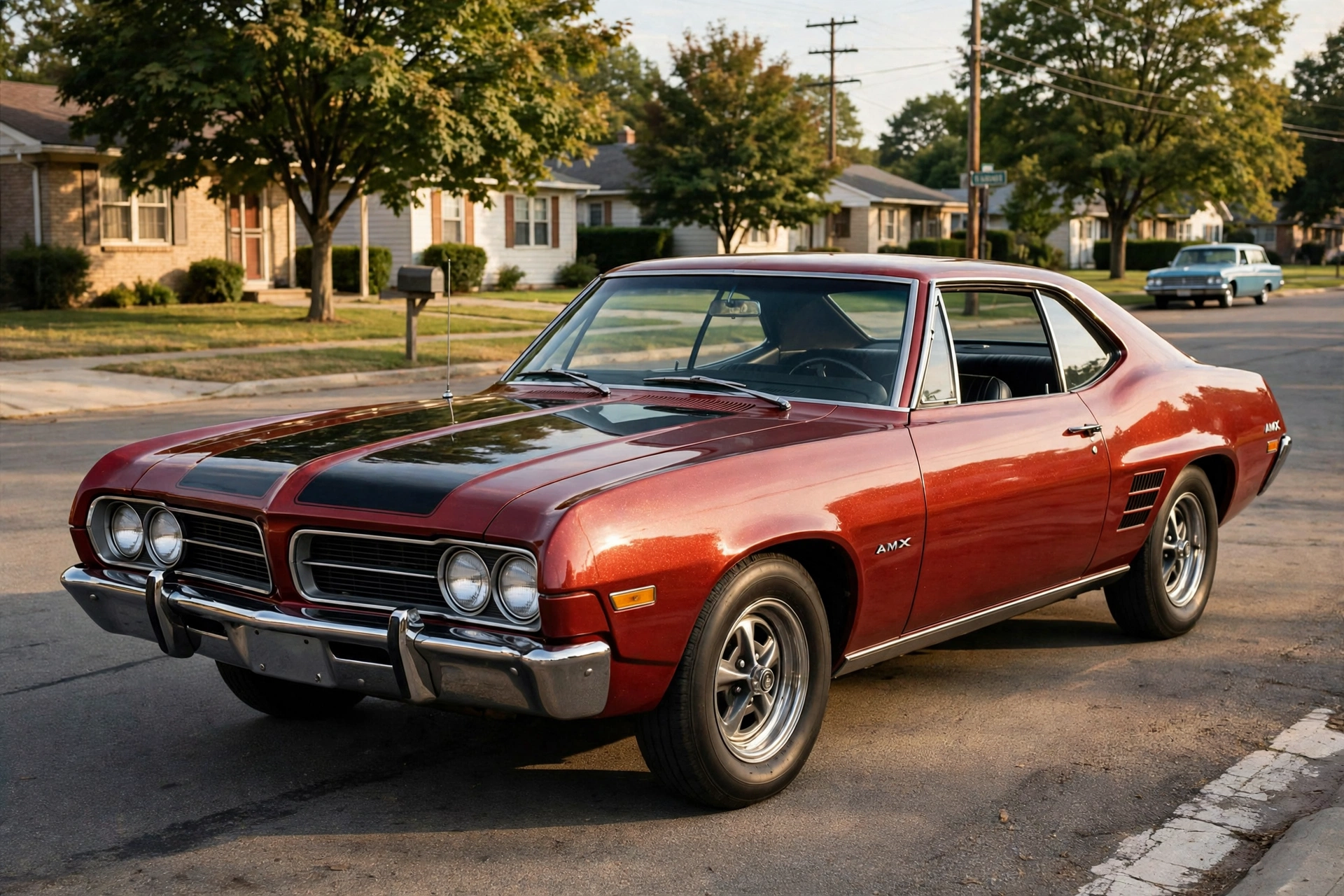
    In 1968, American Motors did something none of the Big Three would dare: it built a two-seat sports car. Not a shortened pony car, not a trim package — a genuine two-seater, on a 97-inch wheelbase, aimed squarely at the Chevrolet Corvette. From 1968 to 1970, exactly two American production cars seated two people: the Corvette and the AMX. AMC built just 19,134 of them in three model years — 6,725 in 1968, 8,293 in 1969, and 4,116 in 1970 — which makes every surviving AMX rarer than almost any Mustang or Camaro of the same era.

    The 390: AMC’s Biggest Hammer

    The 1969 car in this morning’s reel is the one to have: the AMX 390. The 390-cubic-inch (6.4-litre) V8 was the top engine in the range, rated at 315 horsepower at 4,600 rpm and 425 lb-ft of torque at 3,200 rpm, with a 10.2:1 compression ratio and a single Carter four-barrel carburetor. It was a serious piece for the money — a forged steel crankshaft and forged connecting rods at a time when plenty of competitors were casting theirs. In 1969, 3,620 buyers paired the 390 with a four-speed manual and 2,183 with the three-speed automatic. Add the Go Package — $311 covering the 390, power disc brakes, redline tyres, a handling package, a Twin-Grip differential and heavy-duty cooling — and you had a complete performance car for about $3,681, on a base price of $3,297.

    It was quick, too, and not just on paper. Motor Trend’s road test of a 390 four-speed AMX recorded 0–60 mph in 6.9 seconds and the quarter-mile in 15.2 seconds at 92 mph — in a car weighing barely over 3,000 pounds. That is the AMX’s real trick: it did not need the biggest engine in Detroit, because it did not carry the most weight. The short wheelbase and light body made it feel closer to a sports car than a muscle car, which is exactly what AMC’s designer Dick Teague intended.

    Why It Stayed the Underdog

    So why is it still the underdog? AMC never had Ford’s or GM’s megaphone, and the AMX never got a second act — the two-seater died after 1970, and the Javelin carried on alone. But that is also the appeal. The 1969 AMX 390 is a car that had to be good to exist at all: no heritage to trade on, no massive dealer network, just a small company betting everything on 97 inches of wheelbase and 390 cubic inches. This morning’s reel shows the engine bay because the engine bay is the argument — open it, and the smallest car company in Detroit suddenly looks like it belonged in the fight.

    This morning’s reel asked it first — Comment 1 for AMX, 2 for JAVELIN. Watch the 390 under the hood, then tell us: does the underdog deserve a place next to the Corvette?

    Keep Reading

    Sources

    Specifications, production figures and test results in this article were checked against:

  • Listen to That 429 Scream: The 1969 Boss 429 Mustang Was a NASCAR Engine With Licence Plates

    Listen to That 429 Scream: The 1969 Boss 429 Mustang Was a NASCAR Engine With Licence Plates

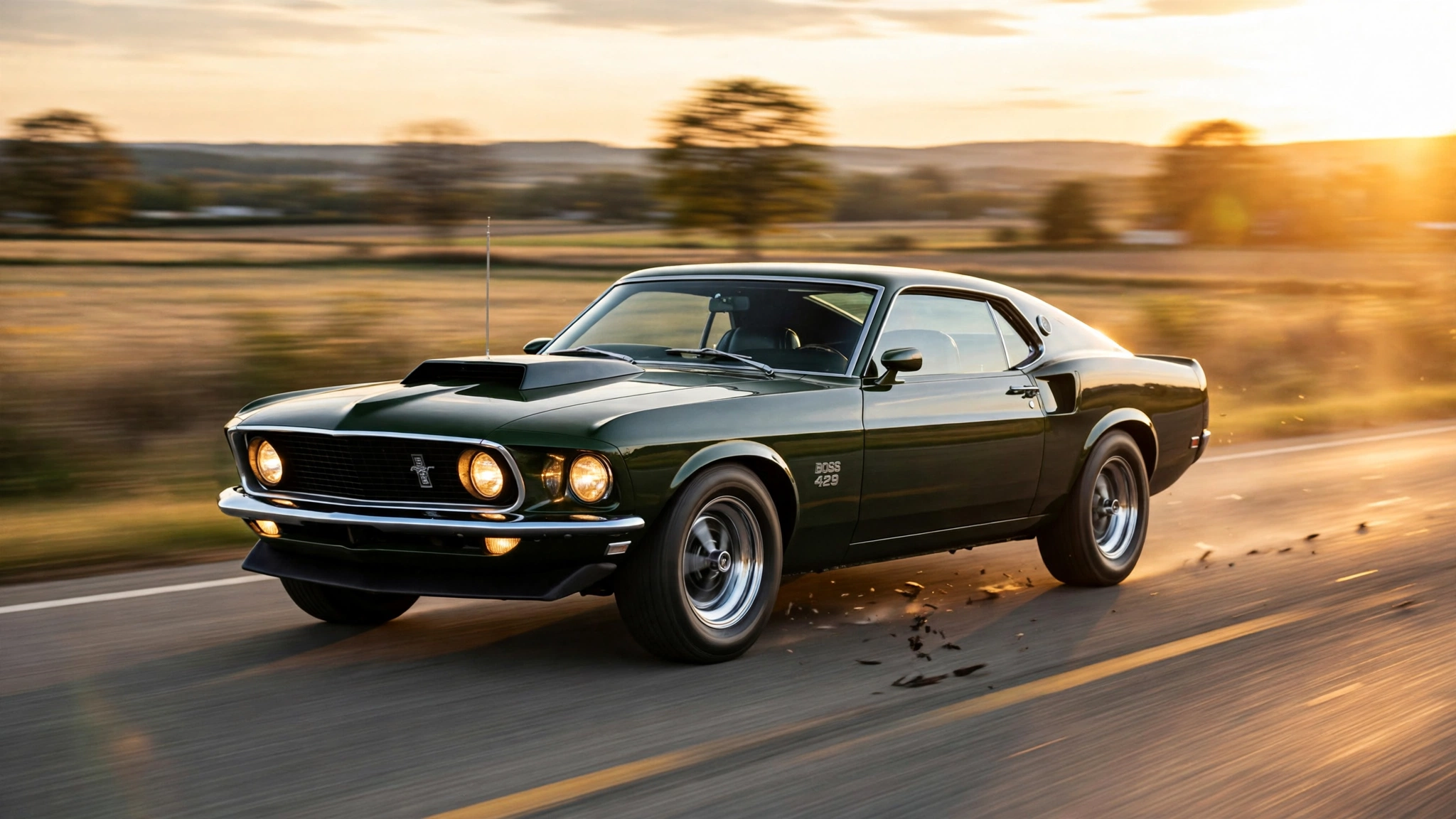
    Some muscle cars were built to sell. The 1969 Boss 429 Mustang was built to qualify. NASCAR’s homologation rules said Ford had to put at least 500 street cars with its new 429 engine on the road before it could race the engine — so Ford did exactly that, and not one car more than it had to. Only 859 Boss 429 Mustangs were built for 1969, with another 499 for 1970.

    The engine was the whole point. The 429 cubic-inch (7.0-litre) Boss V8 was a race design from the start: aluminium cylinder heads with semi-hemispherical combustion chambers — the “semi-hemi” — four-bolt main caps, a forged steel crank and forged steel connecting rods, and a 735 CFM Holley four-barrel on an aluminium intake. Ford rated it at 375 horsepower at 5,200 rpm and 450 lb-ft of torque at 3,400 rpm, figures everyone at the time understood were conservative. Period tests and insider estimates put the real output near 500 horsepower, with quarter-mile times around 14 seconds.

    It was so big it did not fit. A standard Mustang engine bay could not take the Boss 429, so Ford sent partially built bodies from its Rouge plant to Kar Kraft, its specialist contractor in Brighton, Michigan — the same outfit that had helped build the Le Mans-winning GT40. Kar Kraft widened the space between the shock towers, revised the suspension geometry, relocated the battery to the trunk, and installed the engine by hand. Every finished car carried a Ford serial number plus a Kar Kraft “KK” number stamped on its door data plate. The 1969 cars ran hydraulic lifters; 1970 switched to solid lifters to stop valve float at high rpm.

    Ford’s target was never the Mustang itself. The homologated 429 went racing in Torino Talladegas and Mercury Cyclones on the superspeedways, making its NASCAR debut on 30 March 1969 at Atlanta with Cale Yarborough at the wheel — built to take on Chrysler’s 426 Hemi, the engine that had ruled the big ovals. The Mustang was simply the street car Ford chose to carry the engine into the showrooms, because no Torino could make the statement a Mustang could.

    That is what makes tonight’s reel worth ten seconds of your evening. The car in it is one of 859 — a hand-finished homologation special, a race engine wearing licence plates, sold through ordinary dealerships because a rulebook demanded it. Turn the volume up for the flyby, then answer the reel’s question honestly: would you drive it, or lock it in a museum?

    Watch tonight’s 1969 Boss 429 flyby reel on the page, then tell us in the comments: drive it, or lock it in a museum?

    Ford reference material

    Ford’s Mustang timeline lists the Boss 429 as a 375-horsepower addition to the 1969 lineup. Ford Performance’s engine history provides background on the 429 Boss and the related Ford big-block engines.

    Sources

    Specifications, production figures and test results in this article were checked against:

  • Chevelle vs Road Runner: The 1970 Duel That Ended in a Dead Heat

    Chevelle vs Road Runner: The 1970 Duel That Ended in a Dead Heat

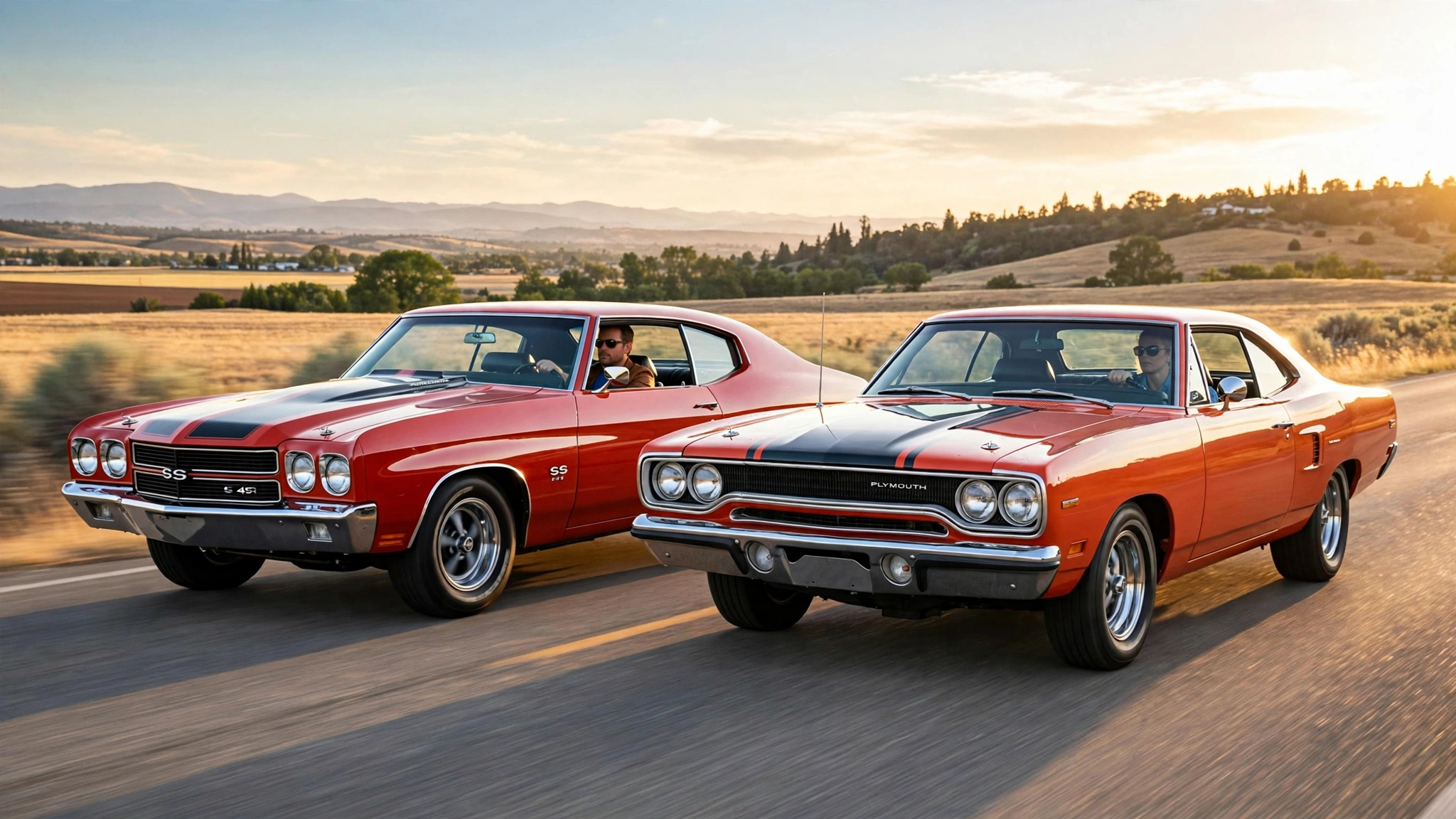
    1970 was the year the horsepower war peaked, and this duel is the proof. For years General Motors had banned engines over 400 cubic inches in its intermediate cars. When that ban lifted for 1970, Chevrolet finally gave the Chevelle the engine it had been waiting for: the 454. In LS5 form it made 360 horsepower; in LS6 form — a one-year-only option, produced only in 1970 — it made 450 horsepower and 500 lb-ft of torque, the most powerful stock big-block Chevrolet ever built.

    The Road Runner answered with choice instead of a single headline number. It was born in 1968 as a cheap, bare-bones speed machine — a $2,870 sticker price that left buyers money to spend on the engine — and by 1970 the menu ran from the standard 383 at 335 horsepower, through the 440 at 375, to the 440 Six Barrel at 390 horsepower and 490 lb-ft, and finally the 426 Street Hemi at 425 horsepower and 490 lb-ft. The Six Barrel is the clever pick in this fight: three two-barrel carburetors, Hemi-matching torque, and a $250 option price against $841 for the Hemi — near-Hemi speed for a third of the money.

    So who actually won? The period timing slips refuse to pick a side. Hot Rod magazine ran a stock LS6 Chevelle through the quarter-mile in 13.44 seconds, and period tests put the Hemi Road Runner right beside it. Car Craft went quicker still in the Chevelle, 13.12 seconds at 107 mph, while the 440 Six Barrel Road Runner was clocked around 13.5 seconds, again essentially the same car. Different days, different tracks, different drivers — but every serious test lands both cars in the low 13s, and that is the real result: on horsepower the Chevelle wins by 25, on the clock nobody wins.

    That is the argument this morning’s reel is having, ten seconds at a time. Two 1970 big-blocks, side by side, full car and movement from the first second — the exact format that works, after the static tachometer reel on Day 4 stalled at 575 views. Watch it, pick your side, and be honest about why: the numbers, or the noise?

    This morning’s reel asked it first — Comment 1 for CHEVELLE, 2 for ROAD RUNNER. Cast your vote on the page, then tell us: which one are you taking home?

    Sources

    Specifications, production figures and test results in this article were checked against: