Author: Chris Flournoy

  • Plum Crazy: The Colour That Made the 1970 Challenger R/T Impossible to Ignore

    Plum Crazy: The Colour That Made the 1970 Challenger R/T Impossible to Ignore

    Dodge arrived late to the pony-car fight, and it arrived loud. The Challenger debuted for 1970 on the new E-body platform — the same bones as the Plymouth ‘Cuda — with a long hood, a short deck, and room under it for almost every engine Chrysler made. The R/T, Road/Track, was the performance model, and it came standard with the 383 Magnum: 335 horsepower and 425 lb-ft of torque.

    The Engine Ladder

    The ladder above it was pure Mopar. The 440 Magnum added 40 horsepower and 55 lb-ft, to 375 horsepower. The 440 Six-Pack — three two-barrel carburetors — made 390 horsepower and 490 lb-ft. And at the top, the 426 Hemi: 425 horsepower and 490 lb-ft, officially, in a figure everyone understood was underrated, good for 0–60 mph in 5.8 seconds and a 14.1-second quarter-mile. Only 356 Challengers left the factory with a Hemi in 1970, which is why a documented Hemi car is now one of the most valuable muscle cars on earth.

    The Paint: Plum Crazy, Code FC7

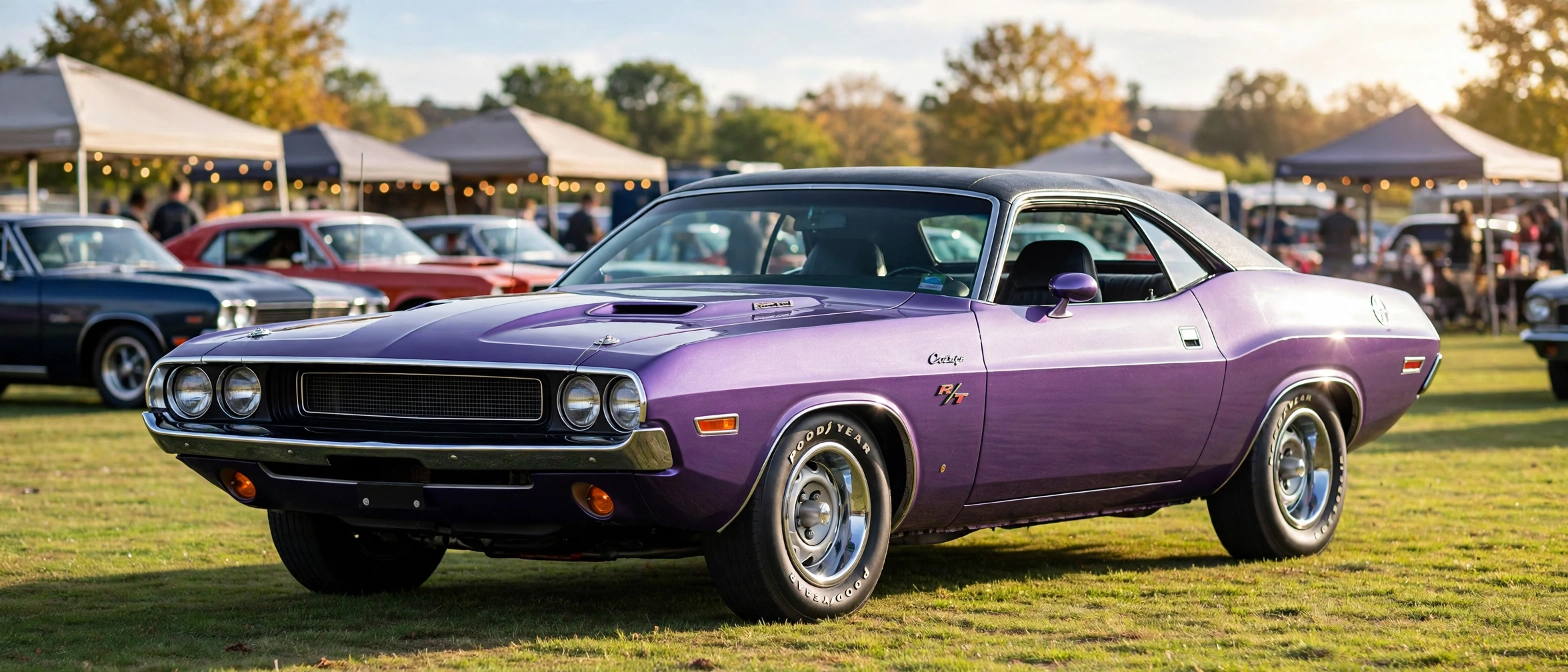
    But the engine is only half of this morning’s reel. The other half is the paint. Plum Crazy — factory code FC7 — was one of Chrysler’s High-Impact colours, a $14 option in 1970 alongside Sublime green, Go Mango, Hemi Orange, Panther Pink and Top Banana. The idea was simple: paint so saturated it could be seen from a quarter-mile away, with a name to match. Plum Crazy was sprayed over a white primer, which is what keeps the purple bright instead of muddy — a detail restorers still get wrong when they use a grey or black base. The R/T added its own jewellery around it: the twin-scoop hood with engine call-outs, chrome gas cap, R/T badging on the grille, fenders and trunk, and the Hurst Pistol Grip shifter inside.

    It worked. Fifty-five years later, a Plum Crazy Challenger still stops people at a car show before they have read a single badge — which is exactly what this morning’s reel shows, chrome first, engine second. And the vote in that reel is the same argument Dodge started in 1970: Plum Crazy, or Hemi Orange?

    This morning’s reel asked it first — Comment 1 for Plum Crazy, 2 for Hemi Orange. Cast your vote on the page, then tell us: which High-Impact colour would you order today?

    Keep Reading

    Sources

    Specifications, production figures and test results in this article were checked against:

  • How Much Tire Life Is Left? The 1968 Camaro SS and the Art of the Burnout

    How Much Tire Life Is Left? The 1968 Camaro SS and the Art of the Burnout

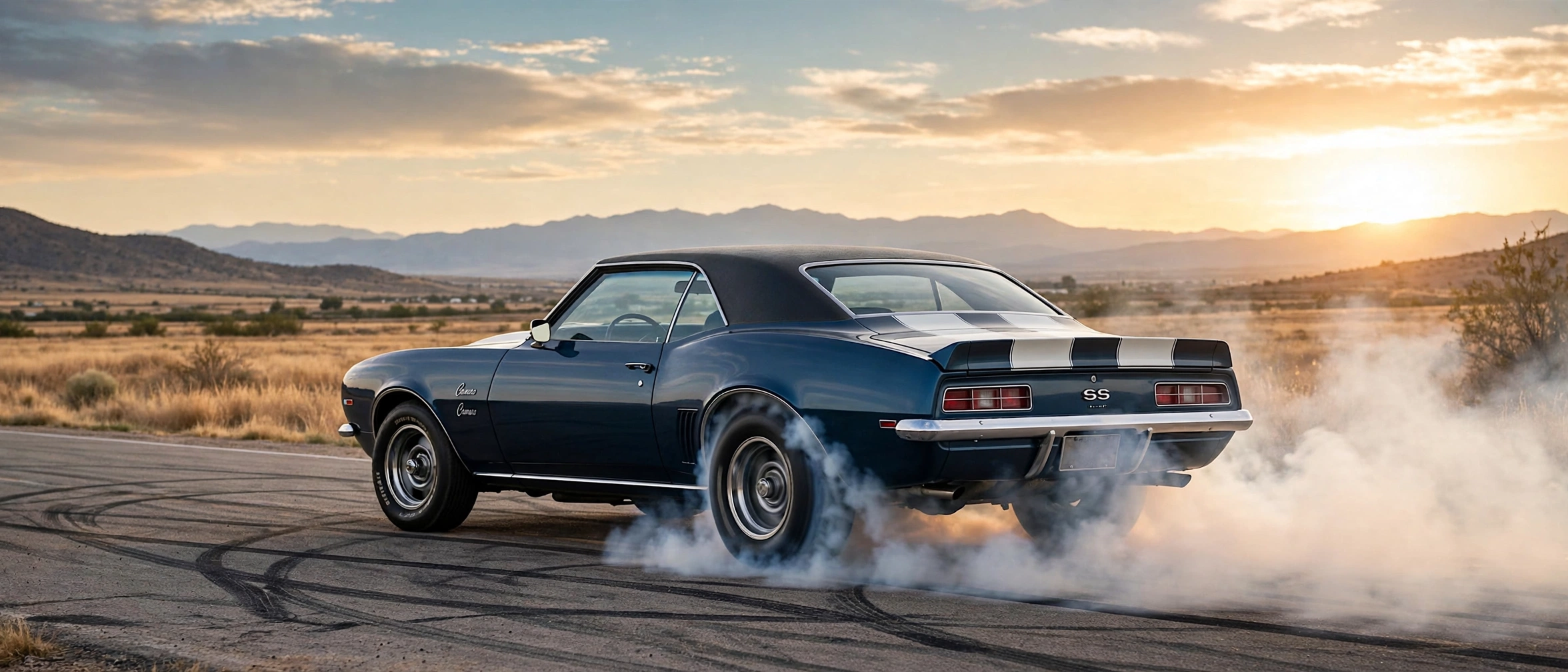
    A burnout looks like showing off, and it is — but it started as work. On a drag strip, spinning the rear tyres cleans them and heats the rubber until it grips, and on the street it became the loudest possible way to say what is under the hood. The 1968 Camaro SS had plenty to say.

    The SS was an option package, not a separate model, and in 1968 it came with a real choice. The base SS350 carried the new-for-1967 350 small-block, rated at 295 horsepower and 380 lb-ft of torque. Step up to the SS396 and there were three big-blocks to pick from: the 325-horsepower L35, the 350-horsepower L34 — new for 1968 — and the 375-horsepower L78 with its solid-lifter cam, 11:1 compression and Holley four-barrel. The rarest of all was the L89, the L78 fitted with aluminium cylinder heads: only 272 were built in 1968. Every SS came with a four-barrel carburetor and dual exhaust as standard, plus the bumblebee nose stripe, blacked-out grille and simulated hood intakes that told everyone at the lights what they were looking at.

    The 1968 car matters for a burnout for a reason you cannot see in the smoke. The 1967 Camaro suffered from axle tramp — the rear axle hopping under hard acceleration — so for 1968 Chevrolet fitted multi-leaf rear springs in place of the single-leaf set-up and staggered the rear shock absorbers. It was a small, unglamorous fix, and it is exactly what lets a ’68 SS plant its tyres and spin them cleanly instead of juddering across the asphalt. Side marker lamps were the visible change for the year; the suspension was the one that mattered when the light went green.

    How many SS Camaros were built in 1968? Chevrolet’s engine records tell the story: 12,496 with the 350, 10,773 with the 325-horsepower 396, 2,579 with the 350-horsepower 396, 4,575 with the 375-horsepower 396, and 272 with the aluminium-head L89 version of it — 30,695 SS Camaros in all, out of about 235,000 Camaros that year. The SS was never rare, and that is part of the point: this was affordable, attainable muscle, built in numbers ordinary buyers could actually find and afford.

    Performance backed up the noise. A 396/325 SS had more than enough muscle to turn a set of rear tyres into smoke on demand. The top L78 cars were quicker still, into the high 13s in the quarter-mile.

    That is what tonight’s reel is: ten seconds, one Camaro, and a question with no wrong answer. Watch it, turn the volume up, and then be honest — how much tyre life is left?

    Watch tonight’s 1968 Camaro SS burnout reel on the page, then tell us in the comments: best burnout car ever — Camaro SS, or something else entirely?

    Sources

    Specifications, production figures and test results in this article were checked against:

  • Here Comes the Judge: The 1969 Pontiac GTO Judge

    Here Comes the Judge: The 1969 Pontiac GTO Judge

    Pontiac did not set out to build The Judge. The original plan was a cheap, stripped-down GTO — a budget drag-strip special with a 350 V8, aimed at the Plymouth Road Runner. Somewhere on the way to the showroom, the joke took over. Pontiac named it after the catchphrase from Rowan & Martin’s Laugh-In — “Here comes the Judge” — and built the loudest, proudest GTO it had ever made.

    The $337 Package

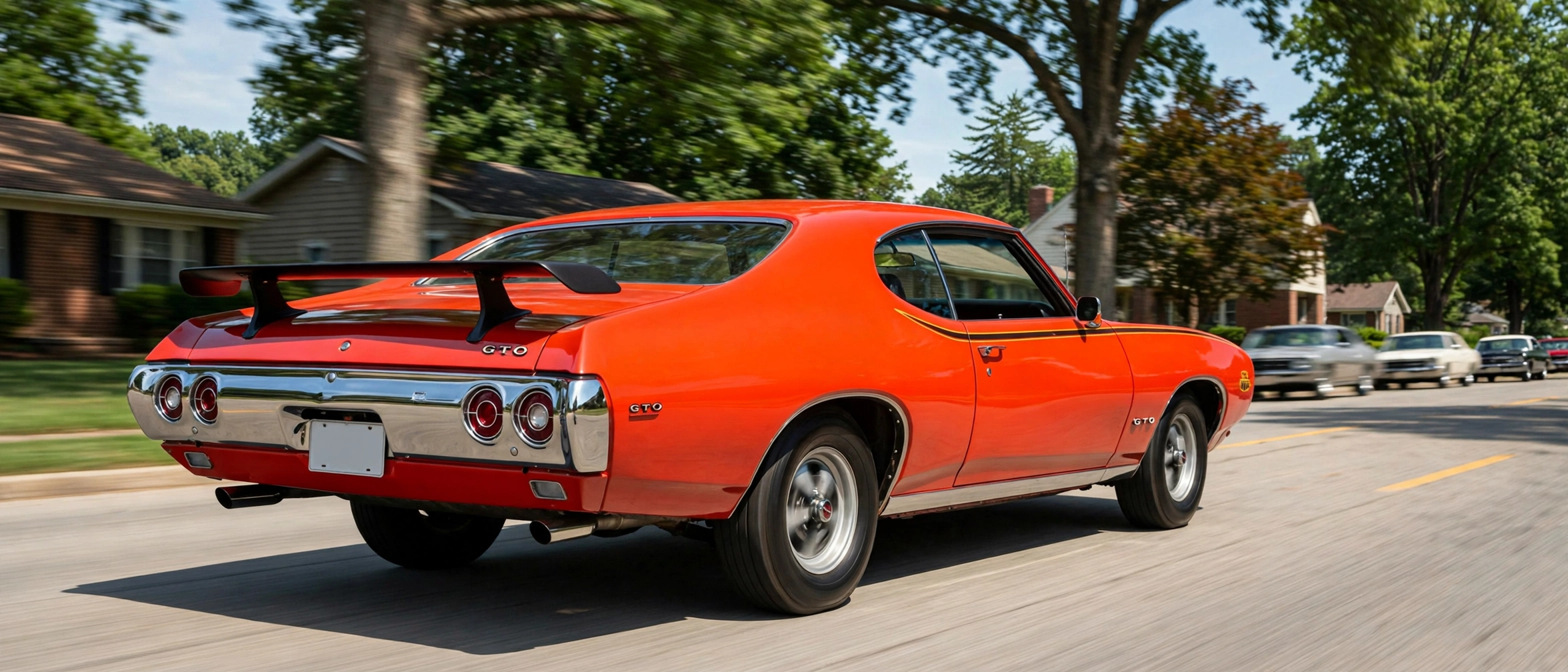
    The Judge package cost $337 on top of a 1969 GTO, and it spent the money where everyone could see it. The first cars were all painted Carousel Red — a bright orange-red borrowed from the Firebird — with tri-color side stripes, a body-color Endura front bumper, Rally II wheels without trim rings, and a 60-inch rear wing bolted to the decklid. It was impossible to miss, and that was the point.

    Ram Air III and Ram Air IV

    Underneath the show, the hardware was serious. The standard engine was the Ram Air III: a 400-cubic-inch V8 with a hot hydraulic cam, 10.75:1 compression and a Rochester Quadrajet, rated at 366 horsepower and 445 lb-ft of torque. The only engine option was the Ram Air IV at 370 horsepower. Functional hood scoops rammed cool air into the carburetor, and with the right gears the Judge was a consistent 14-second drag-strip performer — quick enough to back up every bit of the attitude.

    6,833 Built — 108 Convertibles

    Pontiac built 6,833 Judges for 1969: 6,725 hardtops and just 108 convertibles. The first roughly 2,000 cars were all Carousel Red before other GTO colors were allowed, which is why the orange-red Judge is the one everyone pictures. The Judge ran for only three model years — 1969 to 1971, 11,004 cars in total — and then it was gone, a victim of the same insurance rates and emissions rules that killed the whole muscle era.

    What survives is the idea: a car that refused to be subtle. The Judge did not whisper about performance. It wore stripes, a wing and a punchline, and then went out and ran the number. More than fifty years later, a Carousel Red Judge cruising down a sunny street still does what it did in 1969 — it makes everyone look.

    So here is the question the page will ask again on Day 7, when the Judge returns for the photo post: underrated or overrated? Be honest.

    Watch this morning’s Judge reel on the page, then tell us in the comments: underrated or overrated?

    Keep Reading

    Sources

    Specifications, production figures and test results in this article were checked against:

  • No EV Will Ever Sound Like This: The 1970 Plymouth ‘Cuda

    No EV Will Ever Sound Like This: The 1970 Plymouth ‘Cuda

    There is a sound no software update will ever reproduce. It is a big-block V8 climbing past 5,000 rpm through a pair of exhaust pipes, and the 1970 Plymouth ‘Cuda is one of the best places ever built to hear it.

    The ‘Cuda arrived in 1970 as a clean-sheet car. Plymouth threw out the old Valiant-based Barracuda and built the E-body from scratch — wider, lower, on a 108-inch wheelbase, designed from the start to swallow big engines. The range split in two: Barracuda was the standard car, and ‘Cuda was the performance model, with its own engines, suspension and attitude.

    The engine ladder tells the whole story. The base ‘Cuda carried a 383 big-block rated at 335 horsepower. Above it sat the 340 small-block at 275, the 440 four-barrel at 375, and the 440 Six Barrel — three two-barrel carburetors feeding 390 horsepower — the streetable monster. And at the top, the 426 Hemi: 425 horsepower on paper, fed by two four-barrel carburetors, a figure historians have long treated as a polite fiction for the insurance companies. A healthy street Hemi made at least that, and usually more.

    Fewer than 700 Hemi ‘Cudas were built for 1970, out of 55,499 Barracudas total. The Hemi was an $871 option in 1970 — roughly a third of what a basic new car cost outright — which is why most buyers took the 440 Six Barrel instead: nearly as quick in a straight line, and far easier to live with. Today that rarity is exactly why documented Hemi ‘Cudas trade for over a million dollars.

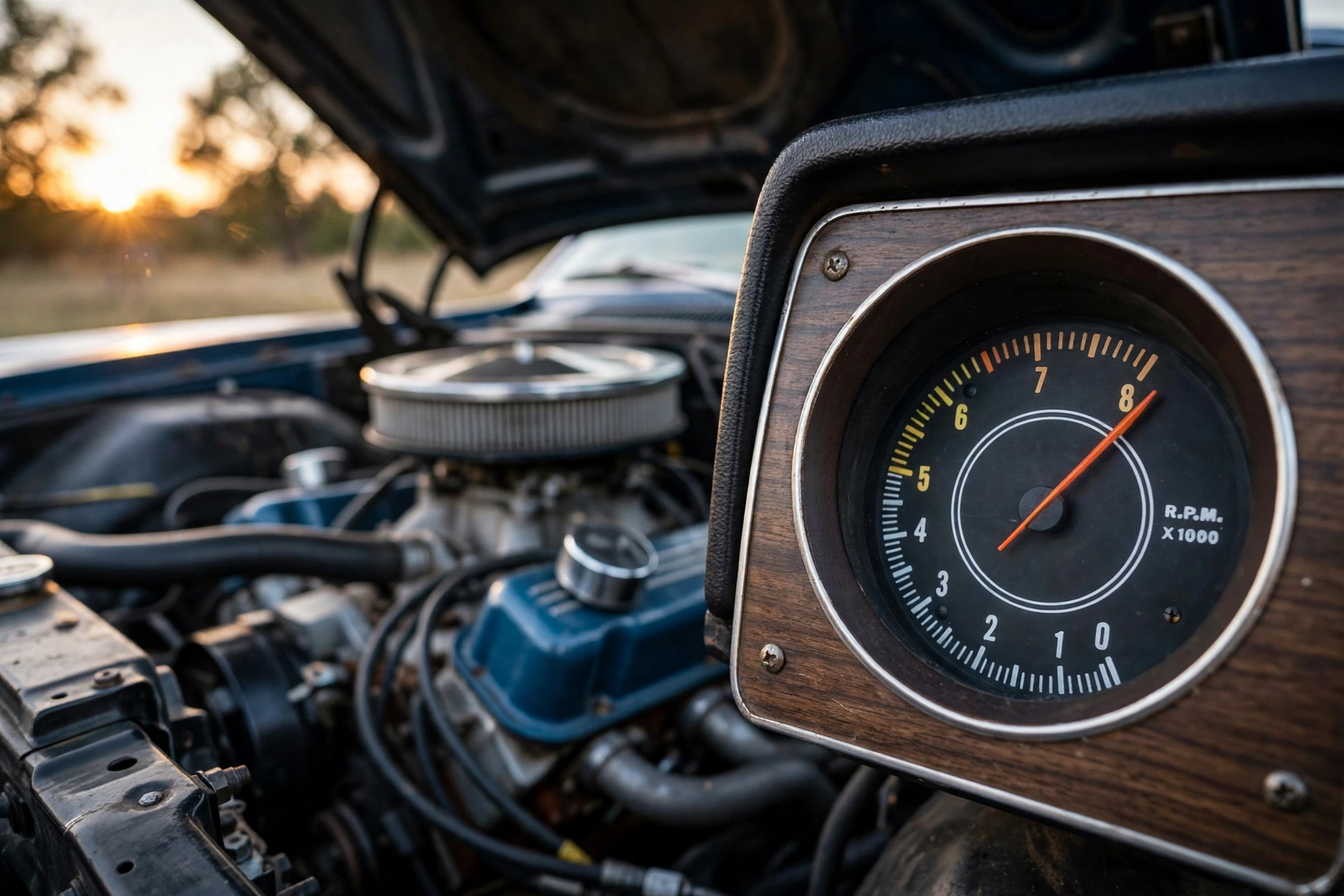
    But the numbers are only half the car. The other half is the noise. A ‘Cuda at full throttle is mechanical music: the lope of a solid-lifter cam at idle, the roar as the secondaries open, the crackle on the overrun. It is the sound of explosions happening 5,000 times a minute, three feet in front of you, with nothing between you and them but sheet metal. An electric car can be fast — faster, even — but it cannot be loud in the same way, because there is nothing in it exploding. The sound is the byproduct of the machine doing its work, not a soundtrack added afterwards.

    That is what tonight’s reel is: ten seconds of tachometer and throttle, no commentary needed. Watch it, turn the volume up, and then answer honestly — can anything electric replace this feeling?

    Watch tonight’s 1970 ‘Cuda reel on the page, then tell us in the comments: which V8 sound beats it — Hemi, 440 Six Pack, or something else entirely?

    Sources

    Specifications, production figures and test results in this article were checked against:

    Hagerty’s valuation page is cited here for production totals and the $871 Hemi option price; the Hemi’s 425 hp rating is sourced from Autoevolution.

  • 5 Real Muscle Cars You Can Still Buy Under $25,000

    5 Real Muscle Cars You Can Still Buy Under $25,000

    Watch enough auction coverage and you’d think classic muscle now starts at six figures. It doesn’t. The famous names got expensive; the honest cars didn’t — at least, not yet. Driver-quality examples of all five cars below still change hands under $25,000 in the US market. Here’s where the smart money starts.

    1. Chevrolet Nova (1968–1974)

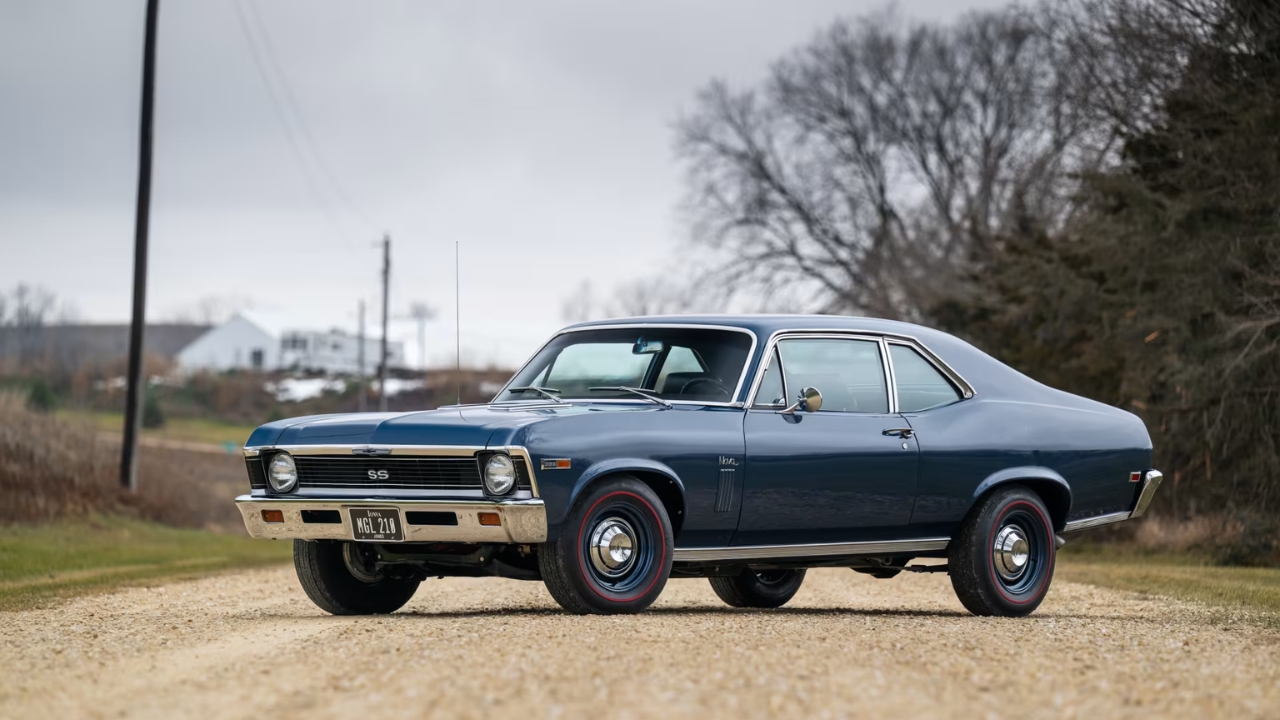
    The thinking person’s muscle car. Light, simple, and built around an engine bay that accepts any small block or big block Chevrolet ever made. V8 cars in driver condition are the easiest under-$25K ticket in this list, and every part is a phone call away.

    2. Plymouth Duster & Dodge Dart (1970–1976)

    Mopar’s A-bodies were the budget bruisers when new and remain so. A 340 car is the dream; a 318 car with a 360 swap in its future is the realistic buy. Watch the torsion-bar front end and rear frame rails for rust.

    3. Ford Maverick Grabber & Comet GT (1970–1977)

    The forgotten Ford. A Maverick with the 302 V8 is a Mustang in a cheaper suit — same drivetrain logic, half the entry price, and a fastback silhouette that gets better looking every year.

    4. Pontiac LeMans (1968–1972)

    Everything a GTO is, without the three letters that double the price. Same A-body, same engine bay, and a 350 or 400 Pontiac V8 under the hood of the right example. Buy the best body you can find; drivetrains are the easy part.

    5. Chevrolet Monte Carlo (1970–1972)

    The personal-luxury coupe that shared its bones with the Chevelle. Big-block cars exist at the top of the budget; small-block cars in clean driver shape sit comfortably under it — with the longest hood in the business thrown in free.

    The under-$25K rules: buy the best body, not the biggest engine — rust repair costs more than horsepower. Verify the VIN matches the story. And budget the wake-up costs (tires, brakes, fuel system) on top of the purchase price, every time.

    None of these cars will headline an auction catalog. All of them will do the thing that actually matters: a V8 idle at a gas station, a Saturday-morning cars-and-coffee, and a garage project that’s yours. That’s the hobby. The rest is just pricing.

    How to check prices before you buy

    Compare recent U.S. sales for the same year, engine, body style and condition. A base six-cylinder Nova and a documented Nova SS are different markets. Use Hagerty’s guide to valuing a classic car to find comparable sales, then get an independent pre-purchase inspection and leave room in your budget for transport and immediate repairs.

    Sources

    Specifications, production figures and test results in this article were checked against:

    Prices for the Pontiac LeMans and Chevrolet Monte Carlo reflect general A-body market observation — no model-specific valuation was available at publication.

  • Top 10 Muscle Cars of the 1970s

    Top 10 Muscle Cars of the 1970s

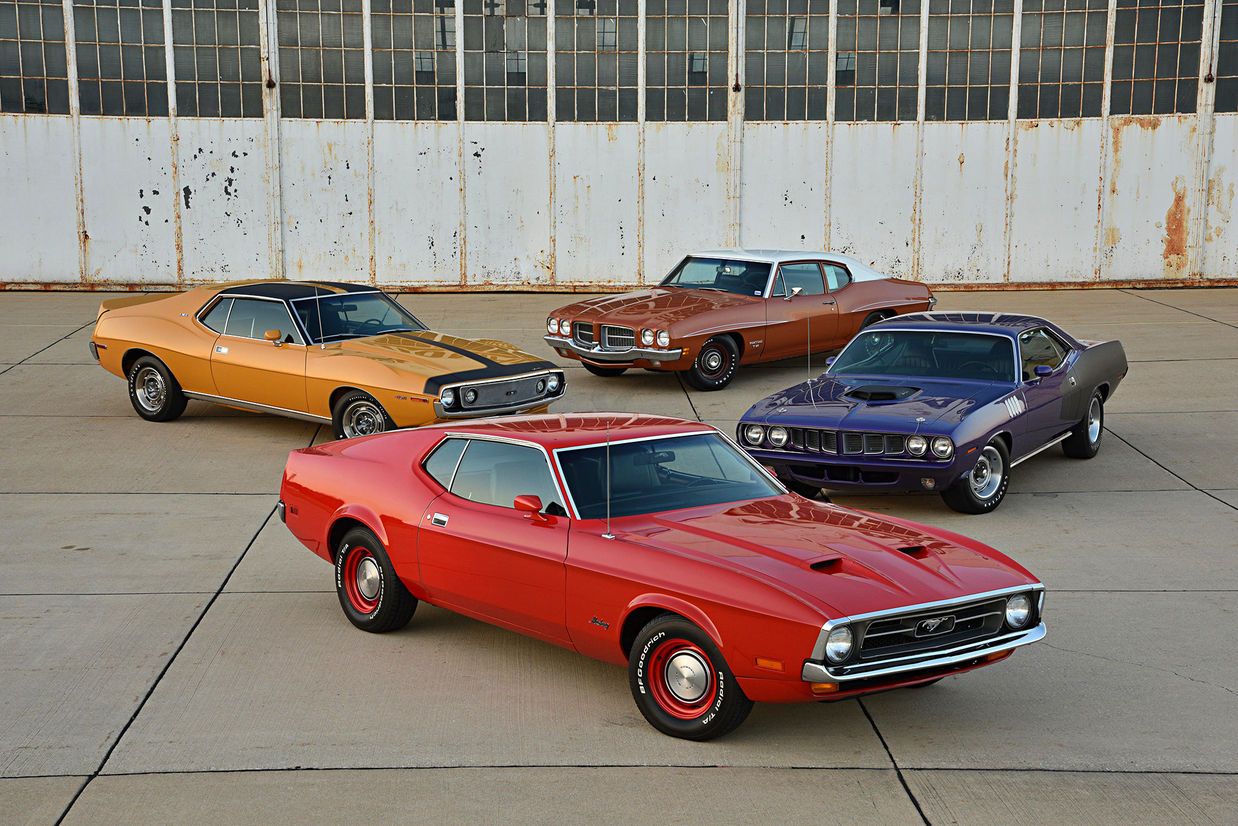
    The seventies opened with the wildest horsepower war in automotive history — and closed with smog pumps, 5-mph bumpers and horsepower ratings that read like typos. But the decade’s best cars weren’t just the last of the breed; several were the best of the breed, full stop. Here is our ranking, argued the way we argue it in the comments: power, presence, and what it feels like when one rolls past.

    1. 10 — 1973 Pontiac Trans Am SD-455

      The last true believer. When everyone else detuned, Pontiac hand-built the Super Duty 455 — advertised at 310 hp — officially rated 290 hp net after certification — in an era of 200 hp flagships. Proof the fire wasn’t out, just banked.

    2. 9 — 1971 Ford Mustang Mach 1 (429 Cobra Jet)

      The biggest Mustang ever made, with the biggest engine ever offered in one. Controversial then, collectible now — and the star of our barn-find story above.

    3. 8 — 1970 AMC AMX

      Two seats, a short wheelbase and a 390 V8 with 325 hp. The underdog from Kenosha embarrassed bigger names at the drag strip and still gets underrated at auction.

    4. 7 — 1970 Pontiac GTO Judge

      Ram Air power, wild stripes, and the most confident name in the business. The Judge was the muscle car as pure theater — 366 hp of it with the Ram Air III.

    5. 6 — 1970 Dodge Challenger R/T

      Late to the pony-car party and dressed to kill. With the 440 Six-Pack or the Hemi, the Challenger had the longest hood and the shortest temper of the class of ’70.

    6. 5 — 1970 Buick GSX Stage 1

      The gentleman’s express. Its 455 was rated 360 hp, but the number that mattered was 510 lb-ft of torque — the highest of any American production car of the era.

    7. 4 — 1970 Plymouth Road Runner Superbird

      A nose cone, a wing you could land aircraft on, and one job: win at NASCAR. Dealers once struggled to sell them. Try that sentence at an auction today.

    8. 3 — 1970 Dodge Charger R/T

      The silhouette alone earns the podium. Add a 440 Magnum — or the 426 Hemi at 425 hp — and you have the decade’s definitive big coupe.

    9. 2 — 1970 Plymouth Hemi ‘Cuda

      The 426 Hemi in the lightest, meanest wrapper Plymouth ever built. Convertible Hemi ‘Cudas are now among the most valuable American cars on Earth. The hardtop is the same thunder, slightly less lottery ticket.

    10. 1 — 1970 Chevrolet Chevelle SS 454 LS6

      450 factory-rated horsepower — the highest rating ever given to a production muscle car of the classic era. The LS6 wasn’t the peak of the horsepower war by accident. It was the peak, period.

    Your turn: this ranking gets defended daily on the page. If your number one isn’t the LS6, the comments on Facebook are open — bring numbers, not feelings.

    Sources

    Specifications, production figures and test results in this article were checked against:

  • Forty Years in the Dark: The Mach 1 That Waited

    Forty Years in the Dark: The Mach 1 That Waited

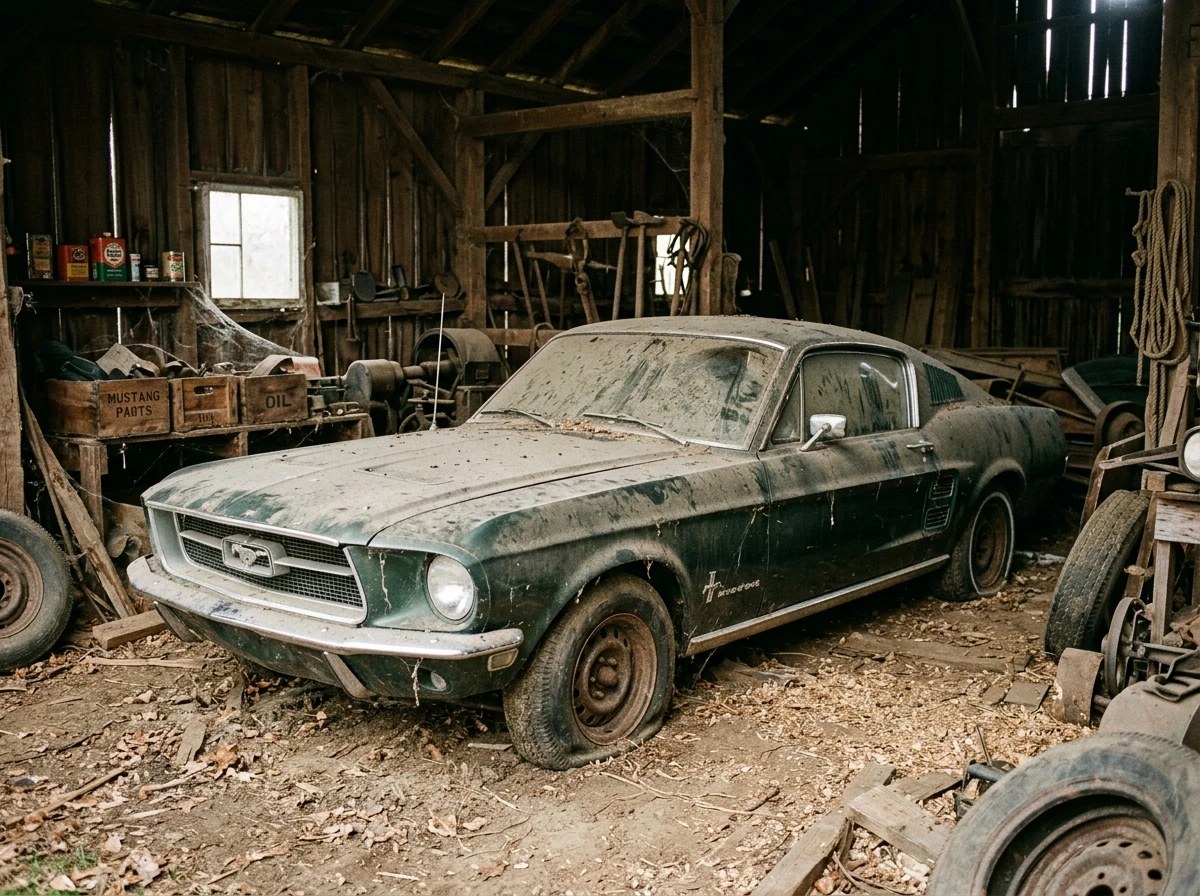
    Every barn-find story starts the same way: a door that hasn’t opened in decades, a shaft of light, and a shape under the dust that makes your heart beat faster. In this case the shape is a Mustang Mach 1 fastback — parked in the mid-1980s when life got busy, and simply never driven again.

    The Mach 1 deserves the drama. Ford launched it for 1969 as the Mustang’s serious performance flagship: fastback-only, with engines running from the 351 Windsor up to the 428 Cobra Jet. It was the car that killed off the GT and took over as the Mustang’s performance flagship once the Shelby program ended. Finding one asleep for forty years is finding a piece of the horsepower war in suspended animation.

    What forty years actually does to a car

    Dust is the least of it. Time attacks a sleeping car in a predictable order, and knowing the order is what separates a rescue from a very expensive sculpture:

    • Fuel system first. Old gasoline turns to varnish, tanks rust from the inside, and rubber lines crack. Nothing from the original fuel system should be trusted.
    • Rubber everything. Tires, belts, hoses, seals and bushings harden and split — even when they look fine in the dark.
    • Brakes. Master cylinders corrode, wheel cylinders seize, and fluid absorbs moisture for four decades straight.
    • The engine itself. Rings can stick, valves can hang open, and cylinders collect moisture. This is the part everyone wants to rush — and the part that punishes rushing.
    • Uninvited tenants. Mice treat wiring harnesses and seat foam as a housing development. Check before you power anything.

    The wake-up order (don’t skip steps)

    1. Photograph everything before touching a bolt. Originality is value, and memory lies.
    2. Pull the plugs, oil the cylinders, and let it sit overnight. Then turn the engine by hand — by hand — before the starter ever gets a vote.
    3. Fresh fluids everywhere: oil, filter, coolant. Prime the oil pump until the gauge or light says pressure.
    4. Feed it from a clean can, not the tank, with a new filter inline. The tank gets cleaned or replaced later.
    5. Brakes before roads. A car that starts but can’t stop is a story nobody wants to tell.
    6. First drive: short, slow, close to home. Listen. A forty-year nap ends in stages, not in a burnout.

    The rule of the barn: the first start is a diagnostic, not a celebration. If it turns by hand, holds oil pressure and takes clean fuel, the celebration comes soon enough — and it will sound like 1969.

    Is a car like this worth saving? A Mach 1 with its original drivetrain is worth saving almost regardless of condition — the fastback shape and the performance pedigree aren’t coming back. But the honest answer is that the cheapest barn find is the one somebody else already woke up. Budget for the fuel system, brakes, rubber and tires before you budget for paint, and the car will reward you in the right order.

    Sources

    Specifications, production figures and test results in this article were checked against: